



AI Summary: CNC lathe machines use programmed, automated control to deliver consistent accuracy, repeatability and faster cycle times, making them suited to medium and high volume or complex component production. Conventional lathe machines rely on manual operator control, offering flexibility for one off jobs, repairs, prototypes and low volume work. Machine selection depends on production quantity, component complexity, required accuracy, repeatability, automation needs, cycle time expectations and available operator skill.
CNC Lathe Machine and Conventional Lathe Machine: An Overview
Choosing between a CNC lathe machine and a conventional lathe machine depends on production volume, component complexity, required accuracy, repeatability and available operator skill rather than assuming automated machining is always the better option. This article explains how CNC lathe machines and conventional lathe machines differ across operation, automation, accuracy, cycle time and cost, helping manufacturers match the right machine to their actual production requirement. Bhavya Machine Tools manufactures both CNC lathe machines and a full range of conventional lathe machines to support this comparison.
CNC Lathe Machine vs Conventional Lathe Machine: What Is the Difference?
The main difference between a CNC lathe and a conventional lathe is the method of control. A CNC lathe machine uses computer numerical control to automate turning, boring and drilling through a programmed cycle, while a conventional lathe machine is operated manually by an operator who controls feed, speed and tool movement by hand.
How This Difference Affects Machining
- A CNC turning machine repeats a programmed cycle with minimal variation, giving consistent output across large batches
- A conventional lathe machine depends on operator skill for every cut, offering flexibility for one off work but less consistency across long runs
- Setup time, programming requirement, component complexity and batch size all influence which machine type suits a given job
What Buyers Are Usually Trying to Solve
Buyers searching for a CNC lathe machine manufacturer in India or a conventional lathe machine manufacturer are usually trying to match a machine type to their production reality rather than simply choosing the newer technology. Long term production plans and available operator involvement matter as much as the technology itself when deciding which lathe machine for manufacturing is genuinely the right investment.
Where Bhavya Machine Tools Fits
Bhavya Machine Tools works with manufacturers, engineering companies and workshops as both a CNC lathe machine supplier and a manufacturer of conventional lathe ranges. Whether a customer needs a lathe machine for engineering workshop use or an automatic CNC lathe machine for continuous production, Bhavya Machine Tools can guide the selection according to component drawings, tolerances and expected output.
 Email!
How CNC Lathe Machines Improve Machining Accuracy and Production Efficiency
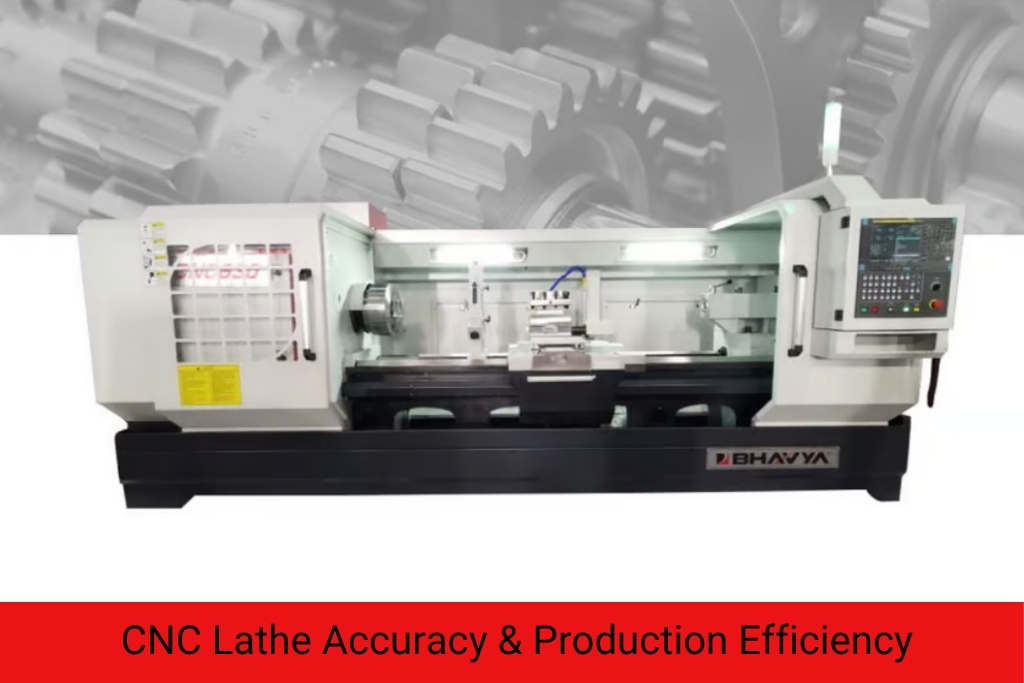
A CNC lathe improves accuracy and efficiency because the machining path, spindle speed, feed rate and tool changes are all controlled by a stored program rather than manual adjustment. Once a program is proven, every subsequent component follows the same path, removing the variation that occurs with hand operated machining.
Where This Accuracy Gain Matters Most
- Components with tight tolerances across multiple diameters
- Threading, grooving or contoured profiles completed in a single setup
- Long production runs where consistency must hold from the first to the last part
How Operator Involvement Changes
Operator involvement shifts from continuous manual control to program setup, tool offset checks and periodic quality monitoring, which also reduces fatigue related error over long shifts.
How Efficiency Gains Are Achieved
Efficiency gains come from reduced non machining time. A CNC lathe machine can complete turning, facing, boring and threading without repositioning the component, since tool changes happen automatically through an indexed turret, shortening cycle time per component.
Bhavya Machine Tools’ Role
Bhavya Machine Tools offers CNC lathe machines built with rigid bed construction and reliable spindle systems so programmed accuracy is maintained across long production runs. For manufacturers shifting from manual to automated turning, Bhavya Machine Tools can review the component drawing and recommend a suitable spindle bore, swing over bed and turret configuration.
Conventional Lathe Machine: Applications, Advantages and Limitations
A conventional lathe machine remains a practical choice wherever direct operator control matters more than automated repeatability. Tool rooms, maintenance departments, repair workshops, training institutions and prototype development all rely on the flexibility of manual machining.
Typical Applications
- Turning, boring, threading, drilling and reaming for one off components
- Repair parts and custom fittings
- Low volume jobs where proving a CNC program would not be practical
- Irregular stock, salvage repairs or unpredictable material conditions
Advantages and Limitations
- Advantages: lower initial investment, simpler maintenance, no programming requirement, quick adaptation to varied one off jobs
- Limitations: manual operation cannot match the repeatability, speed or unattended running capability of a CNC lathe in high volume or high complexity work
Bhavya Machine Tools’ Role
Bhavya Machine Tools manufactures V belt drive lathes and all geared lathe machines across light duty, medium duty and heavy duty ranges to support these applications. A maintenance department needing quick repair turning benefits from a straightforward V belt drive lathe, while a tool room producing varied precision components may need an all geared lathe with finer speed control.
Our Other Product
Bus Bar MachinesCNC Turning Machine vs Conventional Lathe for High Volume Production
For high volume production, a CNC turning machine is generally the more suitable choice because it sustains consistent cycle times and dimensional accuracy across thousands of components without operator fatigue affecting the outcome.
Deciding Factors for High Volume Production
- Required daily output and tolerance consistency across the full batch
- Component complexity
- Availability of skilled operators
- Whether the production requirement is ongoing or seasonal
A CNC lathe for high volume production also reduces labour intensity, since one operator can often supervise multiple CNC lathe machines running simultaneously.
Where Conventional Lathes Still Fit
Conventional lathes still play a role in high volume environments as backup machines, for pre machining operations, or for components that do not justify programming time due to short runs. Many manufacturers operate a mixed shop floor, using CNC lathe machines for repeat items and conventional lathes for auxiliary or variable work.
Bhavya Machine Tools’ Role
Bhavya Machine Tools supplies CNC lathe machines suited to sustained production along with heavy duty and extra heavy duty conventional lathe options for manufacturers who need both automated and manual capacity under one roof.
CNC Lathe Machine for Automotive, Engineering and Industrial Components
Automotive component manufacturers typically require a CNC lathe machine because shafts, bushes, flanges, pins and connector parts demand tight tolerance consistency across large production quantities, so the thousandth component matches the accuracy of the first.
Application by Industry Segment
- Automotive components: CNC lathe machines for interchangeable, high tolerance parts
- General engineering and fabrication: a mix of CNC turning for repetitive parts and conventional lathe machining for custom, variable fittings
- Valve manufacturing and shaft machining: CNC lathe machines for multiple diameters, threading and precise length control
- Educational and training institutions: conventional lathe machines to build manual machining skill before progressing to programmed operation
Bhavya Machine Tools’ Role
Bhavya Machine Tools has supplied lathe machines across these industry segments and can recommend spindle bore size, turning length and centre distance based on the specific component range a manufacturer produces.
CNC Lathe Machine Accuracy, Repeatability and Surface Finish Comparison
CNC lathe machines generally achieve tighter dimensional accuracy and more consistent repeatability than conventional lathes, since programmed tool paths eliminate the variation introduced by manual feed control. Surface finish also tends to be more uniform across a batch.
How Conventional Lathes Compare
Conventional lathe machines can still achieve excellent accuracy and surface finish on individual components in the hands of a skilled operator. For a single precision component or a small quantity of critical parts, a well operated conventional lathe can match CNC level results, though this quality depends on operator consistency rather than a programmed cycle.
The Real Deciding Factor
The deciding factor is not accuracy potential alone but accuracy consistency across the full production quantity:
- Guaranteed tolerance repeatability across hundreds or thousands of parts favours a CNC lathe
- Occasional high precision work on varying components can rely on a capable conventional lathe machine
Bhavya Machine Tools’ Role
Bhavya Machine Tools manufactures precision lathe machines with rigid construction and quality spindle assemblies to support close tolerance work on both CNC and conventional platforms. Buyers requiring guaranteed tolerance bands for automotive or valve components can share drawing specifications before order.
Our Other Product
Universal Cutter GrindersCNC Lathe Machine Production Capacity and Cycle Time Considerations
Production capacity on a CNC lathe machine depends on cycle time per component, influenced by spindle speed range, turret indexing speed, rapid traverse rate and the number of operations combined in a single setup.
What Affects Conventional Lathe Cycle Time
Conventional lathe cycle time depends heavily on operator pace, tool change time and the number of manual measurements required, making output less predictable across a shift, though adequate for low or medium volume needs.
Factors to Check Before Estimating Capacity
- Component size and swing over bed requirement
- Spindle bore diameter for bar feeding
- Whether components require secondary operations outside the lathe
Bhavya Machine Tools’ Role
Bhavya Machine Tools offers CNC lathe machines and heavy duty conventional lathes across a range of swing over bed and spindle bore specifications, helping manufacturers match machine capacity to actual component dimensions rather than oversizing or undersizing the investment.
CNC Lathe Machine Tooling, Automation and Material Handling Requirements
CNC lathe machines typically use indexed turrets holding multiple tools, allowing several operations to run within one program without manual tool changes.
Automation Options
- Bar feeders for continuous unattended machining
- Automatic chucking
- Part catchers for high volume or unattended runs
How Conventional Lathes Differ
Conventional lathe machines rely on manual tool changes and operator judgement for depth of cut and feed adjustment. This tooling flexibility helps with varied job work, since operators can quickly adapt to different shapes without reprogramming, though changeover between dissimilar jobs is slower.
Material Handling Considerations
A CNC lathe machine handling bar stock benefits from adequate spindle bore diameter and, where volume justifies it, a bar feeder. Conventional lathes are more commonly used with individually loaded components or shorter bar lengths suited to manual handling.
Bhavya Machine Tools’ Role
Bhavya Machine Tools can advise on turret configuration, spindle bore sizing and material handling accessories based on the material type, bar diameter and batch size a manufacturer works with.
CNC Lathe Machine Price vs Conventional Lathe Machine Cost
A CNC lathe machine generally carries a higher upfront cost than a conventional lathe machine due to its control system, servo drives, automated tooling and construction required to sustain programmed accuracy. A conventional lathe, particularly a V belt drive lathe or all geared lathe, offers a lower initial investment.
What the Cost Comparison Should Be Based On
- Labour cost per component and reduced rework from dimensional variation
- Throughput gains, which can offset the higher CNC investment in medium and high volume work
- Lower cost and simpler operation, which often represent better value for low volume or highly variable work
Other Cost Factors
- Programming time for CNC work
- Operator skill level required for each machine type
- Tooling investment and expected machine utilisation
Bhavya Machine Tools’ Role
Bhavya Machine Tools offers CNC lathe machines alongside light duty, medium duty and heavy duty conventional lathe options at different price points, allowing manufacturers to select according to actual budget and production volume.
Read Our Article
Common Errors in Automatic Panel Bending and How to Avoid ThemCNC Lathe Machine Maintenance, Service and Spare Parts Considerations
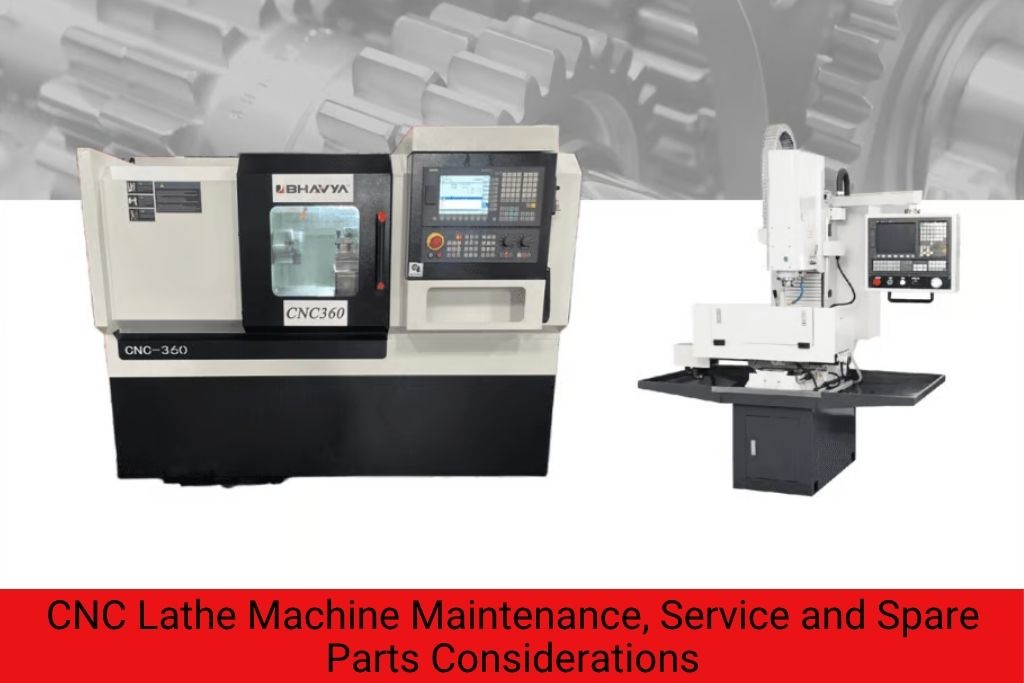
CNC lathe machines require more structured maintenance than conventional lathes because of their control system, servo motors, encoders and automated tooling components. Regular calibration checks, backlash monitoring and control software updates keep a CNC lathe machine performing within its programmed tolerance.
How Conventional Lathe Maintenance Differs
Conventional lathe machines have simpler mechanical systems, meaning more straightforward maintenance such as lubrication, belt or gear inspection and spindle bearing checks, often handled by in house staff without specialised electronic diagnostic knowledge.
What Buyers Should Confirm
- Spare parts lead time
- Availability of critical components such as spindle bearings, ball screws and control system parts
- Whether local technical support is available
Bhavya Machine Tools’ Role
Bhavya Machine Tools provides after sales support and spare parts guidance for both its CNC lathe machines and conventional lathe range, helping manufacturers plan preventive maintenance schedules and minimise downtime risk.
How to Select the Right Lathe Machine Based on Material, Component Size and Production Volume
Selecting the right lathe machine starts with three core factors: the material being machined, the size range of components, and the required production volume. Harder materials and larger diameters generally require greater spindle power and machine rigidity.
Quick Comparison
|
Factor |
Favours CNC Lathe |
Favours Conventional Lathe |
|
Production volume |
Medium to high |
Low to occasional |
|
Component complexity |
Multiple operations, tight tolerance |
Simple turning, variable jobs |
|
Batch repetition |
Repeat orders |
One off or prototype work |
|
Operator skill available |
Programming knowledge |
Manual machining skill |
|
Budget |
Higher initial investment |
Lower initial investment |
Sizing the Machine Correctly
Turning length, centre distance, swing over bed and spindle bore should be matched to the largest and longest components regularly produced, not only the average job. Manufacturers expecting future growth in volume or complexity should factor planned expansion into the selection.
Bhavya Machine Tools’ Role
Bhavya Machine Tools reviews component drawings, material specifications and expected production volume to recommend the appropriate machine category, whether a CNC lathe machine for automated repeat production or a light, medium, heavy or extra heavy duty conventional lathe.
Our Other Product
Lathe MachinesCNC Lathe Machine Buying Checklist for Global Industrial Buyers
Before requesting a quotation, industrial buyers should prepare clear technical information so Bhavya Machine Tools can recommend the most suitable CNC lathe machine or conventional lathe machine without back and forth clarification delays.
Details to Share Before Requesting a Quote
- Component drawings or sample dimensions
- Material type and hardness
- Required dimensional tolerances
- Expected production quantity, whether one off, batch or continuous
- Required operations such as turning, boring, threading or drilling
- Swing over bed and turning length required
- Spindle bore requirement if bar stock is used
- Automation preference, including bar feeders or part catchers
- Available operator skill level
- Installation location and any space constraints
For Global Buyers
Global buyers should also confirm export packing requirements, applicable certifications, delivery timelines and after sales support availability, since these factors affect total landed cost and long term machine reliability. Bhavya Machine Tools works with manufacturers, engineering companies and machine shops across domestic and international markets and can guide buyers through this checklist.
Choosing the Right CNC Lathe Machine or Conventional Lathe Machine
Neither a CNC lathe machine nor a conventional lathe machine is universally better, and the right choice depends on component type, production volume, required accuracy and available operator skill. A CNC lathe suits manufacturers needing automated, repeatable output for medium to high volume or complex components, while a conventional lathe remains practical for one off jobs, repairs and low volume work. Bhavya Machine Tools manufactures both CNC lathe machines and a complete range of conventional lathe machines, and can recommend the appropriate machine after reviewing component drawings, material specifications and expected production volume.
FAQs About CNC Lathe vs Conventional Lathe Machines
FAQs About CNC Lathe vs Conventional Lathe Machines
What is the main difference between a CNC lathe and a conventional lathe?
<span style="font-weight: 400;">A CNC lathe is controlled by a computer program that automates the machining cycle, while a conventional lathe is operated manually by an operator controlling feed, speed and tool movement by hand.</span>
Which is better, a CNC lathe or a conventional lathe, for small batch production?
<span style="font-weight: 400;">Is a CNC lathe better than a conventional lathe for small batch production? For very small or one off batches, a conventional lathe is often more practical because it avoids programming time, while a CNC lathe becomes more advantageous once batch sizes are large enough to benefit from programmed repeatability.</span>
How much does a CNC lathe machine cost compared to a conventional lathe machine?
<span style="font-weight: 400;">A CNC lathe machine generally costs more upfront than a conventional lathe due to its control system and automated tooling, though it can lower long term production cost through reduced labour and rework in medium to high volume work.</span>
Who should use a CNC turning machine instead of a conventional lathe?
<span style="font-weight: 400;">Manufacturers producing components with tight tolerances, complex geometry, threading or multiple operations in medium to high volumes should generally use a CNC turning machine for consistent, repeatable output.</span>
How many components can a CNC lathe machine produce compared to a conventional lathe in a shift?
<span style="font-weight: 400;">Output depends on component complexity and cycle time, but a CNC lathe machine typically produces more components per shift than a conventional lathe once setup and programming are completed, due to reduced non machining time.</span>
Which industries commonly use CNC lathe machines?
<span style="font-weight: 400;">Automotive component manufacturing, valve manufacturing, shaft machining, general engineering and precision component production commonly use CNC lathe machines for consistent, repeatable output.</span>
Where can I find a reliable CNC lathe machine manufacturer in India?
<span style="font-weight: 400;">Bhavya Machine Tools manufactures CNC lathe machines along with a range of conventional lathe machines for domestic and global industrial buyers, supporting selection based on component specifications and production requirements.</span>
Whose responsibility is machine maintenance, and how does it differ between CNC and conventional lathes?
<span style="font-weight: 400;">Machine owners are responsible for maintenance, though CNC lathe machines require more structured checks involving the control system and servo components, while conventional lathe machines generally need simpler mechanical maintenance.</span>
What accuracy can a CNC lathe machine achieve compared to a conventional lathe?
<span style="font-weight: 400;"> A CNC lathe machine generally achieves tighter, more consistent accuracy across a full production batch, while a conventional lathe can achieve comparable accuracy on individual components depending on operator skill.</span>
How do I choose between a light duty, medium duty and heavy duty lathe machine?
<span style="font-weight: 400;">Machine duty class should be selected based on component size, material hardness and required machining force, and Bhavya Machine Tools can recommend the appropriate duty class after reviewing component drawings and material specifications.</span>