



AI Summary: Slotting machines continue to support global manufacturing industries through applications such as internal keyways, slots, grooves and precision machining operations used across automotive, heavy engineering and general industrial production. Global buyers evaluate component type, machine capacity, stroke length, production volume, required accuracy and application suitability before selecting a machine, along with supplier reliability, technical support, spare parts availability and export capability for long term manufacturing requirements.
Slotting Machine Manufacturer and Exporter Overview
The slotting machine remains essential in industrial machining for internal keyways, slots, grooves and profiles that few other machine tools replicate efficiently. Manufacturers across automotive, heavy engineering and general engineering sectors rely on it for component production and repair work. Global buyers evaluating a slotting machine manufacturer, exporter or supplier want to understand current demand and how machine capacity and application should guide their purchase. This article covers global demand, applications, regional markets and key purchasing factors.
 Email Us Today!
Global Slotting Machine Demand: Current Manufacturing Trends
Global demand for the slotting machine remains steady because manufacturers across automotive, heavy engineering and general engineering sectors continue to require internal keyway and slot cutting capability that few other machine tools replicate as economically. As an industrial slotting machine manufacturer, Bhavya Machine Tools observes that this demand is shaped by expanding manufacturing capacity, rising component complexity and the ongoing need for accurate internal machining that supports both new production and industrial repair work.
Industrial machining requirements continue to grow as manufacturing companies expand production of gears, pulleys, dies, fixtures and structural components that require internal slots, keyways and profiles. Manufacturing growth in developing economies, combined with automotive production expansion and heavy engineering activity, has kept the slotting machine relevant as a dependable solution for component manufacturing where precision and repeatability matter.
Buyers searching for a slotting machine for industrial applications typically fall into a few consistent categories: manufacturers producing keyed shafts and hubs, workshops handling internal slot cutting for gearboxes and couplings, and heavy engineering companies machining large components that cannot be economically handled on alternative machine tools. A slotting machine for manufacturing environments with mixed production, where flexibility matters as much as accuracy, remains a practical investment rather than a specialised, single purpose tool.
Global manufacturing trends also show that buyers are increasingly evaluating machine capacity, stroke length and cutting speed alongside price, since production requirements now vary widely between small workshops and export oriented production facilities. As a slotting machine exporter and supplier serving international buyers, Bhavya Machine Tools works with manufacturers to understand current and future production volume so the recommended machine configuration matches actual industrial requirements rather than a generic specification.
Why Slotting Machines Remain Important in Industrial Machining
Slotting machines remain important because they perform internal machining operations, particularly internal keyways, internal slots, grooves and profiles, that are difficult to replicate efficiently on milling or broaching equipment, especially for low to medium production volumes or component modification work. The vertical ram motion of a slotting machine allows precise material removal along a straight internal path, which makes it a practical choice for component manufacturing and repair applications across industrial sectors.
Heavy engineering machining frequently requires internal slot cutting on large or heavy components where handling on other machine types would be impractical. Precision machining operations such as die cavity finishing, internal spline cutting and non circular internal profiles also continue to rely on slotting machines because of the direct control they offer over cutting depth and slot geometry.
For manufacturers requiring component modification, such as adapting existing parts, correcting internal features or producing low volume replacement components, a slotting machine offers a flexible and cost effective alternative to specialised tooling. This is one reason Bhavya Machine Tools continues to supply both conventional and CNC slotting machines to engineering companies that value adaptability alongside accuracy.
Read Our Article
6 Important Types of Lathe machinesGlobal Applications of Slotting Machines in Manufacturing
Slotting machines are used globally wherever internal keyways, internal slots, grooves, profiles and precision internal features need to be machined accurately on components that cannot be processed efficiently by other standard machine tools. Typical applications include:
- Internal keyway cutting on gears, pulleys, couplings and hubs
- Internal spline and slot cutting for gearboxes and transmission components
- Die and mould cavity finishing requiring straight internal profiles
- Slotting of grooves and channels on structural and mechanical components
- Machining internal features on castings and forgings
- Repair and modification of existing industrial components
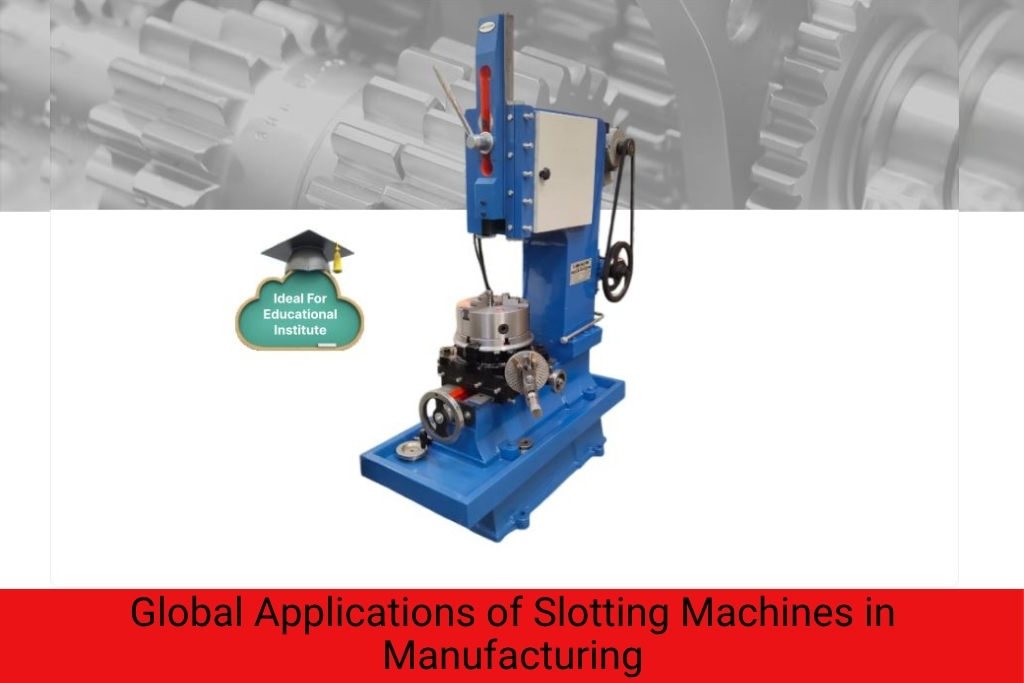
Manufacturers across industrial equipment production, machine building and general engineering rely on this capability because it directly supports component manufacturing where internal accuracy affects final assembly and performance. Bhavya Machine Tools supplies slotting machines suited to this application range, helping engineering companies match ram stroke, table size and cutting speed to the specific internal machining task rather than adapting the component to the limitations of an unsuitable machine.
Slotting Machine Demand in Automotive and Auto Component Manufacturing
Automotive and auto component manufacturers require slotting machines primarily for internal keyway machining on shafts, hubs, gears and coupling components used in transmission and drivetrain assemblies. Demand in this sector is closely tied to production volume, component accuracy requirements and the need for repeatable internal slot geometry across large batches of similar parts.
Auto component producers evaluating a slotting machine for automotive components generally consider cutting speed, cycle time and dimensional consistency, since these directly affect production throughput. Where production volumes are higher, CNC slotting machines are often preferred for repeatability, while conventional machines remain suitable for lower volume or mixed component manufacturing.
Bhavya Machine Tools works with automotive component manufacturers to recommend machine capacity and stroke configuration based on component size and batch requirements, ensuring that internal keyway and slot machining supports both current production targets and future volume growth without requiring premature equipment replacement.
Slotting Machine Demand in Heavy Engineering Industries
Heavy engineering industries require slotting machines for internal slot cutting, keyway machining and profile work on large, heavy or structurally complex components used in machinery, equipment manufacturing and industrial plant construction. Demand here is driven by infrastructure development, industrial expansion and the ongoing need to manufacture and repair heavy components economically.
A heavy duty slotting machine becomes particularly relevant in this sector because it must handle larger table sizes, longer ram strokes and heavier workpiece loads while maintaining machining accuracy. Heavy engineering companies also value machine rigidity, since inconsistent rigidity directly affects slot straightness and surface finish on large components.
Bhavya Machine Tools supplies heavy duty slotting machine configurations designed for demanding industrial applications, and works closely with heavy engineering buyers to confirm workpiece dimensions, required stroke length and cutting load before finalising a machine recommendation, since undersized capacity is a common and costly selection error in this sector.
Our Other Product
Hydraulic Thread Form Rolling MachinesSlotting Machine Applications for Internal Keyways and Slots
Internal keyway and slot machining remains one of the most consistent reasons manufacturers purchase a slotting machine for keyways, since keyed connections are fundamental to shaft, gear and coupling assemblies across nearly every industrial sector. Slotting machines allow accurate control of keyway width, depth and length, which directly affects fit and load transfer in the finished assembly.
Beyond simple keyways, slotting machines are also used for internal splines, non standard slot profiles and grooves that require straight line internal cutting rather than rotary machining. This makes the process suitable for both standard component manufacturing and custom internal features that general purpose machine tools cannot easily produce.
Bhavya Machine Tools supports manufacturers requiring internal keyway and slot machining by helping determine appropriate ram stroke, cutting speed and tooling setup based on keyway dimensions and material type, since these factors influence both machining accuracy and tool life over extended production runs.
Slotting Machine Demand in Developing Manufacturing Markets
Developing manufacturing markets continue to generate steady slotting machine demand because industrial growth in these regions often includes expansion of general engineering, component manufacturing and machine building capacity, where flexible internal machining equipment is essential. Manufacturers in these markets frequently prioritise reliable machining solutions that offer long term value and straightforward maintenance over highly specialised or automated equipment.
Buyers in developing manufacturing markets typically evaluate machine capacity, cost effective production capability and supplier support before committing to a purchase, since access to spare parts and technical assistance can be limited locally. This makes supplier reliability and export support particularly important considerations for these buyers.
Bhavya Machine Tools, as a slotting machine manufacturer in India, supplies developing manufacturing markets with machines built for durability and ease of maintenance, along with export support that helps buyers establish dependable long term machining capability without requiring extensive local technical infrastructure.
Slotting Machine Market Opportunities in Africa
Manufacturing markets across Africa present growing opportunities for slotting machine demand as industrial sectors including automotive component assembly, general engineering and infrastructure related fabrication continue to expand in countries such as South Africa, Nigeria, Kenya and Egypt. Local manufacturing capacity building in these markets often requires reliable, cost effective machines capable of handling varied component work rather than narrowly specialised equipment.
African manufacturers evaluating a slotting machine supplier for global buyers generally prioritise machine durability, ease of operation and dependable after sales support, since production facilities may operate with limited access to specialised servicing. Flexible machining capability that supports multiple applications on a single machine is also a practical advantage in markets where production requirements can change as industrial capacity develops.
Bhavya Machine Tools, as a slotting machine exporter from India, supports African industrial buyers with machines suited to varied manufacturing conditions, along with export documentation and shipping support that simplifies the purchasing process for buyers new to importing industrial machine tools.
Read Our Article
Global Demand of Slotting MachineSlotting Machine Demand in the Middle East and GCC Countries
Slotting machine demand across the Middle East and GCC countries, including the United Arab Emirates, Saudi Arabia and Oman, is closely linked to industrial diversification efforts, engineering services growth and expanding local manufacturing and fabrication capacity beyond traditional oil and gas dependent sectors. Buyers in this region often require machines capable of handling both general engineering work and heavier industrial components used in equipment manufacturing and maintenance.
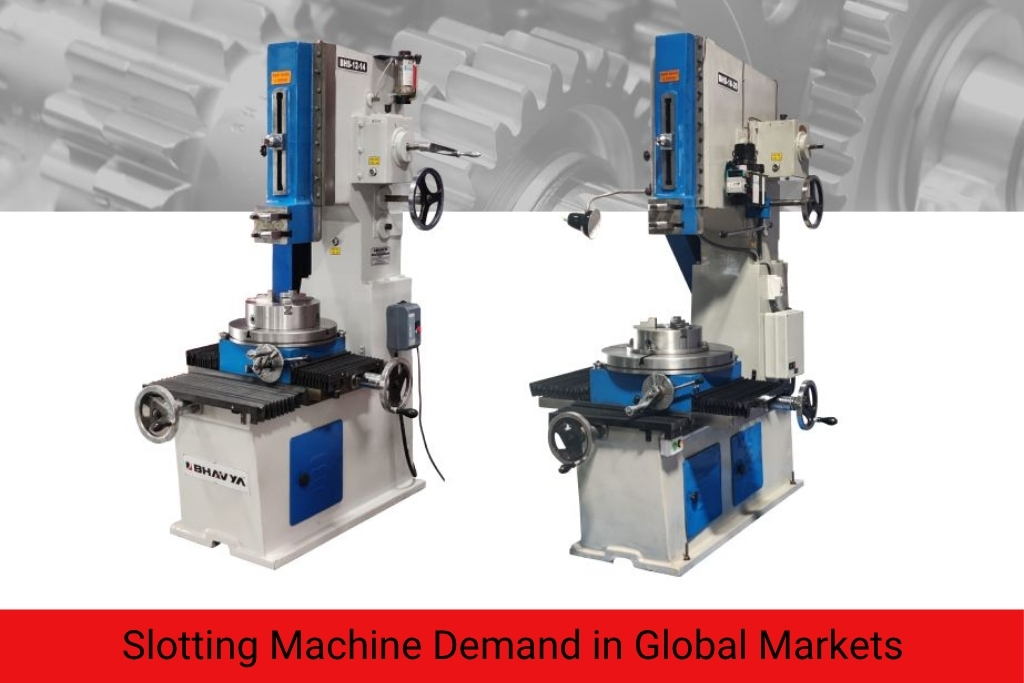
GCC based manufacturers and fabrication companies evaluating an industrial slotting machine supplier typically place importance on machine capacity, build quality and the availability of technical support, since production facilities in the region frequently operate with international quality expectations. Export support and clear documentation are also significant factors given the volume of imported machine tools in these markets.
Bhavya Machine Tools works with Middle East and GCC buyers to specify slotting machines suited to regional industrial and fabrication requirements, providing export support that addresses the documentation, shipping and after sales expectations common among buyers in this region.
Slotting Machine Demand in Southeast Asian Manufacturing Markets
Southeast Asian manufacturing markets, including Vietnam, Indonesia, Thailand and the Philippines, continue to show rising slotting machine demand as component manufacturing, automotive assembly and general engineering activity expand alongside broader regional industrial growth. Manufacturers in these markets often require machines that balance production capability with cost effective operation, given the competitive nature of export oriented manufacturing in the region.
Buyers in Southeast Asia evaluating a slotting machine manufacturer generally consider machine capacity, production quantity requirements and long term reliability, since many facilities operate multiple shifts and require machines built for sustained industrial use rather than intermittent operation.
Bhavya Machine Tools supports Southeast Asian manufacturers with slotting machine solutions suited to sustained production environments, along with the spare parts availability and export coordination that export oriented production facilities require to maintain consistent output.
Our Other Product
Hydraulic Surface GrindersConventional vs CNC Slotting Machine: Changing Global Buyer Preferences
Global buyer preference between conventional and CNC slotting machines depends primarily on production volume, component complexity and required repeatability, with conventional machines remaining suitable for low to medium volume and varied component work, while CNC slotting machines are preferred where high repeatability and reduced operator dependency are priorities.
|
Factor |
Conventional Slotting Machine |
CNC Slotting Machine |
|
Production volume |
Low to medium |
Medium to high |
|
Component variety |
High flexibility |
Efficient for repeat components |
|
Operator involvement |
Skilled operator required |
Reduced manual dependency |
|
Initial investment |
Lower |
Higher |
|
Suitability |
General and mixed production |
Consistent, repeat production |
Manufacturers with varied, low volume component requirements often continue to prefer conventional machines for their flexibility and lower investment, while automotive and higher volume component manufacturers increasingly consider CNC slotting machines for consistent internal keyway and slot accuracy across large batches.
Bhavya Machine Tools guides buyers through this decision based on actual production patterns rather than assuming that CNC configuration is automatically the correct choice, since conventional machines remain the more practical and cost effective option for many industrial and export manufacturing units.
Factors Driving Global Slotting Machine Purchasing Decisions
Global buyers evaluate slotting machine requirements based on component type, workpiece size, machining application, production quantity, required accuracy, machine capacity, stroke length, cutting speed, material type, industry requirement and future production plans. These factors together determine whether a conventional or CNC machine, and what specific capacity, is appropriate for a given manufacturing operation.
Key purchasing considerations typically include:
- Machine capacity and ram stroke suited to component size
- Table size relative to workpiece dimensions
- Cutting speed appropriate to material type
- Machine rigidity for consistent slot accuracy
- Production volume and required automation level
- Maintenance support and spare parts availability
- Export support and supplier reliability
Because slotting machine requirements differ significantly between automotive component manufacturers, heavy engineering industries, general engineering companies, machine shops and fabrication companies, no single machine configuration suits every buyer. Bhavya Machine Tools encourages buyers to share component drawings, production volume and application details early in the enquiry process so that machine capacity and configuration can be matched accurately to actual manufacturing requirements rather than general assumptions.
Read Our Article
Top 10 Industries Using CNC Press Brake MachinesHow Manufacturers Evaluate Slotting Machine Price, Capacity and Performance
Manufacturers evaluating slotting machine price typically weigh initial cost against machine capacity, build quality, expected service life and total cost of ownership, rather than selecting purely on the lowest quoted price. Slotting machine capacity, including ram stroke, table size and maximum workpiece dimensions, has a direct relationship with price, and buyers benefit from evaluating capacity against actual and future production requirements rather than current needs alone.
Performance evaluation generally includes cutting speed capability, machine rigidity, dimensional accuracy and consistency across production runs. Buyers producing components for automotive or heavy engineering applications tend to place greater weight on rigidity and repeatability, while general engineering and machine shop buyers may prioritise flexibility across varied component work.
Bhavya Machine Tools provides transparent technical specifications and capacity details to help manufacturers compare slotting machine price against actual performance requirements, ensuring buyers invest in a machine configuration that supports both immediate production needs and reasonable future growth.
Slotting Machine Export Considerations for International Buyers
International buyers purchasing a slotting machine from an overseas manufacturer should evaluate export documentation support, shipping arrangements, machine packaging for long distance transport, installation guidance and the availability of technical support after delivery. These factors influence total landed cost and how smoothly the machine can be commissioned once it reaches the buyer’s facility.
Buyers should also confirm spare parts availability and expected lead times for replacement components, since delayed access to spares can directly affect production continuity in export markets far from the manufacturer’s base location. Clear communication regarding machine specifications, electrical requirements and applicable standards for the destination country further reduces the risk of installation delays.
As a slotting machine exporter, Bhavya Machine Tools supports international buyers with export documentation, shipping coordination and post delivery technical guidance, helping manufacturing units in export markets establish dependable slotting machine capability without unexpected delays or compliance issues.
How to Choose a Reliable Slotting Machine Manufacturer and Exporter
Choosing a reliable slotting machine manufacturer and exporter depends on verifying manufacturing experience, machine build quality, availability of technical support, spare parts supply and a demonstrated track record of serving industrial and export markets. Buyers should request detailed technical specifications and, where possible, references from existing industrial customers before finalising a purchase decision.
Supplier reliability also includes the manufacturer’s ability to guide machine selection based on the buyer’s actual component requirements, machining application, production volume and required accuracy, rather than promoting a single standard configuration for every enquiry. Long term production requirements, including expected future capacity needs, should also factor into the selection discussion.
Before selecting a manufacturer, buyers are encouraged to share component details, machining requirements, production volume, required capacity and application details with Bhavya Machine Tools so that machine selection, whether conventional or CNC, standard or heavy duty, is based on accurate technical evaluation rather than general assumptions, supporting a dependable long term manufacturing partnership.
Our Other Product
Light Duty Universal Milling MachinesSlotting Machine Manufacturer and Exporter Summary
Slotting machines remain commercially relevant across global manufacturing because internal keyway, slot, groove and profile machining continue as essential operations in automotive, heavy engineering and general industrial production. Buyers should base their decision on component requirements, application, production volume and required accuracy, not a single standard configuration. A reliable slotting machine manufacturer and exporter offering technical guidance, spare parts and export support ensures a dependable investment. Bhavya Machine Tools helps industrial and export buyers worldwide match machine selection to genuine manufacturing needs.
Global Slotting Machine Buyer FAQs
Global Demand of Slotting Machine
What is a slotting machine used for in industrial manufacturing?
<span style="font-weight: 400;">A slotting machine is used to cut internal keyways, slots, grooves and profiles on components that cannot be efficiently machined by milling or broaching, making it useful for gear, shaft, coupling and die manufacturing.</span>
Who typically requires an industrial slotting machine?
<span style="font-weight: 400;">Automotive component manufacturers, heavy engineering companies, general engineering firms, machine shops and fabrication businesses requiring internal keyway or slot machining typically require an industrial slotting machine.</span>
How do I choose between a conventional and CNC slotting machine?
<span style="font-weight: 400;">The choice depends on production volume and component repeatability; conventional machines suit varied, lower volume work, while CNC machines suit consistent, higher volume production requiring repeatable accuracy.</span>
How much does a slotting machine cost?
<span style="font-weight: 400;">Slotting machine price varies based on machine capacity, ram stroke, table size and whether the machine is conventional or CNC, so buyers should request a quotation based on their specific component and production requirements.</span>
Which factors determine slotting machine capacity requirements?
<span style="font-weight: 400;">Workpiece dimensions, required stroke length, material type, cutting speed and production volume together determine the appropriate slotting machine capacity for a given application.</span>
Where are slotting machines commonly used in global manufacturing?
<span style="font-weight: 400;">Slotting machines are commonly used in automotive component production, heavy engineering, general engineering, die and mould making, and industrial repair applications across manufacturing markets worldwide.</span>
How can international buyers purchase a slotting machine from an Indian manufacturer?
<span style="font-weight: 400;">International buyers can contact a slotting machine manufacturer and exporter such as Bhavya Machine Tools directly, sharing component and production details to receive machine recommendations, technical specifications and export support.</span>
What should buyers check before selecting a slotting machine exporter?
<span style="font-weight: 400;">Buyers should verify manufacturing experience, machine build quality, spare parts availability, export documentation support and after sales technical assistance before selecting a slotting machine exporter.</span>
Whose responsibility is machine installation and after sales support in export orders?
<span style="font-weight: 400;">Installation guidance and after sales technical support are typically coordinated between the manufacturer and the buyer, with reliable exporters such as Bhavya Machine Tools providing documentation and remote assistance to support smooth commissioning.</span>
How many production factors should be shared with a manufacturer before purchase?
<span style="font-weight: 400;">Buyers should share component type, machining application, production volume, required accuracy and future production plans so the manufacturer can recommend an appropriately configured slotting machine.</span>