



AI Summary: Medical device manufacturing demands tolerances measured in microns and a Grinding Machine is often the only process capable of delivering that accuracy on hardened, biocompatible materials. This article explains howGrinding Machines are used across surgical instrument, bone implant and medical component production and how manufacturers select the right Grinding Machine for these applications.
What Makes Grinding Machine Technology Essential to Medical Device Manufacturing?
Medical components rarely tolerate the finishing marks or dimensional drift that other industries can accept. A screw thread on an orthopedic implant, the cutting edge of a scalpel or the bore of a surgical cannula must match design specifications within a few microns or the part is rejected. Machining processes such as turning and milling can bring a component close to its final shape, but they leave surface irregularities and residual stress that grinding is uniquely suited to remove.
A grinding machine uses a bonded abrasive wheel rotating at high speed to remove material in extremely fine increments. Because the cutting action happens at a microscopic scale, the process can hold tolerances that turning or milling cannot reliably achieve, while also producing the smooth, low-friction surface finish that implants and instruments require for biocompatibility and long-term performance inside the human body. This is why grinding sits at the final stage of most medical component production lines, after primary shaping and before inspection and sterilization.
How Do Surface Grinding Machines Achieve Micron-Level Tolerances on Surgical Instruments?
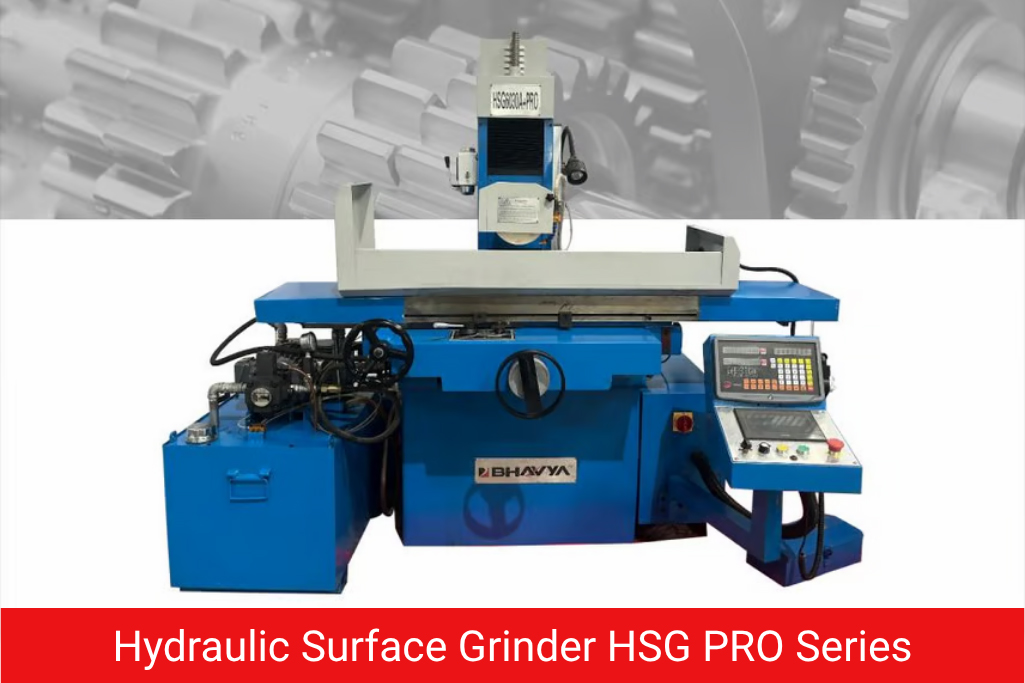
Surface Grinding Machines are used to flatten and finish planar and contoured surfaces on components such as bone plates, surgical trays, forceps jaws and instrument handles. The machine holds the workpiece on a magnetic or vacuum chuck while an abrasive wheel passes over the surface in controlled increments, typically removing only a few microns of material per pass.
For surgical instruments, this level of control matters for two reasons. First, dimensional accuracy determines how precisely mating parts, such as a forceps jaw or a locking mechanism, fit and function. Second, surface quality affects how easily an instrument can be cleaned and sterilized between uses; a rough or porous surface can harbour contaminants even after autoclaving. Surface grinding addresses both requirements in a single, repeatable operation and modern machines log dimensional data automatically so each batch can be traced back to its process parameters for quality audits.
What Role Does a Cylindrical Grinding Machine Play in Producing Bone Implants?
Bone implants such as hip stems, knee femoral components and spinal rods are typically round or contoured, which makes a Cylindrical Grinding Machine the primary tool for their final finishing. The machine rotates the workpiece between centers or in a chuck while the grinding wheel traverses along its length, correcting any ovality or surface irregularity left over from forging or machining.
Titanium alloys and cobalt-chrome, the two materials most commonly used in load-bearing implants, are difficult to machine conventionally because they work-harden and generate heat quickly. A Cylindrical Grinding Machine manages this through coolant delivery and controlled wheel speeds, preventing thermal damage that could otherwise compromise the implant’s fatigue strength. The result is a component with a consistent diameter along its full length and a surface finish smooth enough to reduce wear at the bone-implant interface after implantation.
Why Do Manufacturers Rely on a Centerless Grinding Machine for High-Volume Medical Components?
Many medical devices are produced in large volumes with tight, repeatable tolerances, including bone screws, dowel pins, needle blanks and guidewires. For these parts, a Centerless Grinding Machine offers a distinct advantage: the workpiece is supported between a regulating wheel and a work rest blade rather than being mounted between centers, which removes the time needed for fixturing each piece individually.
Because parts feed through continuously, a Centerless Grinding Machine can process long runs of small-diameter components at a consistent rate while holding diameter tolerances tighter than most alternative processes. This is particularly valuable for guidewires and cannulated needles, where diameter consistency along the entire length directly affects how the device performs during a procedure. The absence of center-mounting also reduces the risk of bending slender parts during processing, which matters for components that are only a fraction of a millimeter in diameter.
How Does a Tool and Cutter Grinding Machine Support Surgical Blade and Cutting Instrument Production?
Surgical blades, bone saws, rongeurs and other cutting instruments depend on a sharp, precisely angled edge to perform reliably without excessive force. A Tool and Cutter Grinding Machine, more commonly used for producing and resharpening industrial cutting tools, is applied in medical manufacturing to grind these cutting edges and profiles to exact geometry.
A Tool & Cutter Grinding Machine typically uses multi-axis wheel positioning to grind complex edge angles, flutes and bevels in a single setup, which keeps the edge geometry consistent from one instrument to the next. For reusable surgical instruments that go through repeated sterilization cycles, this consistency also determines how many times an edge can be reground before the instrument reaches the end of its usable life, which has a direct bearing on the total cost of ownership for hospitals and surgical centers.
 Email!
How to Select the Right CNC Grinding Machine for Medical Component Manufacturing
Choosing grinding equipment for medical production is not simply a matter of picking the highest-precision machine available. The selection depends on part geometry, material, batch size and the surface finish called for in the design specification.
- Identify the part geometry. Flat or contoured surfaces point toward Surface Grinding Machines; round shafts, pins and stems point toward a Cylindrical Grinding Machine; small-diameter, high-volume round parts are usually better suited to a Centerless Grinding Machine.
- Confirm the material and hardness. Titanium, stainless steel and cobalt-chrome each respond differently to wheel selection, coolant type and feed rate and the machine’s control system should allow these parameters to be adjusted and saved per material.
- Match tolerance and finish requirements to machine repeatability. A CNC Grinding Machine with closed-loop feedback and in-process gauging is generally required when tolerances fall below 5 microns, since manual adjustment cannot reliably hold that range across a production run.
- Evaluate documentation and traceability features. Medical manufacturing is subject to regulatory audit, so a CNC Tool Grinding Machine or production grinder should be capable of logging process data for each part or batch.
- Plan for cutting tool maintenance. Where in-house cutting tools are used for machining medical components before grinding, a Tool and Cutter Grinding Machine for resharpening keeps tool geometry consistent and reduces the variability that dull tools introduce further down the line.
Our Other Product
Slotting MachinesBhavya Machine Tools: A Trusted Name in Grinding Machine Manufacturing
Bhavya Machine Tools has built a global reputation across the machine tool industry for engineering expertise and precision-focused manufacturing, serving sectors that include automotive, aerospace and general engineering alongside medical component producers. Its product range spans Grinding Machines, including Centerless Grinding Machines and CNC Tool Resharpener Machines, along with lathe, milling, drilling and sheet metal processing equipment. With operations headquartered in Ahmedabad, India and an international branch in Dubai, UAE, Bhavya supports manufacturers across India and international markets with equipments and its service for precision production requirements.
Conclusion
Grinding remains the process that medical device manufacturers turn to when a component’s function depends on dimensional accuracy measured in microns rather than millimeters. From Surface Grinding Machines finishing bone plates to a Centerless Grinding Machine processing guidewires at volume, each grinding method addresses a specific combination of geometry, material and tolerance that machining alone cannot satisfy. As implant designs and surgical instruments continue to demand tighter specifications, the role of precise, well-controlled grinding processes in medical manufacturing is only set to grow.
FAQs
Grinding Machine Applications in the Medical Device Industry: Precision without Compromise
What tolerances can a Grinding Machine typically achieve on medical components?
Depending on the machine and process, tolerances in the range of 1 to 5 microns are achievable, which is significantly tighter than what turning or milling alone can consistently deliver.
Why a Cylindrical Grinding Machine only used for round implants?
It is most commonly used for round or contoured parts such as hip stems and spinal rods, but it can also finish tapered and stepped profiles found on certain implant designs.
Why is a Centerless Grinding Machine preferred for needle and guidewire production?
It supports continuous processing without individual fixturing, which keeps diameter tolerances consistent along the full length of thin, flexible parts while maintaining production speed.
How a CNC Grinding Machine handle multiple medical materials on the same setup?
Yes, provided the machine's control system allows operators to store and switch between saved parameters for wheel speed, feed rate and coolant delivery specific to each material.
Where does surface grinding affect the biocompatibility of an implant?
Surface grinding does not alter the base material's biocompatibility, but the finish it produces affects how the surface interacts with surrounding tissue and how easily it can be cleaned before use.