



| AI Summary |
| A fiber laser cutting machine requires structured preventive maintenance across daily, weekly, monthly, and annual intervals to ensure peak performance and longevity. |
| Key maintenance areas include: cleaning the cutting head & lens, checking assist gas pressure, inspecting the chiller water temperature, lubricating linear rails, and regularly calibrating the focus position. |
| Neglecting maintenance can result in poor cut quality, increased kerf width, burnt edges, beam misalignment, and expensive component replacements. |
| Bhavya Machine Tools (www.bhavyamachinetools.com) offers after-sales service, genuine spare parts, and AMC contracts for all fiber laser cutting machines supplied across India and GCC markets. |
Introduction: Why Fiber Laser Cutting Machine Maintenance Matters
A fiber laser cutting machine is one of the highest-value capital investments in any sheet metal fabrication workshop. Whether you are cutting mild steel, stainless steel, aluminium, copper, or brass – the machine’s precision, speed, and edge quality depend directly on the quality of its maintenance.
In India’s competitive manufacturing landscape, unplanned downtime of even a single shift can result in lost orders, delayed deliveries, and avoidable repair costs running into lakhs of rupees. A well-documented preventive maintenance plan eliminates most of these risks.
This guide from Bhavya Machine Tools gives you a complete, actionable fiber laser cutting machine maintenance checklist – structured by daily, weekly, monthly, and annual tasks – along with the best practices followed by leading fabrication shops across India, UAE, Saudi Arabia, and East Africa.
 Email Us Today!
How a Fiber Laser Cutting Machine Works: Quick Technical Overview
Understanding what you are maintaining helps you maintain it better. A fiber laser cutting machine generates a high-powered laser beam through a fiber optic cable from a laser source (typically IPG, Raycus, MAX, or JPT). The beam is focused through a cutting head onto the workpiece. Assist gases (nitrogen, oxygen, or air) blow the molten metal away to create a clean cut.
The key sub-systems requiring maintenance are:
- Laser source (fiber module)
- Cutting head (lens, nozzle, ceramic ring)
- Chiller / water cooling unit
- Linear motion system (rails, rack & pinion, servo drives)
- Assist gas system (regulator, hoses, nozzle)
- Electrical cabinet & CNC controller
- Exhaust & dust extraction system
- Machine bed & slat system
Daily Fiber Laser Cutting Machine Maintenance Checklist
Daily checks take 15-20 minutes and prevent the most common causes of poor cut quality.
| Task | Why It Matters | Action |
| Clean the cutting head nozzle | Spatter buildup causes off-center beam & poor cuts | Wipe with a clean dry cloth or replace if deformed |
| Inspect & clean the protective lens | Dirty lens absorbs laser energy, causes overheating | Use lens tissue + isopropyl alcohol; replace if scratched |
| Check assist gas pressure | Low pressure = rough edges & dross on bottom | Verify N2/O2 pressure as per cutting parameter table |
| Check chiller water temperature | Overheating damages the laser source | Ensure temp is within ±1°C of set point (usually 20-22°C) |
| Check chiller water level | Low coolant causes temp spikes & source failure | Top up with distilled water only |
| Inspect nozzle centering | Misaligned nozzle = asymmetric cut & increased dross | Run nozzle centering check from CNC panel |
| Check focus position (Z-axis) | Wrong focus height = increased kerf, poor finish | Run auto-focus calibration or verify with test cut |
| Clear metal debris from cutting bed | Debris causes reflections that can damage the head | Remove with magnetic rake or vacuum tool |
| Inspect red dot pointer alignment | Indicates beam path accuracy | Run pointer test; re-align if offset > 0.5mm |
| Check servo alarm messages | Early warning of motor or encoder faults | Log any alarms; clear or escalate as required |
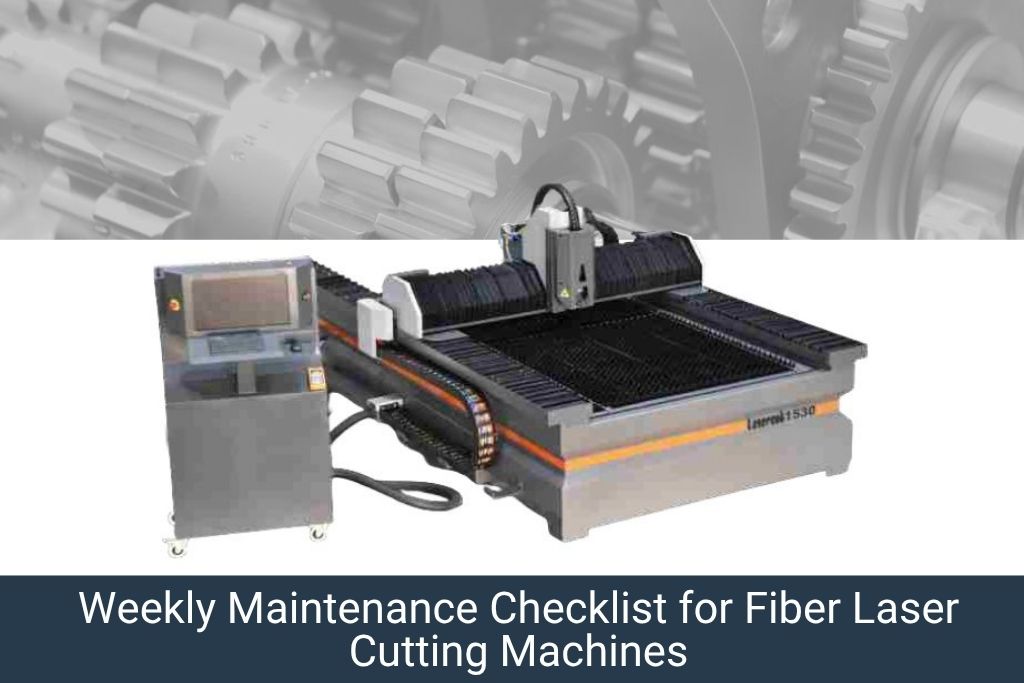
Weekly Fiber Laser Cutting Machine Maintenance Checklist
Weekly maintenance tasks (typically 30-45 minutes) address mechanical wear and environmental contamination.
- Clean the focusing lens with proper optical cleaning kit – do not use compressed air directly on the lens surface.
- Lubricate X-axis and Y-axis linear guide rails using the recommended grease (usually NSK or THK-compatible grease).
- Check rack & pinion teeth for wear, metal shavings, or grease contamination – clean and re-grease.
- Inspect all drive belts for tension and signs of wear – replace if fraying or cracked.
- Check the beam combiner window for contamination – this is a common source of sudden power loss.
- Clean the internal mirrors and beam path (if applicable on your machine model) using lens tissue.
- Inspect assist gas hoses and connectors for micro-leaks – soap-water test on joints.
- Check the exhaust fan and dust collector filter – clean or replace as needed.
- Verify the Z-axis height sensor calibration – run a capacitive sensor test on a flat sheet.
- Check electrical cabinet cooling fans – blocked fans cause controller overheating.
Our Other Product
Press MachinesMonthly Fiber Laser Cutting Machine Maintenance Checklist
Monthly tasks (1-2 hours) address deeper mechanical and optical system health.
- Replace the chiller coolant filter cartridge or clean the filter screen.
- Flush and refill the chiller water circuit with fresh distilled water and anti-algae additive.
- Perform a full beam quality check – compare actual cut quality on standard test plates to baseline.
- Measure and record laser output power using a power meter; compare with factory spec.
- Inspect all cable chains (drag chains) on X and Y axes – replace any broken links.
- Check ballscrew backlash (if applicable) – excessive backlash causes positional errors.
- Lubricate the Z-axis lead screw and motor coupling.
- Inspect the ceramic ring (nozzle holder) for cracks or burns – replace if damaged.
- Check all earthing connections – laser cutting machines are sensitive to grounding issues.
- Run a full geometry test: cut a 500mm circle and measure diameter accuracy in X and Y.
- Calibrate the cutting table flatness with a dial gauge – resurface or replace slats if needed.
What Our Customers Say
“Our production speed has improved ever since we got a Bhavya machine. It’s smooth, durable, and works exactly as promised.”
Arti Mishra On Google
Annual Fiber Laser Cutting Machine Maintenance
Annual maintenance should ideally be performed by a qualified service engineer from your machine supplier. Key tasks include:
- Full optical alignment check of the beam delivery system
- Replacement of the collimating and focusing lens set
- Inspection and testing of the laser source power output vs rated power
- Drive system calibration: servo tuning, backlash compensation
- Electrical insulation test of all motors and drives
- Software and firmware update of the CNC controller
- Safety system verification: emergency stop, door interlocks, key switch
- Full documentation review and maintenance log audit
Read Our Article
Fiber Laser Cutting Machine for Structural Steel FabricationCommon Fiber Laser Cutting Machine Problems & Maintenance-Based Solutions
| Problem | Likely Cause | Maintenance Fix |
| Dross on bottom of cut | Wrong focus, dirty nozzle, low gas pressure | Recalibrate focus; clean/replace nozzle; check gas supply |
| Burnt or discoloured edges | Contaminated lens or wrong assist gas | Clean/replace protective lens; verify O2/N2 selection |
| Rough or wavy cut surface | Vibration from worn rails or loose rack | Lubricate rails; check rack gear mesh & tighten |
| Machine cutting off-position | Encoder fault or rail contamination | Clean rails; check servo alarm; recalibrate home position |
| Laser power dropping suddenly | Dirty beam combiner window or chiller fault | Clean beam combiner; check chiller temp & flow |
| Nozzle frequently crashing | Z-sensor drift or damaged capacitive sensor | Recalibrate Z height sensor; replace if faulty |
| Irregular circle/arc cuts | Backlash in drive system | Check backlash compensation settings in CNC controller |
Our Other Product
Plate Rolling MachinesBest Practices for Fiber Laser Cutting Machine Longevity
Use Only Genuine Spare Parts
Always use OEM-recommended lenses, nozzles, and ceramic rings. Third-party low-quality optical components are the single biggest cause of premature laser source damage.
Maintain a Maintenance Log
Record every maintenance activity with date, technician name, parts replaced, and observations. This log is invaluable for warranty claims and for diagnosing recurring problems.
Train Your Operators
Most maintenance issues originate from operator errors: wrong gas selection, excessive pierce time on thick materials, or incorrect focus settings. Regular operator training pays dividends immediately.
Control the Operating Environment
Fiber laser cutting machines perform best in a dust-reduced, temperature-stable environment. Ambient temperature should ideally stay between 15°C and 30°C. High humidity accelerates corrosion of the beam delivery optics.
Never Skip the Warm-Up Cycle
Always run the machine warm-up cycle (typically 3-5 minutes) before beginning production cutting, especially in the morning or after extended shutdown. This allows the chiller to stabilize and the servo systems to reach operating temperature.
Frequently Asked Questions on Fiber Laser Cutting Machine Maintenance
Fiber Laser Cutting Machine Maintenance: Preventive Checklist & Best Practices
How often should I clean the protective lens on a fiber laser cutting machine?
The protective lens should be inspected every day and cleaned as needed. In heavy-duty cutting environments (especially with mild steel and oxygen assist gas), it may need cleaning 2-3 times per shift. A contaminated lens is the most common cause of sudden power loss and poor cut quality.
What type of water should be used in the fiber laser chiller?
Always use distilled or deionized water in the chiller circuit. Tap water contains minerals that deposit scale inside the coolant circuit and on the laser source cooling passages, restricting flow and causing thermal damage over time.
How do I know if my fiber laser focus position needs recalibration?
Signs of focus drift include: increased dross on the cut bottom, wider kerf than expected, rough cut surface, or burn marks at pierce points. Run the auto-focus calibration from the CNC panel, or do a manual focus test by cutting a series of lines at different Z-offsets and identifying the sharpest result.
How long does a fiber laser source last with proper maintenance?
A well-maintained fiber laser source from reputable manufacturers typically lasts 100,000 hours or more. Without proper maintenance - especially chiller maintenance and lens cleanliness - this can drop to 20,000-50,000 hours.
What is the best way to clean a fiber laser cutting machine lens?
Use optical-grade lens tissue with 99% isopropyl alcohol or dedicated optical cleaning solution. Never use compressed air directly on the lens surface. Wipe in a single direction - never circular motions - to avoid scratching the anti-reflection coating.
Does Bhavya Machine Tools offer Annual Maintenance Contracts (AMC) for fiber laser cutting machines?
Yes. Bhavya Machine Tools provides AMC and after-sales service support for all fiber laser cutting machines supplied by us. Contact us at https://www.bhavyamachinetools.com for AMC pricing, spare parts supply, and on-site service scheduling across India and the GCC region.
Conclusion
A fiber laser cutting machine is a precision instrument that rewards disciplined maintenance with years of high-quality, profitable operation. By following this preventive maintenance checklist – daily, weekly, monthly, and annually – you protect your capital investment, minimize downtime, and deliver consistently superior cut quality to your customers.
Bhavya Machine Tools is a leading supplier of fiber laser cutting machines, CNC press brakes, automatic panel benders, lathe machines, and CNC shearing machines across India and international markets. For machine enquiries, spare parts, or service support, visit https://www.bhavyamachinetools.com.