



AI Summary: Grinding machines are used in automotive component manufacturing to achieve precise dimensions, controlled surface finish and consistent repeatability on parts such as shafts, gears, bushes, bearings, engine components and transmission parts. Machine selection depends on component type, material, required tolerance, surface finish, production volume, grinding operation and automation needs. Cylindrical, centreless and CNC grinding machines each suit different accuracy, complexity and volume requirements across automotive and industrial manufacturing.
Automotive Grinding Machine Overview
Automotive component manufacturing depends on precise, repeatable finishing, and a grinding machine delivers this accuracy on shafts, gears, bushes, bearings and transmission parts. Choosing the right automotive grinding machine, whether cylindrical, centreless or CNC grinding machine, depends on component type, material, tolerance, surface finish and production volume. Bhavya Machine Tools, a grinding machine manufacturer, helps automotive and industrial customers match machine capability to their actual production needs.
Grinding Machine Applications in Automotive Component Manufacturing
A grinding machine is a core piece of equipment in automotive component manufacturing because it delivers the dimensional accuracy, surface finish and repeatability that automotive parts demand. Components such as shafts, pins, gears, bushes, bearings, camshafts and transmission parts are routinely finished on a grinding machine after turning or milling, since these earlier processes cannot consistently hold the tight tolerances that automotive assemblies require.
An automotive grinding machine is typically used for finishing operations rather than bulk material removal. It removes a small, controlled amount of material to correct dimensional variation, improve roundness, reduce surface roughness and prepare mating surfaces for assembly. This makes the grinding machine for automotive components an essential step between rough machining and final quality inspection.
Automotive manufacturers, auto ancillary units and precision component producers use grinding machines for applications including shaft grinding, bore grinding, gear finishing, bearing race grinding and flat or profile grinding of housings and brackets. The choice of machine depends on component geometry, material hardness, batch size and the accuracy expected by the end customer.
Bhavya Machine Tools works with manufacturers at this evaluation stage by reviewing component drawings, material specifications and tolerance requirements to recommend a grinding machine configuration that matches the actual application rather than a generic standard model.
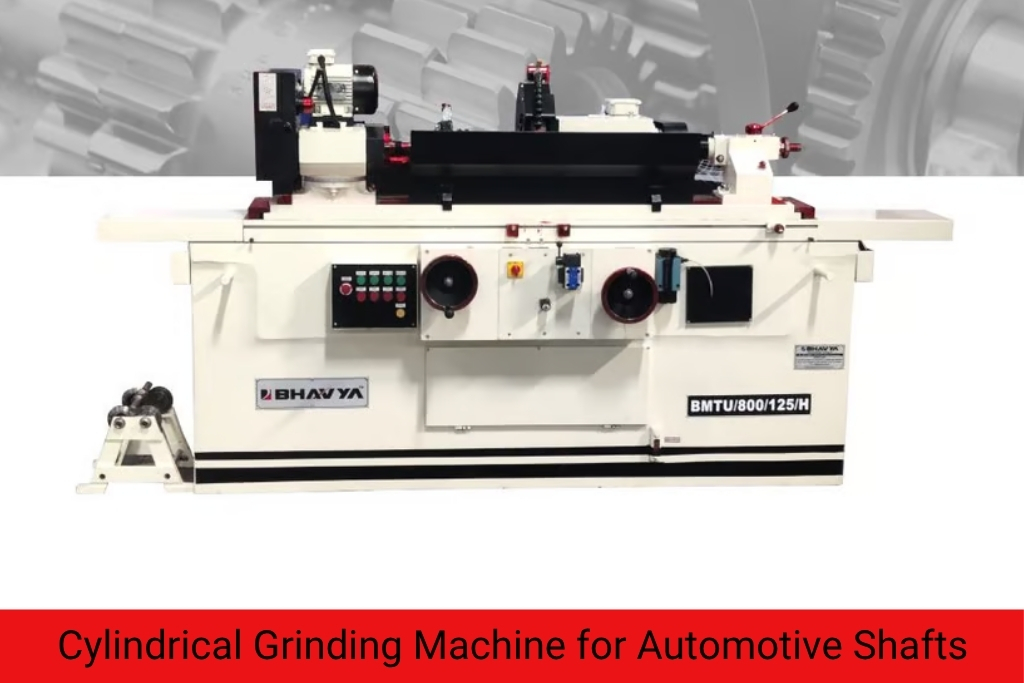
Cylindrical Grinding Machine for Automotive Shafts and Round Components
A cylindrical grinding machine is the right choice when the automotive component is a round part such as a shaft, spindle, axle or pin that needs precise outer diameter control, roundness and straightness. It supports work between centres or chuck mounted work, allowing accurate grinding of stepped diameters, shoulders and tapers found on many automotive shafts.
Cylindrical grinding machine for shafts is commonly specified where the part has multiple diameters along its length, requires concentricity between sections, or needs a fine surface finish on a bearing seat or sealing surface. This machine type suits low to medium production volumes as well as prototype and one off jobs, since setup can be adjusted for different shaft profiles without extensive tooling changes.
For automotive component manufacturers producing input shafts, output shafts, camshafts or similar round components in varying batch sizes, Bhavya Machine Tools supplies cylindrical grinding machines sized to the shaft length, diameter range and swing capacity required, and advises on wheel head configuration where multiple diameters or tapers must be ground in a single setup.
Centerless Grinding Machine for High Volume Automotive Production
A centreless grinding machine is best suited for automotive components produced in high volume where consistent diameter and fast cycle time matter more than complex profile grinding. Because the workpiece is supported between a grinding wheel, a regulating wheel and a work rest rather than fixed centres, loading and unloading is faster, which supports continuous or automated production.
Centreless grinding machine for high volume production is widely used for pins, small shafts, rollers, bushes and similar cylindrical automotive parts that share a common diameter and require tight, repeatable tolerances across thousands of pieces. It is particularly effective where manual handling time needs to be minimised and where diameter consistency across a batch is more critical than machining multiple features in one setup.
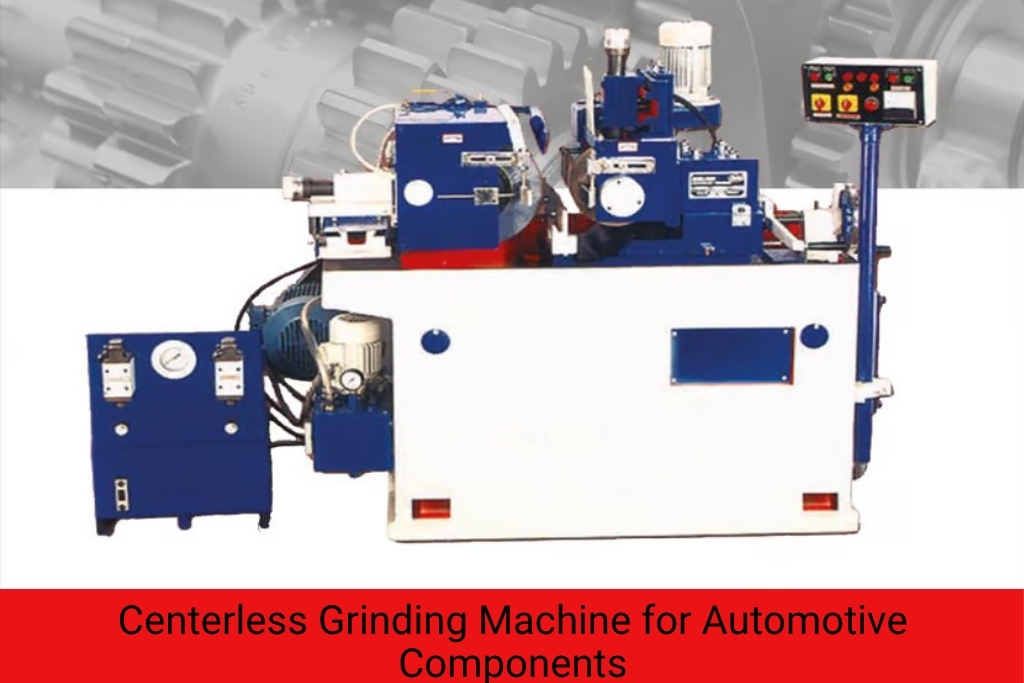
Automotive component manufacturers and auto ancillary companies supplying tier one and tier two production lines often move from cylindrical to centreless grinding once volumes justify dedicated tooling. Bhavya Machine Tools helps manufacturers assess this transition point by evaluating current cycle time, batch size and diameter tolerance to confirm whether a centreless grinding machine will genuinely improve throughput for their specific component.
Grinding Machine for Engine Components and Transmission Parts
Engine and transmission components place some of the highest accuracy demands on a grinding machine because dimensional error directly affects noise, vibration, fuel efficiency and component life. A grinding machine for engine components is used on parts such as camshafts, crankpins, valve stems, cylinder liners and piston pins, where roundness, straightness and surface finish must be held within close limits.
Grinding machine for transmission parts covers gears, shafts, synchroniser rings and clutch components, where dimensional consistency affects gear meshing, shift quality and overall transmission durability. These components often involve hardened materials after heat treatment, which means the grinding machine must be capable of finishing hardened surfaces without inducing thermal damage or grinding burn.
Because engine and transmission parts frequently combine tight tolerance with demanding material hardness, manufacturers need to specify wheel type, coolant delivery and machine rigidity carefully. Bhavya Machine Tools reviews the specific engine or transmission component, its hardness after heat treatment and the tolerance band required, then proposes a grinding machine configuration suited to that combination rather than a general purpose setup.
Grinding Machine for Gears, Shafts, Bushes and Bearings
Gears, shafts, bushes and bearings represent some of the most common automotive components finished on a grinding machine, but each has different grinding requirements. Gears need profile and form accuracy on tooth surfaces, shafts need diameter and concentricity control along their length, bushes need consistent bore and outer diameter for a controlled fit, and bearings need extremely fine surface finish on raceways to reduce friction and wear.
Grinding machine for gears typically involves specialised form grinding or profile grinding to maintain tooth geometry within automotive gearbox tolerances. Grinding machine for bearings focuses heavily on surface finish and roundness, since even minor surface irregularity can affect bearing life and noise. Grinding machine for bearings and grinding machine for precision components both depend on wheel selection and machine stability more than on raw material removal rate.
Because these four component families rarely share the same grinding parameters, Bhavya Machine Tools works with manufacturers component by component, matching machine type, wheel specification and workholding method to whether the priority is profile accuracy, bore consistency, diametral control or surface finish.
Our Other Product
Lathe MachinesHow Grinding Machines Achieve High Dimensional Accuracy in Automotive Parts
Dimensional accuracy in automotive components is achieved through controlled, incremental material removal combined with machine rigidity, precise feed control and stable temperature management during grinding. A well built grinding machine minimises deflection, vibration and thermal drift, all of which directly affect the final dimension and roundness of the component.
Achieving accuracy also depends on workholding. Centres, chucks, magnetic tables or specialised fixtures must hold the component without introducing distortion, since even small clamping errors translate directly into dimensional variation after grinding. Coolant delivery further supports accuracy by controlling heat generation at the grinding zone, which prevents thermal expansion errors and surface damage.
Manufacturers requiring tolerances in the range of a few microns typically need a precision grinding machine with fine feed increments, in process or post process gauging, and consistent wheel dressing. Bhavya Machine Tools supports this requirement by specifying machine rigidity, spindle accuracy and feed resolution appropriate to the tolerance band the customer has stated, and by advising on gauging options where repeat accuracy across a production run must be verified.
Grinding Machine Surface Finish Requirements for Automotive Components
Surface finish requirements vary significantly across automotive components, and the correct grinding machine and wheel combination should be selected based on the functional role of the surface. Bearing raceways, sealing surfaces and sliding contact surfaces generally need very fine surface finish, while structural or non contact surfaces may only need moderate finish for cost efficiency.
Achieving a specified surface finish depends on wheel grain size, wheel bond, dressing frequency, feed rate and coolant condition. A coarser wheel and faster feed can achieve production speed for less critical surfaces, while a finer wheel, slower feed and controlled dressing cycle are needed where surface finish directly affects component function, such as valve stems, bearing seats or hydraulic piston surfaces.
Automotive manufacturers should communicate the exact surface finish value required, typically in Ra, along with the functional purpose of the surface, since this determines wheel selection and cycle time. Bhavya Machine Tools advises customers on matching wheel specification and grinding parameters to the stated surface finish requirement so that the component meets functional needs without over grinding, which unnecessarily extends cycle time and wheel consumption.
CNC Grinding Machine vs Conventional Grinding Machine for Automotive Production
The right choice between a CNC grinding machine and a conventional grinding machine depends on production volume, component complexity, repeatability requirements and available operator skill rather than one machine type being universally superior.
|
Factor |
CNC Grinding Machine |
Conventional Grinding Machine |
|
Production volume |
Medium to high volume, repetitive production |
Low to medium volume, varied jobs |
|
Component complexity |
Suited to complex profiles and multiple features |
Suited to simpler geometries |
|
Repeatability |
High, program controlled |
Depends on operator skill |
|
Operator dependency |
Lower, once programmed |
Higher, skilled operator needed |
|
Setup flexibility for varied jobs |
Slower for frequent product changes |
Faster for one off or varied jobs |
|
Investment |
Higher initial cost |
Lower initial cost |
A CNC grinding machine for mass production suits automotive component manufacturers running long production series where consistent quality across thousands of parts is required with minimal operator intervention. A conventional grinding machine remains a practical and cost effective choice for workshops, maintenance departments, prototype work, small batch production and applications where flexibility to switch between different components matters more than automated repeatability.
Bhavya Machine Tools guides manufacturers through this decision by reviewing expected annual volume, component variety and available skilled manpower, and recommends CNC, conventional or a combination of both depending on where the production actually sits between flexibility and repeatability.
Grinding Wheel Selection for Automotive Component Grinding
Grinding wheel selection has a direct effect on accuracy, surface finish, cycle time and tool life, and should be matched to the component material, hardness and required finish rather than treated as a fixed accessory. Aluminium oxide wheels are commonly used for general steel components, while cubic boron nitride wheels are often selected for hardened steel components such as ground camshafts or hardened gears, since they maintain sharpness longer on hard materials.
Wheel grain size affects both surface finish and material removal rate. A coarser grain removes material faster but leaves a rougher finish, while a finer grain achieves better surface finish at a slower rate. Wheel bond type affects how the wheel wears and how frequently it needs dressing, which in turn affects consistency across a production run and overall tool life.
Since wheel selection differs by component material and finish requirement, Bhavya Machine Tools works with manufacturers to identify the correct wheel specification for each grinding operation, helping avoid premature wheel wear, inconsistent finish or unnecessary cycle time caused by an incorrectly matched wheel.
Our Other Product
Slotting MachinesGrinding Machine Automation for High Volume Automotive Manufacturing
Automation on a grinding machine becomes commercially justified once production volume reaches a level where manual loading, unloading and measurement start to limit output or introduce inconsistency. Automatic grinding machine for automotive production typically includes automated loading and unloading, in process gauging, automatic wheel dressing and integration with upstream or downstream machining stations.
Automation delivers its greatest value in high volume, repetitive production where the component design is stable and changes infrequently, since automated systems are optimised for a defined part rather than frequent changeover. For automotive manufacturers in India, UAE and Southeast Asia supplying large original equipment or export orders, automation also supports consistent quality documentation, which is often required for export certification and tier one supplier audits.
Lower volume or highly varied production, by contrast, often does not justify full automation, since changeover time and programming effort can outweigh the labour savings. Bhavya Machine Tools evaluates a customer’s annual volume, component variety and quality documentation needs before recommending full automation, semi automation or a manually loaded CNC grinding machine, so that the automation level matches the actual production requirement rather than adding unnecessary cost.
How Grinding Machines Reduce Rejection Rates and Improve Component Quality
Rejection rates in automotive component manufacturing are frequently linked to dimensional drift, inconsistent surface finish or variation between operators rather than a single obvious defect. A properly specified grinding machine reduces these issues by holding tolerance consistently across a batch, minimising the manual judgement required during finishing operations.
Machine rigidity, spindle accuracy and thermal stability all contribute to reduced rejection, since a machine that drifts during a production run will produce parts that pass early in the batch and fail later. In process or post process gauging further reduces rejection by identifying dimensional deviation immediately rather than after a batch has already been produced.
For automotive component manufacturers and export oriented production units where rejected parts represent direct cost and delivery risk, Bhavya Machine Tools focuses on machine rigidity, gauging integration and wheel dressing consistency during machine selection, since these factors have the most direct influence on maintaining component quality across an entire production run rather than only on individual parts.
Grinding Machine Productivity and Cycle Time Benefits in Automotive Manufacturing
Grinding machine productivity depends on component dimensions, material hardness, required accuracy and expected output, and cycle time should be evaluated against these factors rather than compared in isolation between machine models. A larger diameter or longer shaft naturally requires a longer grinding pass, while a tighter tolerance or finer surface finish requirement extends cycle time through slower feed rates and additional dressing cycles.
Production efficiency also depends on non grinding time, including component loading, measurement and wheel dressing, which is why automated loading and in process gauging can improve overall output even when the grinding pass itself remains unchanged. For manufacturers targeting specific daily or monthly output figures, cycle time should be calculated across the full cycle rather than the grinding pass alone.
Bhavya Machine Tools works with automotive manufacturers to review target output, component dimensions and tolerance requirements together, so that the grinding machine recommended is capable of achieving the required production rate rather than only meeting accuracy requirements in isolation.
How to Select the Right Grinding Machine for Automotive Components
Selecting the right grinding machine depends on matching component requirements, production volume and available resources to the correct machine type rather than defaulting to the most advanced option available. Manufacturers should evaluate the following before finalising a grinding machine.
- Type and size of the automotive component to be machined
- Material and hardness, including condition after heat treatment
- Required dimensional accuracy and tolerance band
- Required surface finish
- Simple versus complex grinding operations, such as straight diameters versus profiles or tapers
- One off or prototype jobs versus repetitive production
- Low, medium or high production volume
- Required cycle time and production efficiency
- Operator skill availability and manpower requirements
- Automation requirements, including loading, gauging and dressing
- Machine rigidity and construction suited to the component size
- Grinding capacity and maximum component dimensions
- Grinding wheel type and specification
- Tooling and machining flexibility needed for future components
- Maintenance and technical support availability
Machine selection can also differ by business type. Automotive component manufacturers and auto ancillary companies producing repetitive parts often prioritise automation and cycle time, while general engineering workshops, fabrication companies and maintenance facilities often prioritise flexibility and the ability to handle varied jobs on the same machine. Precision machining companies and export manufacturing units typically prioritise accuracy, gauging and documented consistency to meet customer or certification requirements.
Bhavya Machine Tools, as a grinding machine manufacturer, asks customers to share component drawings, material specification, tolerance requirement, surface finish requirement and expected production quantity before recommending a machine, since these details determine whether a cylindrical, centreless, CNC or conventional grinding machine is the correct fit, and whether current or future production plans should also be factored into the decision.
Grinding Machine Solutions for Automotive Manufacturing
Selecting the right grinding machine for automotive components depends on matching component type, material, tolerance, surface finish and production volume to the correct machine, whether cylindrical, centreless, CNC or conventional. No single machine suits every application. Bhavya Machine Tools works with automotive component manufacturers, auto ancillary companies and export production units to recommend suitable grinding machine solutions, and welcomes component drawings and production details for an accurate quotation.
Grinding Machine FAQs for Automotive Manufacturers
Grinding Machine for Automotive Components: Applications and Benefits
Which grinding machine is suitable for automotive shafts?
<span style="font-weight: 400;">A cylindrical grinding machine is generally suitable for automotive shafts, since it can grind multiple diameters, shoulders and tapers along the shaft length while holding roundness and concentricity. For high volume shaft or pin production with a single common diameter, a centreless grinding machine may be more efficient.</span>
How does a grinding machine improve automotive component accuracy?
<span style="font-weight: 400;">A grinding machine improves accuracy through controlled, incremental material removal, machine rigidity, stable workholding and precise feed control, which together reduce dimensional variation and improve roundness compared with earlier machining operations alone.</span>
When should manufacturers choose CNC grinding machines?
<span style="font-weight: 400;">Manufacturers should choose CNC grinding machines when production volume is medium to high, component geometry is complex, and consistent repeatability across a long production run is required with limited operator intervention.</span>
What factors affect grinding machine selection?
<span style="font-weight: 400;">Grinding machine selection is affected by component type and material, required accuracy and surface finish, production volume, grinding operation complexity, automation requirements, machine rigidity and available operator skill.</span>
Which grinding machine is suitable for high volume automotive production?
<span style="font-weight: 400;">A centreless grinding machine or an automated CNC grinding machine is generally suitable for high volume automotive production, since both support fast cycle time and consistent diameter control across large batches.</span>
How much production volume requires an automated grinding machine?
<span style="font-weight: 400;">There is no fixed volume threshold, since it depends on component complexity and available manpower, but automation typically becomes commercially justified once manual loading, unloading and measurement begin limiting output or introducing inconsistency across a production run.</span>
Who uses automotive grinding machines?
<span style="font-weight: 400;">Automotive component manufacturers, auto ancillary companies, engineering workshops, precision machining companies and export manufacturing units use automotive grinding machines for finishing shafts, gears, bushes, bearings, engine parts and transmission components.</span>
Where can manufacturers find a reliable grinding machine manufacturer in India?
<span style="font-weight: 400;">Bhavya Machine Tools is a grinding machine manufacturer in India offering cylindrical, centreless, CNC and precision grinding machine solutions for automotive component manufacturers, auto ancillary suppliers and engineering companies across domestic and export markets, including manufacturers supplying automotive production in UAE, Africa and Southeast Asia.</span>
Which grinding wheel is suitable for hardened automotive components?
<span style="font-weight: 400;">Cubic boron nitride wheels are commonly suitable for hardened automotive components such as ground camshafts or hardened gears, since they retain sharpness longer on hard materials compared with conventional aluminium oxide wheels.</span>
How is surface finish measured on automotive grinding applications?
<span style="font-weight: 400;">Surface finish on automotive grinding applications is typically measured in Ra, and the required value should be specified based on the functional role of the surface, such as a bearing raceway, sealing surface or sliding contact surface.</span>
Whose responsibility is it to specify grinding tolerance and finish requirements?
<span style="font-weight: 400;">The automotive component manufacturer is responsible for specifying tolerance, surface finish and material requirements, since these details determine grinding machine selection and quotation accuracy.</span>