



AI Summary: Correct shaping machine stroke length and cutting speed depend on workpiece length, required tool travel, approach and over travel clearance, workpiece material, cutting tool, feed, depth of cut, number of strokes per minute and machine capacity. Matching these factors to the actual component and required surface finish improves machining efficiency, protects tool life and helps achieve consistent, accurate results across general engineering, tool room and industrial production applications.
Shaping Machine Stroke Length and Cutting Speed Basics
Selecting the right shaping machine stroke length and cutting speed decides how efficiently a workpiece is machined, how long the cutting tool lasts, and how close the finished surface comes to the required accuracy and finish. An incorrect stroke or speed setting on a shaper machine adds unnecessary cycle time, shortens tool life or reduces surface quality, even on a mechanically sound industrial shaping machine. This page explains how to work out the correct settings for a specific job, with the practical questions Bhavya Machine Tools, a shaping machine manufacturer, is most often asked by workshops and industrial buyers.
What Is Shaping Machine Stroke Length?
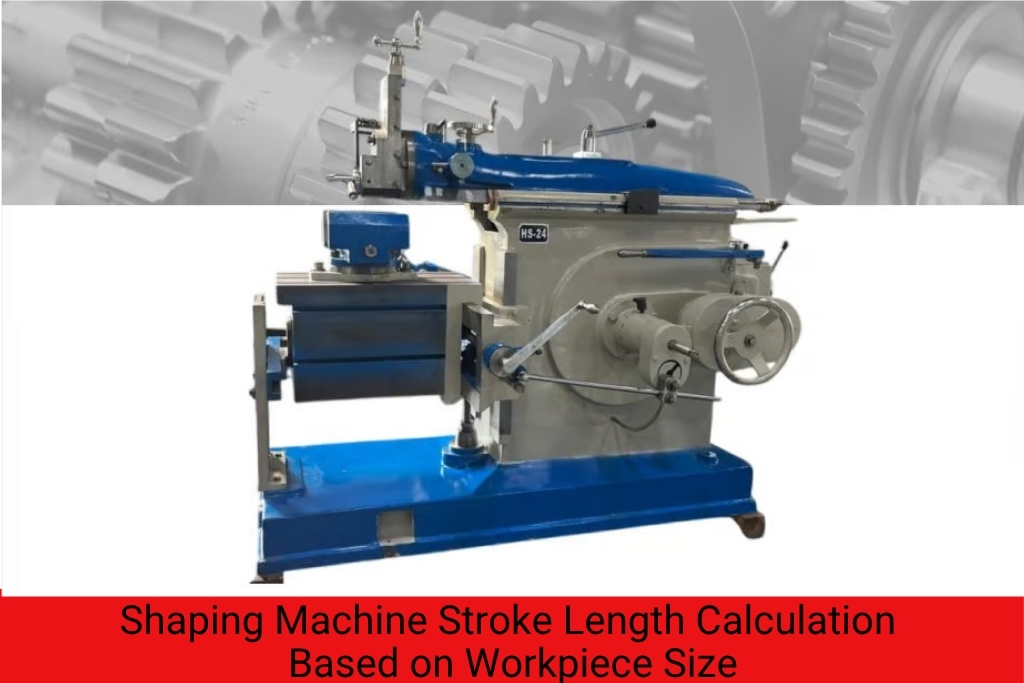
Shaping machine stroke length is the distance the ram, and therefore the cutting tool, travels during one complete forward and return cycle. It is set by the operator to match the length of the surface being machined, plus a small allowance at each end so the tool can safely enter and clear the workpiece.
Stroke length versus maximum stroke
- Stroke length is a job specific setting, adjusted for each component.
- Maximum stroke is a fixed mechanical limit of the shaping machine itself.
- The working stroke length must always be set within the machine’s maximum stroke capacity.
Selecting a shaping machine on stroke capacity
Every shaping machine model has a defined maximum stroke, and this is one of the first specifications an industrial buyer should confirm before selecting a machine. Bhavya Machine Tools offers shaping machines across a range of stroke capacities, so workshops handling small precision parts and those handling longer structural or plate components can each select a machine whose stroke range genuinely matches their typical work.
 Drop Us an Email!
How Shaping Machine Stroke Length Affects Machining Performance
Stroke length has a direct effect on cycle time, tool travel and overall machine loading.
- A longer stroke than the job requires means the ram travels further on every pass without removing extra material, increasing cycle time without improving the result.
- An insufficient stroke length can prevent the tool from covering the full machining surface, forcing repositioning of the workpiece or leaving an incomplete cut.
- A stroke set close to the actual requirement keeps the ram operating in a more controlled portion of its travel, supporting steadier cutting conditions on longer or heavier workpieces.
When customers describe their typical component lengths and machining allowances to Bhavya Machine Tools, this information is used to recommend a shaping machine whose stroke range and ram support are suited to that work, rather than a machine that is oversized or undersized for the application.
Shaping Machine Cutting Speed: What Does It Mean?
Shaping machine cutting speed refers to the speed at which the cutting edge of the tool moves relative to the workpiece during the forward, material removing stroke. It is usually expressed in metres per minute and is a separate value from strokes per minute.
Cutting speed versus strokes per minute
- Strokes per minute is simply how many complete forward and return cycles the ram completes in one minute.
- Cutting speed describes how fast the tool edge moves through the material during the cutting portion of that cycle.
- Cutting speed depends on stroke length, strokes per minute and the ratio between cutting time and return time created by the quick return mechanism.
Because shaping is an interrupted cutting process, cutting speed on a shaper machine is generally discussed as an average value across the cutting stroke rather than a constant figure. Bhavya Machine Tools’ technical team regularly helps customers interpret this distinction against their own operating range before finalising machine selection.
How to Calculate Shaping Machine Cutting Speed
Shaping machine cutting speed can be estimated from the stroke length, the number of strokes per minute and a factor that accounts for the quick return mechanism. A commonly used simplified relationship is as follows.
Simplified formula
- V = average cutting speed in metres per minute
- L = stroke length in millimetres
- N = number of complete strokes the ram makes per minute
V (m/min) = (L x N) / 1000
This simplified figure represents the approximate distance covered in one minute if the cutting stroke were the only movement counted. In practice, because the return stroke on most shaping machines is completed faster than the cutting stroke through the quick return mechanism, the actual instantaneous speed of the tool during the cutting stroke differs from this simplified average, and a more detailed calculation would also account for the ratio of cutting stroke time to return stroke time. This is shown with a worked example in the next section.
Selecting the right cutting speed also depends on the workpiece material, the cutting tool material, depth of cut, feed and the required surface finish, which is why Bhavya Machine Tools does not recommend a single fixed speed value for every job, and instead works with each customer’s material and finish requirement when advising on suitable shaping machines and operating ranges.
Shaping Machine Stroke Length vs Workpiece Size
The required stroke length is not the same as the length of the workpiece. It is based on the length of the surface actually being machined, plus a small approach clearance before the cut starts and an over travel clearance after the cut ends, so the tool can enter and leave the cut cleanly. This combined figure must fit within the maximum stroke capacity of the shaping machine being used.
Worked example
- Surface length to be machined: 300 mm
- Approach clearance: 15 mm
- Over travel clearance: 15 mm
- Required stroke length = 300 mm + 15 mm + 15 mm = 330 mm
- Assumed machine setting: 40 strokes per minute
V (m/min) = (L x N) / 1000 V = (330 mm x 40) / 1000 V = 13,200 / 1000 V = 13.2 m/min
This 13.2 metres per minute figure is a simplified average based on stroke length and strokes per minute alone. It is important to note that this is a simplified example, and that the actual tool speed experienced during the cutting stroke can differ from this average because of the machine’s quick return mechanism, which completes the return stroke in less time than the cutting stroke. The true cutting stroke time, and therefore the true cutting speed during that stroke, depends on the specific quick return ratio of the machine in question.
This kind of calculation is exactly the information Bhavya Machine Tools asks customers to share, workpiece length, required clearance and expected strokes per minute, when confirming whether a particular shaping machine’s stroke and speed range is suitable for their component before an order is placed.
Our Other Product
Plate Rolling MachinesHow to Select the Correct Shaping Machine Stroke Length
The correct stroke length should be based primarily on the length of the surface being machined, with just enough approach and over travel clearance added, while remaining within the shaping machine’s available maximum stroke.
- Setting the stroke longer than necessary adds travel time to every cycle without contributing to material removal.
- Setting it shorter than required risks an incomplete cut or an unsafe tool engagement condition.
- The correct approach is to confirm the actual surface length, add a consistent clearance allowance, and check the total against the machine’s maximum stroke rating.
For workpieces that sit close to a machine’s maximum stroke capacity, Bhavya Machine Tools recommends confirming this figure in advance, since selecting a shaping machine with adequate stroke margin for current and reasonably expected future components avoids the need to reconsider machine capacity later.
How Cutting Speed Changes With Different Workpiece Materials
Workpiece material has a direct and significant effect on the cutting speed that can be used without excessive tool wear or poor surface finish. Softer, more machinable materials generally tolerate a higher cutting speed, while harder or more abrasive materials generally require a lower cutting speed.
Factors that influence cutting speed selection
- Material hardness and machinability
- Cutting tool material and cutting edge condition
- Depth of cut and feed rate
- Availability of cooling or lubrication
Cutting speed cannot be selected from the material alone, since the same workpiece material can justify a different cutting speed depending on the tool material and how heavy the cut is. Bhavya Machine Tools discusses the typical materials a customer machines, along with their usual tooling, before suggesting an operating range on a shaping machine.
Shaping Machine Cutting Speed for Mild Steel, Cast Iron and Other Metals
As a general, indicative guide only, and assuming standard high speed steel tooling, moderate depth of cut and normal feed, shaping machine cutting speeds for common workshop materials tend to fall into approximate ranges such as the following.
|
Workpiece material |
Typical indicative cutting speed range |
|
Mild steel |
Approximately 15 to 25 m/min |
|
Cast iron |
Approximately 10 to 18 m/min |
|
Aluminium and soft non ferrous alloys |
Approximately 25 to 45 m/min |
|
Alloy or tool steel |
Approximately 8 to 15 m/min |
These figures are indicative only. Actual suitable cutting speed must be adjusted for the exact grade and hardness of the material, the cutting tool material and geometry, the depth of cut and feed selected, the required surface finish, and the rigidity of the machine itself. A shaping machine capable of operating comfortably across this kind of range gives a workshop flexibility across mixed material work, which is one of the factors Bhavya Machine Tools reviews with customers whose production involves several different material types.
Relationship Between Stroke Length, Cutting Speed and Production Rate
Production rate on a shaping machine is the combined result of stroke length, cutting speed, return stroke behaviour, feed, number of passes required, setup time and actual cutting time.
- A shorter, correctly sized stroke run at an appropriate strokes per minute setting reduces wasted non cutting travel.
- A cutting speed that matches the material and tool allows each pass to remove material efficiently without excessive tool wear.
- Increasing cutting speed beyond what the material, tool and machine condition can support does not automatically increase output, and can instead increase vibration or tool wear.
Because production rate depends on this balance rather than on stroke length or cutting speed alone, Bhavya Machine Tools works with production focused customers to understand their expected workload and required output before recommending a shaping machine.
How Shaping Machine Settings Affect Surface Finish and Machining Accuracy
Surface finish and dimensional accuracy on a shaping machine are influenced by several settings working together rather than any single cause.
Main influences on finish and accuracy
- Cutting speed and feed relative to the tool and material
- Tool sharpness and geometry
- Machine rigidity and ram condition
- Workpiece clamping and stroke setting
- Vibration and depth of cut
Poor workpiece clamping or excessive ram overhang relative to the set stroke can introduce vibration, which shows up as chatter marks or inconsistent depth even when cutting speed is reasonable. Bhavya Machine Tools designs its shaping machines with attention to ram guideway rigidity and table support, and discusses expected finish requirements with customers so machine selection reflects the accuracy the finished component actually needs.
Common Shaping Machine Setting Errors and Their Solutions
Several recurring setting errors affect shaping machine output, and most have a straightforward corrective direction once identified.
|
Common error |
Likely effect |
Corrective direction |
|
Stroke set unnecessarily long |
Wasted non cutting travel, longer cycle time |
Reduce stroke to surface length plus adequate clearance only |
|
Stroke too short for the workpiece |
Incomplete cut, unsafe tool engagement |
Recalculate stroke from actual surface length and clearance needed |
|
Incorrect ram position relative to workpiece |
Uneven cut, risk of tool striking fixture |
Reset ram stroke position before starting the cut |
|
Cutting speed too high for material or tool |
Rapid tool wear, poor finish, excess heat |
Reduce cutting speed to a range suited to material and tool |
|
Cutting speed too low for the operation |
Reduced productivity without finish benefit |
Increase cutting speed within a range the tool and material support |
|
Incorrect feed for the job |
Poor finish or excessive tool loading |
Adjust feed to match required finish and depth of cut |
|
Excessive depth of cut |
Increased vibration, tool and machine loading |
Take lighter passes, particularly on less rigid setups |
|
Poor workpiece clamping |
Chatter, inaccurate dimensions |
Improve clamping and workholding before resuming the cut |
|
Worn or incorrectly ground tool |
Poor finish, increased cutting forces |
Regrind or replace the tool and confirm correct geometry |
None of these corrections involve exceeding the shaping machine’s specified stroke, speed or load limits. Where a workshop finds it is regularly working near the limits of its current machine, Bhavya Machine Tools treats that as a machine selection question rather than a settings question, and reviews whether a different stroke or speed capacity would better suit the actual workload.
How to Improve Shaping Machine Productivity and Tool Life
Productivity and tool life on a shaping machine both benefit from the same underlying discipline, matching stroke length, cutting speed, feed and depth of cut to the actual job rather than defaulting to maximum settings.
- A stroke trimmed to the real requirement reduces non cutting movement across every cycle of a production run.
- A cutting speed chosen for the specific material and tool reduces unnecessary heat and wear, extending the interval between regrinds or tool changes.
- Balanced feed and depth of cut settings reduce cutting forces, lowering strain on the machine’s guideways and drive components over time.
These are incremental gains on any single job, but they compound significantly across a full production schedule. Bhavya Machine Tools supports this by supplying shaping machines with stroke and speed ranges suited to a workshop’s typical component mix, and by advising customers on realistic operating settings for their common materials.
Our Other Product
Saw Blade SharpenerShaping Machine Selection Based on Stroke Length, Speed and Application
Selecting the right shaping machine comes down to matching maximum stroke, operating speed range, table capacity and overall rigidity to the actual components and workload a business handles.
- A general engineering workshop machining varied small to medium components benefits from a versatile stroke and speed range.
- A tool room working on precision components may prioritise rigidity and fine control over sheer stroke length.
- A production facility running longer components or higher volumes needs to confirm both maximum stroke and sustainable strokes per minute against expected output.
Before recommending a specific shaping machine, Bhavya Machine Tools asks customers to share their typical workpiece dimensions, the surface length to be machined, common workpiece materials, expected production volume and any specific surface finish requirement, so a machine can be matched on maximum stroke, table size, speed range and rigidity to the application.
Selecting Shaping Machine Stroke Length and Cutting Speed for Your Application
Shaping machine stroke length and cutting speed are not fixed values, they are settings that must be worked out from the actual surface length, clearance, material, tool and finish required for each job. Getting them right protects tool life, cycle time and accuracy, while a shaping machine with a stroke and speed range matched to the application makes this easier to achieve consistently. Bhavya Machine Tools works with workshops and industrial buyers to confirm these requirements before recommending a suitable shaping machine for their components and production goals.
Shaping Machine Stroke Length and Cutting Speed FAQs
Shaping Machine Stroke Length and Cutting Speed: How to Select the Right Settings
How is shaping machine stroke length calculated?
<span style="font-weight: 400;">Shaping machine stroke length is calculated by taking the length of the surface that needs to be machined and adding a suitable approach clearance and over travel clearance at each end, while keeping the total within the machine's maximum stroke capacity.</span>
How is cutting speed calculated in a shaping machine?
<span style="font-weight: 400;">Cutting speed can be approximated as stroke length in millimetres multiplied by the number of strokes per minute, divided by 1000 to give an answer in metres per minute. This is a simplified average, since the quick return mechanism means the actual cutting stroke time differs from the return stroke time.</span>
Which stroke length is required for a given workpiece?
<span style="font-weight: 400;">The required stroke length depends on the length of the surface being machined, plus the clearance needed for tool approach and over travel. It is not simply equal to the overall workpiece length.</span>
How much clearance should be added to workpiece length when setting stroke?
<span style="font-weight: 400;">Clearance requirements vary by job, but a modest, consistent allowance is typically added at both the start and end of the stroke to allow the tool to enter and clear the cut without striking the workpiece or fixtures.</span>
What happens if shaping machine stroke length is too long?
<span style="font-weight: 400;">An excessively long stroke increases non cutting ram travel on every cycle, which adds to cycle time and reduces productivity without improving the machining result.</span>
Which cutting speed is suitable for mild steel on a shaper machine?
<span style="font-weight: 400;">For mild steel with standard high speed steel tooling and moderate cutting conditions, cutting speed is typically in an approximate range that should be confirmed against the specific tool, depth of cut, feed and required finish.</span>
How does cutting speed change for cast iron compared to mild steel?
<span style="font-weight: 400;">Cast iron is generally machined at a somewhat lower cutting speed range than mild steel due to differences in machinability and tool wear behaviour, though the exact figure still depends on the specific grade and tooling.</span>
How many strokes per minute should a shaping machine use for a given job?
<span style="font-weight: 400;">Strokes per minute should be selected together with stroke length so the resulting cutting speed suits the workpiece material and tool. Longer strokes generally use a lower strokes per minute setting.</span>
What affects shaping machine surface finish the most?
<span style="font-weight: 400;">Surface finish is affected by cutting speed, feed, tool sharpness and geometry, machine rigidity, workpiece clamping and vibration, so a poor finish can result from any one of several settings.</span>
Which shaping machine capacity is suitable for a general engineering workshop?
<span style="font-weight: 400;">Suitable capacity depends on the typical component length and surface area machined by that workshop, and should be confirmed against the machine's maximum stroke, table size and speed range.</span>
What information is needed before buying a shaping machine from a manufacturer?
<span style="font-weight: 400;">A shaping machine manufacturer such as Bhavya Machine Tools typically needs the workpiece dimensions, surface length to be machined, common workpiece materials, expected production volume and required surface finish to recommend a suitable stroke and speed range.</span>
Whose responsibility is it to confirm stroke length stays within machine limits?
<span style="font-weight: 400;">Confirming that the required stroke length fits within a shaping machine's maximum stroke rating is the responsibility of the operator or production planner setting up the job, and should be checked before the machine is run.</span>