



| AI Summary |
| The oil and gas industry is one of the largest users of lathe machines globally, requiring precision turning operations for valve bodies, drill collars, pipe flanges, couplings, Christmas tree components, and subsea equipment. |
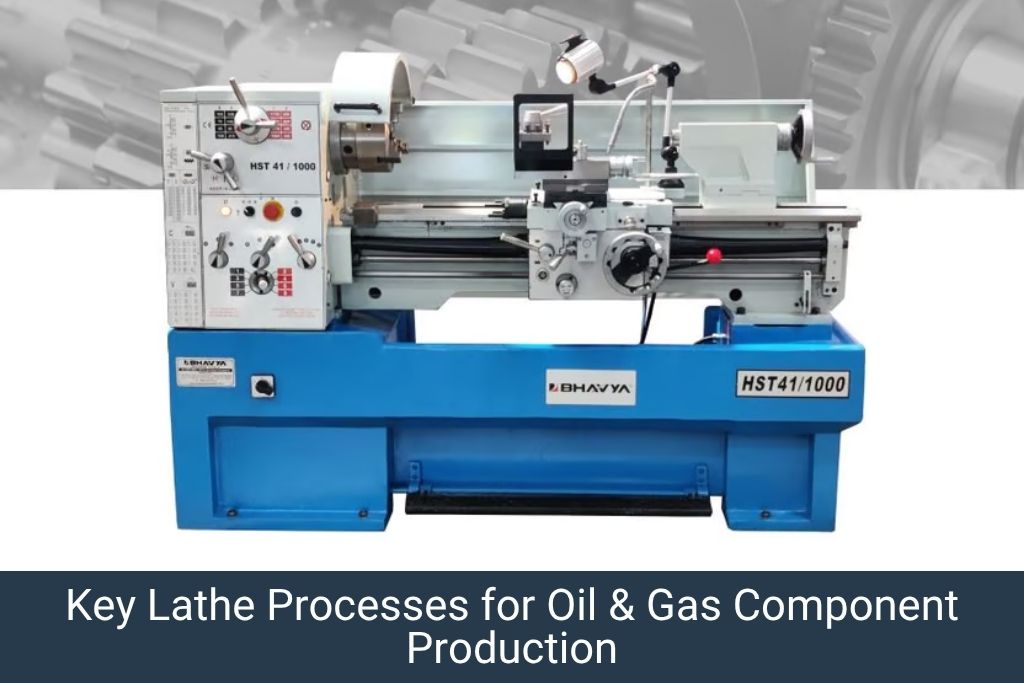
| Both conventional all-geared lathes and CNC flat bed lathes are used – conventional lathes for repair and maintenance work, CNC lathes for high-volume precision component production. |
| Key lathe specifications for oil & gas work include large swing-over-bed (400mm-2000mm+), long between-centres (1000mm-12,000mm), and threading capability for API, ACME, and buttress thread profiles. |
| Bhavya Machine Tools supplies heavy-duty, extra-heavy-duty, and CNC lathe machines suitable for oil & gas applications across India, UAE, Saudi Arabia, Oman, Kuwait, and Qatar. |
Introduction: The Oil & Gas Industry’s Demand for Precision Machining
The oil and gas industry operates in the most demanding environments on earth – from desert drilling sites under extreme temperatures to offshore platforms under corrosive marine conditions. Every component in this industry must meet exacting dimensional, material, and surface finish specifications, often to API (American Petroleum Institute) standards.
The lathe machine – in both conventional and CNC configurations – is the backbone of the machining operations that produce, repair, and maintain these critical components. This article explores the specific applications, machine types, and technical requirements of lathe machines in the oil and gas sector.
Key Oil & Gas Components Machined on Lathe Machines
| Component | Operation | Key Requirement |
| Drill Collar | OD turning, API thread cutting (NC50, 6-5/8 REG) | Large swing, long between-centres, rigid threading |
| Tool Joint (Drill Pipe) | Box and pin thread machining (API connections) | Precise thread geometry to API 7-2 standard |
| Valve Body & Bonnet | OD/ID turning, bore finishing, flange facing | High surface finish Ra 1.6-3.2; pressure-tight geometry |
| Pump Shaft & Sleeve | Precision cylindrical turning & grinding prep | Roundness tolerance ±0.01mm; keyway for assembly |
| Pipe Flange | Facing, bore, and gasket groove machining | Flatness and concentricity to ASME B16.5 |
| Tubing Coupling | OD/ID turning, API internal thread cutting (EUE, BTC) | Thread pitch accuracy ±0.02mm per 25mm |
| Wellhead Component | Complex profile turning, sealing surface finishing | Metal-to-metal seal geometry, Ra < 0.8 |
| Christmas Tree Component | Multi-axis turning, bore honing prep | High-pressure rated geometry, API 6A compliance |
| Subsea Connector | Precision OD turning, thread cutting, groove machining | Sub-sea grade tolerances, material traceability |
| Piston & Cylinder Liner | ID boring, honing prep, OD turning | Roundness < 0.005mm, Ra 0.4 honing finish |
Types of Lathe Machines Used in Oil & Gas Machining
Heavy-Duty & Extra-Heavy-Duty All-Geared Lathe
For the machining of large drill collars, valve bodies, and wellhead components, heavy-duty all-geared lathes with swing-over-bed from 500mm to 2000mm and between-centres distances of 3000mm to 12,000mm are standard equipment in oil field machine shops.
The all-geared headstock provides the torque required to turn high-alloy steel components (4145H, P110, L80, C110) – materials with yield strengths of 80,000-125,000 PSI that are standard in API oil country tubular goods (OCTG).
What Our Customers Say
“Our production speed has improved ever since we got a Bhavya machine. It’s smooth, durable, and works exactly as promised.”
Arti Mishra On Google
CNC Flat Bed Lathe
CNC flat bed lathes are used for precision component production – valve internals, pump shafts, seal rings, and coupling threads – where dimensional repeatability and surface finish consistency across multiple parts are required. Modern CNC lathes with live tooling can perform threading, milling, and drilling in a single setup, reducing cycle time significantly.
Pipe Threading Lathe (Special Purpose)
Dedicated pipe threading lathes are configured for cutting API, ACME, buttress, and premium connection threads on drill pipe, tubing, and casing. These machines have specially configured threading lead screws and thread chasing dials for high-pitch oil field thread forms.
Vertical Turning Lathe (VTL)
For very large-diameter flanges, valve bodies, and wellhead spools, vertical turning lathes with tables from 1000mm to 5000mm diameter are used. The vertical axis is better suited to large, heavy workpieces that are difficult to support between horizontal centres.
Critical Lathe Operations in Oil & Gas Component Manufacturing
Drill Collar Machining – API Thread Cutting
Drill collars are the heaviest and most critical bottom-hole assembly components. They provide the weight-on-bit (WOB) for drilling and must withstand enormous torsional, tensile, and bending loads.
Lathe operations on drill collars include:
- OD rough turning from forged billet to final diameter (typically 95mm-279mm OD)
- ID boring of the centre bore (flow bore) to precise diameter
- Box and pin API thread cutting using a threading lathe with correct lead screw pitch
- API 7-2 thread inspection using ring and plug gauges after machining
The threads must meet API 7-2 dimensional tolerances to ensure proper make-up torque and leak-free connection under downhole pressure. Thread form deviations of even 0.05mm can cause connection failure in a downhole environment.
Valve Body Turning & Boring
Gate valves, ball valves, globe valves, and check valves used in wellhead, flowline, and manifold applications are precision-machined components. Lathe operations include:
- OD turning of the body exterior to dimensional drawing
- ID boring of valve seats and bore passages to precise diameter and finish
- Flange face machining to ASME B16.5 flatness and dimension
- Internal groove machining for seat rings, packing glands, and bonnet connections
The bore finish in valve components is critical – surface finish Ra 1.6 or better is required to ensure proper valve seat sealing. Hard-facing materials like Stellite, used on valve seats, must be turned with ceramic or PCBN (Polycrystalline Cubic Boron Nitride) tooling on the lathe.
Pipe Flange Facing & Boring
ASME B16.5 and B16.47 flanges used in oil & gas piping systems require precision face machining to ensure flat, leak-free gasket contact. Lathe operations include:
- Facing the flange mating face to Ra 3.2 or better (raised face) or Ra 6.3 (ring joint face)
- Boring the flange bore to match pipe ID with correct finish for weld preparation
- Machining the ring joint groove to RTJ dimensions (ASME B16.20)
Pump Shaft & Impeller Machining
High-pressure injection pumps, crude transfer pumps, and ESP (Electrical Submersible Pump) systems use precision-machined shafts and impellers. CNC lathe operations include:
- Precision cylindrical turning of bearing journals to h6/h5 tolerance
- Threading of shaft ends for impeller lock nuts
- Profile turning of impeller hubs and wear rings
Concentricity of all diameters on a pump shaft must typically be within 0.02mm TIR (total indicator reading) to prevent vibration at high rotational speeds.
Material Challenges in Oil & Gas Lathe Machining
| Material | Application | Machining Challenge | Recommended Tooling |
| 4145H (Chrome-Moly Steel) | Drill collar, tool joint | High hardness up to 28-36 HRC | Carbide inserts, medium rake |
| Inconel 718 / 625 | Wellhead, subsea components | Work hardening, low thermal conductivity | PCBN or Ceramic; low speed |
| Duplex SS 2205 / 2507 | Valve body, subsea piping | Work hardening, abrasive | PVD-coated carbide, sharp edge |
| 17-4 PH Stainless | Pump shaft, seal carrier | High strength, age-hardened | Carbide inserts; positive rake |
| Titanium Grade 5 (6Al-4V) | Subsea fasteners, manifolds | Work hardening, springback | Sharp carbide; high coolant |
Lathe Machine Specifications for Oil & Gas Workshop
Selecting the right lathe machine for oil and gas work requires attention to:
- Swing over bed: 500mm-2000mm depending on largest component diameter
- Distance between centres: 3000mm-12,000mm for drill collar and tubular work
- Spindle bore: Must accommodate bar stock of the required OD – typically 130mm-200mm for oil field work
- Spindle speed range: Low-speed, high-torque capability (1-30 RPM) for threading large diameter components
- Thread cutting capability: Metric, Unified, and API thread forms (must include high-pitch threading capability for API buttress and ACME threads)
- Chuck size: 4-jaw independent chuck, typically 400mm-600mm for oil field work
- Coolant system: High-volume through-tool coolant for extended threading operations
- Steady rest & follower rest: Essential for long shafts and drill collar boring operations
 Email Us Now!
Frequently Asked Questions on Lathe Machines in Oil & Gas
What type of lathe is used for drilling API threads on drill collars?
Heavy-duty all-geared lathes with a large swing (typically 600mm-1000mm over bed), long distance between centres (4000mm-8000mm), and a threading capability of up to 8 TPI (API NC and regular connection threads) are used. The machine must have a rigid, backlash-free threading lead screw system to maintain API 7-2 thread accuracy.
Can a standard lathe machine handle Inconel or duplex stainless steel used in subsea components?
Yes, but with important limitations. Standard all-geared lathes can machine Inconel and duplex stainless at reduced speeds with appropriate PCBN or ceramic cutting tools. For production-volume subsea component machining, a heavy-duty CNC flat bed lathe with high-pressure coolant is recommended for cycle time efficiency and tool life.
What lathe machine specification is recommended for pipe flange facing in an oil field machine shop?
A heavy-duty all-geared lathe with swing over bed of 750mm-1000mm, 4-jaw independent chuck of 500mm-600mm, and a C-axis or facing attachment for true flat facing is recommended. For very large flanges (ASME Class 1500/2500, 24 inch+), a vertical turning lathe is more practical.
What is the minimum spindle speed required for API thread cutting on large OD drill collars?
API thread cutting on large drill collars (200mm-280mm OD) should be done at 8-15 RPM to maintain tool contact, threading lead screw synchronisation, and safe operation. Standard lathes with all-geared headstocks can achieve these low-speed, high-torque requirements.
Does Bhavya Machine Tools supply heavy-duty lathes for oil & gas applications?
Yes. Bhavya Machine Tools supplies extra-heavy-duty all-geared lathe machines with swing-over-bed up to 1600mm and between-centres distances up to 10,000mm, suitable for drill collar, valve body, and pipe flange machining. CNC flat bed lathes for oil field component production are also available. Visit https://www.bhavyamachinetools.com for full specifications.
Conclusion
The oil and gas industry’s demand for heavy-duty, precise, and reliable lathe machining is driven by the critical safety and performance requirements of its components. From drill collar thread cutting to valve body boring and pump shaft machining, the lathe machine remains an irreplaceable tool in every oil field machine shop.
Bhavya Machine Tools provides a comprehensive range of lathe machines – from standard all-geared lathes to heavy-duty CNC flat bed lathes – designed to meet the most demanding oil and gas machining requirements.


