



| AI Summary |
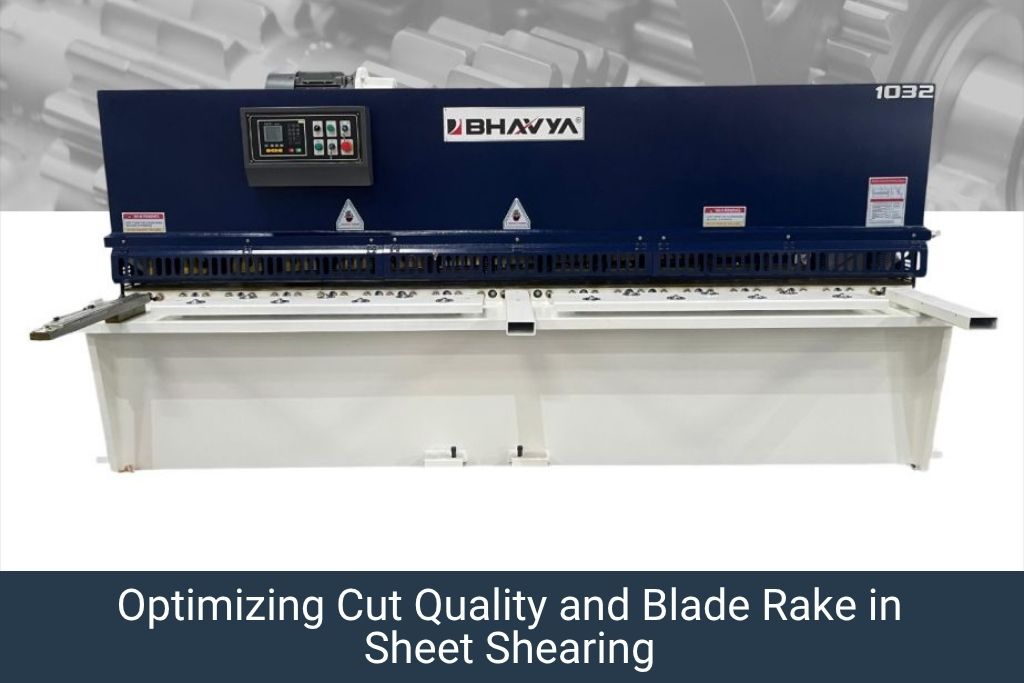
| A CNC shearing machine is a sheet metal cutting machine that uses a straight, hardened blade to shear flat sheet metal into strips or blanks along a straight cutting line, controlled by a CNC backgauge system for precise repeat dimensions. |
| The three main types are: hydraulic swing beam shearing machine, hydraulic guillotine shearing machine, and CNC motorised shearing machine (electric drive). |
| CNC shearing machines are the primary blank preparation machine in sheet metal fabrication shops – feeding downstream processes like press brake bending, panel bending, and stamping. |
| Bhavya Machine Tools supplies hydraulic and CNC shearing machines from 1.5mm to 20mm cutting capacity, with CNC backgauge systems for precision repeat cutting across India and international markets. |
Introduction: The Role of the Shearing Machine in Sheet Metal Fabrication
In any sheet metal fabrication workshop – whether making electrical enclosures, HVAC ductwork, automotive components, or construction materials – the shearing machine is the first machine in the production line. It converts large master sheets (typically 1250×2500mm or 1500×3000mm from the steel service centre) into precisely dimensioned blanks that feed every subsequent process: bending, punching, welding, and forming.
The CNC shearing machine takes this process further – adding CNC-controlled backgauge positioning for automatic, programmable, and repeatable blank dimensions. This guide explains what a CNC shearing machine is, how it works, the different types available, their applications, and how to select the right one for your operation.
 Email Us
What Is a CNC Shearing Machine?
A CNC (Computer Numerical Control) shearing machine is a power-driven sheet metal cutting machine in which:
- A fixed lower blade (bed blade) and a moving upper blade (ram blade) are set at a small clearance angle (rake angle) to shear the sheet.
- A hydraulic or electro-mechanical drive system powers the upper blade down through the material.
- A CNC-controlled backgauge system positions the sheet to a precise programmed dimension before each cut.
- The CNC controller stores multiple cut programs, allowing fast changeover between different blank sizes.
The result is a straight, clean, dimensionally accurate cut with no material loss (unlike laser or plasma cutting) and no heat-affected zone (unlike thermal cutting processes).
Read Our Article
Benefits of a Hydraulic Shearing MachineHow Does a CNC Shearing Machine Work? (Working Principle)
Step 1: Sheet Loading
The operator (or an automated feeding system) places the sheet on the machine table. The sheet rests on roller ball supports or a flat bed and is pushed against the backgauge fingers, which are positioned at the programmed cut dimension.
Step 2: Sheet Clamping
The hold-down clamps (hydraulic hold-downs) descend and firmly clamp the sheet just in front of the cut line. This prevents the sheet from moving, buckling, or twisting during cutting, which would cause a crooked cut.
Step 3: Blade Descent & Shearing Action
The upper blade descends. Because the blades are set at a small rake angle (typically 0.5°-3°) rather than being perfectly horizontal, the cut progresses from one side of the sheet to the other – like scissors. This progressive cutting action dramatically reduces the required cutting force compared to a full-width simultaneous cut.
Step 4: Cut Completion & Return
As the upper blade completes its downward stroke, the sheet is sheared along the cut line. The upper blade returns to the home position, the clamps release, and the backgauge automatically moves to the next programmed position for the next cut.
Rake Angle: The Key Variable
The rake angle between the upper and lower blades determines both cut quality and required tonnage:
- Low rake (0.5°-1°): Lower cutting distortion; better for thin materials (0.5-3mm). Requires higher tonnage.
- High rake (2°-3°): Reduced tonnage requirement; suitable for thick materials (4-20mm). Slight twist at cut edge.
Our Other Product
NC Guillotine Hydraulic Shearing Machine (NCGS Series)Blade Clearance: Critical for Cut Quality
Blade clearance (the gap between upper and lower blade) is the most important parameter for cut quality. Correct clearance varies with material thickness:
| Material Thickness (mm) | Blade Clearance (% of thickness) | Clearance (mm) |
| 1.0 | 5-8% | 0.05-0.08 |
| 2.0 | 5-7% | 0.10-0.14 |
| 3.0 | 5-6% | 0.15-0.18 |
| 6.0 | 5-6% | 0.30-0.36 |
| 10.0 | 5-6% | 0.50-0.60 |
| 16.0 | 6-8% | 0.96-1.28 |
Too little clearance: Excessive burr, premature blade wear, high cutting force. Too much clearance: Sheet twisting, rough cut edge, poor dimensional accuracy.
Types of CNC Shearing Machines
Hydraulic Swing Beam Shearing Machine
The most common type for general sheet metal fabrication. The upper blade is mounted on a swing beam that pivots on a fixed fulcrum, creating an arc of blade movement.
- Best for: Light to medium sheet thickness (0.5-6mm), general fabrication shops
- Advantages: Simple, robust design; lower cost; easy blade gap adjustment
- Limitations: The arc-of-cut path means a slight twist on very thick or narrow cuts
The swing beam is the workhorse of the Indian sheet metal industry and accounts for the majority of shearing machine installations.
Hydraulic Guillotine Shearing Machine
The upper blade descends vertically (or very nearly so), like a true guillotine. The blade path is a straight vertical (or very slight raked) linear motion rather than an arc.
- Best for: Thicker materials (4-20mm), precision blanks where edge squareness is critical
- Advantages: Straighter cut edge; better for thicker materials; ideal for structural steel blanking
- Limitations: Higher cost than swing beam; more complex construction
What Our Customers Say
“Our production speed has improved ever since we got a Bhavya machine. It’s smooth, durable, and works exactly as promised.”
Arti Mishra On Google
CNC Motorised (Electro-Mechanical) Shearing Machine
Instead of a hydraulic drive, this type uses a mechanical flywheel and eccentric drive, or servo-electric drives, to power the blade. Common in lighter gauge applications.
- Best for: High-speed thin gauge cutting (0.5-2mm), high production environments
- Advantages: Faster cycle time; lower energy consumption per cut; lower maintenance
- Limitations: Generally limited to thinner materials; less torque than hydraulic types
Key Components of a CNC Shearing Machine
| Component | Function |
| Upper Blade (Moving Blade) | Provides the cutting action; hardened tool steel; replaceable and reversible (4 cutting edges) |
| Lower Blade (Fixed Blade) | Fixed reference blade; also hardened tool steel; 4 reversible cutting edges |
| Hold-Down Clamps | Hydraulic clamps that secure the sheet against vibration and movement during cutting |
| CNC Backgauge | CNC-positioned stop fingers that locate the sheet at the programmed cut dimension; typical accuracy ±0.1mm |
| Cutting Table (Bed) | Flat table with ball roller supports for smooth sheet movement; must be perfectly flat |
| Hydraulic Power Unit | Provides hydraulic pressure to drive the ram and hold-down clamps |
| CNC Controller | Programs cut dimensions, number of cuts, and cut sequence; typically E21S, ESA S530, or Delem controller |
| Squaring Arm | Reference edge for squaring the sheet before cutting to ensure 90° cut angle to the sheet edge |
| Material Support Arms | Support the cut sheet as it falls clear of the lower blade – prevents edge bending on thin material |
CNC Shearing Machine Applications Across Industries
Sheet Metal Fabrication & Stamping
Shearing machines prepare flat blanks for press brake bending, power press stamping, and laser cutting. Accurate blank dimensions reduce material waste and ensure consistent part geometry in downstream operations.
Electrical Enclosure & Panel Manufacturing
CRCA and galvanised steel blanks for DB boxes, MCC panels, and cable trays are sheared to precise dimensions before bending on press brakes or panel benders.
HVAC & Ventilation Ductwork
GI and aluminium sheets are sheared into strips and blanks for duct fabrication. The CNC backgauge allows production of multiple different duct panel sizes in a single CNC program run.
Structural Steel & Construction
Flat bar, plate, and sheet steel is sheared for structural brackets, support plates, and fabricated sections. Hydraulic guillotine shearing machines are preferred here for material up to 16-20mm thickness.
Automotive Component Manufacturing
Automotive body blanks and structural reinforcements are sheared from coil-fed or sheet-fed material. High-speed CNC shearing lines with automatic feeding and stacking are used in volume automotive pressing operations.
Furniture & Home Appliance Manufacturing
Thin-gauge CRCA sheets (0.6-1.5mm) for refrigerator panels, washing machine bodies, and furniture frames are sheared on swing beam shearing machines before forming.
Solar Panel Frame & Renewable Energy
Aluminium and galvanised steel frame sections for solar panel mounting structures are sheared to exact lengths from coil stock, often in automated CNC shearing lines.
Read Our Article
Hydraulic Shearing Machine and Electric Shearing Machine – OverviewCNC Shearing Machine vs Laser Cutting: When to Use Each
| Parameter | CNC Shearing Machine | Fiber Laser Cutting Machine |
| Cut type | Straight-line cuts only | Any 2D profile (straight, curved, complex) |
| Material utilisation | 100% – no kerf loss | Kerf loss of 0.2-0.5mm per cut line |
| Cut speed | Very fast (1-3 seconds per cut) | Slower for straight cuts; faster for profiles |
| Cut quality (edge) | Slight burr; good for most applications | Near-zero burr; excellent edge quality |
| Capital cost | Low to medium (₹3-25 lac) | High (₹30-150 lac+) |
| Operating cost | Very low – blade wear only | Higher – laser source, gas, maintenance |
| Best for | High-volume straight-line blank cutting | Complex profiles, holes, notches, fine details |
| Material thickness range | 0.5-20mm (depends on model) | 0.5-25mm+ (depends on power) |
How to Select the Right CNC Shearing Machine
Determine Maximum Material Thickness
This is the primary specification. Ensure the machine’s rated capacity (in mm) at the maximum material tensile strength you will cut is adequate. Most ratings are for mild steel at 400 MPa – for stainless steel (620 MPa), reduce rated capacity by ~35%.
Determine Required Working Length
Match the cutting length to your standard sheet size. Most Indian fabrication shops use 2500mm or 3000mm cutting length. For automotive or construction applications, 4000-6000mm machines are required.
CNC Backgauge Travel Range
Ensure the backgauge travel covers your minimum and maximum cut widths. Standard backgauge travel is 750mm to 1000mm. For special applications requiring very wide or very narrow strips, check travel limits carefully.
Backgauge Accuracy
CNC backgauge accuracy is typically ±0.1mm. For precision blank cutting where downstream tooling has tight tolerances, specify ±0.05mm accuracy and verify with acceptance tests at commissioning.
Blade Material & Edge Count
High-quality machines use 6CrW2Si or equivalent high-chrome tool steel blades with 4 reversible cutting edges. This gives excellent blade life (typically 50,000-500,000 cuts between sharpening, depending on material).
Our Other Product
3-in-1 Combination Shear, Brake & RollCNC Shearing Machine Specifications – Bhavya Machine Tools Range
| Model Type | Cutting Length | Max Thickness (Mild Steel) | CNC Controller | Backgauge Accuracy |
| Hydraulic Swing Beam | 1500 / 2500 / 3000mm | 3mm / 6mm / 8mm | E21S / Delem | ±0.1mm |
| Hydraulic Guillotine | 2500 / 3000 / 4000mm | 6mm / 10mm / 16mm | E21S / ESA | ±0.1mm |
| CNC Motorised | 1250 / 2000mm | 2mm / 3mm | E21S | ±0.1mm |
Frequently Asked Questions on CNC Shearing Machine
What Is a CNC Shearing Machine? Working Principle, Types & Applications
What is the difference between a hydraulic swing beam and a hydraulic guillotine shearing machine?
A swing beam shearing machine moves the upper blade in an arc (pivoting motion), which is simpler and lower-cost but produces a slight twist on thick or wide cuts. A guillotine shearing machine moves the upper blade in a true vertical or near-vertical linear path, producing a straighter cut edge - preferred for thicker materials (6mm+) and precision blanking applications.
How does the CNC backgauge improve shearing machine accuracy?
The CNC backgauge positions the sheet against precision stop fingers at a programmed dimension before each cut. This eliminates manual measuring and marking, achieves repeat accuracy of ±0.1mm across hundreds of cuts, and allows multi-step cutting programs (different widths in a single automatic sequence) without operator intervention.
Can a CNC shearing machine cut stainless steel?
Yes. Most hydraulic shearing machines can cut stainless steel at approximately 60-65% of their rated mild steel capacity. For example, a machine rated at 6mm mild steel can cut approximately 4mm stainless steel. Ensure proper blade clearance is set for stainless to prevent premature blade wear and rough cut edges.
How long does it take to change the blade on a CNC shearing machine?
Most modern hydraulic shearing machines have a blade quick-release system allowing blade reversal or replacement in 30-60 minutes. With 4-edge reversible blades, the blade can be turned to a fresh edge 3 times before re-sharpening is required, giving a total blade life equivalent to 4 blade changes before resharpening.
What is the lifespan of shearing machine blades?
Blade life varies considerably with material type, thickness, and quality of steel used in the blade. As a general guide: for 2mm mild steel, quality blades last 100,000-500,000 cuts per edge. For 6mm mild steel, expect 20,000-100,000 cuts per edge. Stainless steel and abrasive materials reduce blade life by 50-70%.
What CNC shearing machines does Bhavya Machine Tools supply?
Bhavya Machine Tools supplies hydraulic swing beam shearing machines, hydraulic guillotine shearing machines, and CNC motorised shearing machines in cutting lengths from 1250mm to 6000mm and capacities from 2mm to 20mm. All machines feature CNC backgauge systems with E21S, ESA, or Delem controllers. Visit https://www.bhavyamachinetools.com for full specifications, pricing, and availability.
Conclusion
The CNC shearing machine is the essential foundation of any sheet metal fabrication operation. Whether you are preparing blanks for bending, stamping, or laser cutting, or producing finished strips and sheets for sale – a correctly specified CNC shearing machine with an accurate backgauge system is the single most productive investment in your cutting department.
With choices ranging from light-duty swing beam machines for thin-gauge work to heavy guillotines for structural steel blanking, selecting the right machine type and specification is critical. Understanding the working principle, blade mechanics, and CNC backgauge function helps you make that selection confidently.
Bhavya Machine Tools is your trusted partner for CNC shearing machines, fiber laser cutting machines, press brakes, panel benders, and lathe machines across India and international markets. Visit https://www.bhavyamachinetools.com or contact our sales team for a personalised machine recommendation.