



AI Summary: This article explains ten common types of hydraulic press machines, including hand operated, power operated, H type, C type, four column, deep drawing, forging, punching, briquetting and workshop hydraulic presses. It also highlights the H type hand operated and H type power operated hydraulic press machines offered by Bhavya Machine Tools, explaining how each press type suits different metal forming applications.
A hydraulic press machine uses fluid pressure generated within a hydraulic cylinder to apply controlled compressive force for operations such as forming, punching, forging, blanking and deep drawing. Bhavya Machine Tools offers hydraulic press machines including the H type hand operated hydraulic press and the H type power operated hydraulic press, which you can explore in their hydraulic press machines range for hand and power operated pressing needs. Because hydraulic presses operate on Pascal’s principle, they can generate very high tonnage using a relatively compact power pack, making them suitable for both light workshop tasks and heavy industrial forming operations. Different hydraulic press machine types are designed around specific frame structures and operating methods, each suited to particular applications and production volumes. This article explains ten common types of hydraulic press machines so manufacturers can identify which configuration best matches their metal forming, moulding or assembly requirements.
H Type Hand Operated Hydraulic Press for Light Duty Tasks
The H type hand operated hydraulic press offered by Bhavya Machine Tools is designed for light duty pressing tasks where manual control over stroke and pressure is sufficient for the job at hand. This press type uses a manually operated hydraulic pump to build pressure gradually, giving the operator precise control during delicate assembly, bearing insertion or bending operations. Since it does not require an electric motor for pressure generation, the hand operated hydraulic press is often chosen for smaller workshops, maintenance departments or tool rooms with occasional pressing needs rather than continuous high volume production. Its simple construction also means lower maintenance requirements and a longer service life for facilities that only need pressing capability on an intermittent basis.
H Type Power Operated Hydraulic Press for Continuous Production
The H type power operated hydraulic press uses an electric motor driven pump to generate hydraulic pressure automatically, making it suitable for workshops that require frequent or continuous pressing operations throughout a production shift. This press type reduces operator fatigue since the motor handles the pressure building process, allowing faster cycle times compared to manually pumped alternatives. Bhavya Machine Tools manufactures power operated hydraulic press machines with a rigid H shaped frame that provides stable, accurate pressing force across the working area of the bed. Manufacturers running higher volume assembly, forming or straightening operations typically prefer the power operated configuration for the productivity gains it delivers over a full working day.
C Type Hydraulic Press for Open Front Accessibility
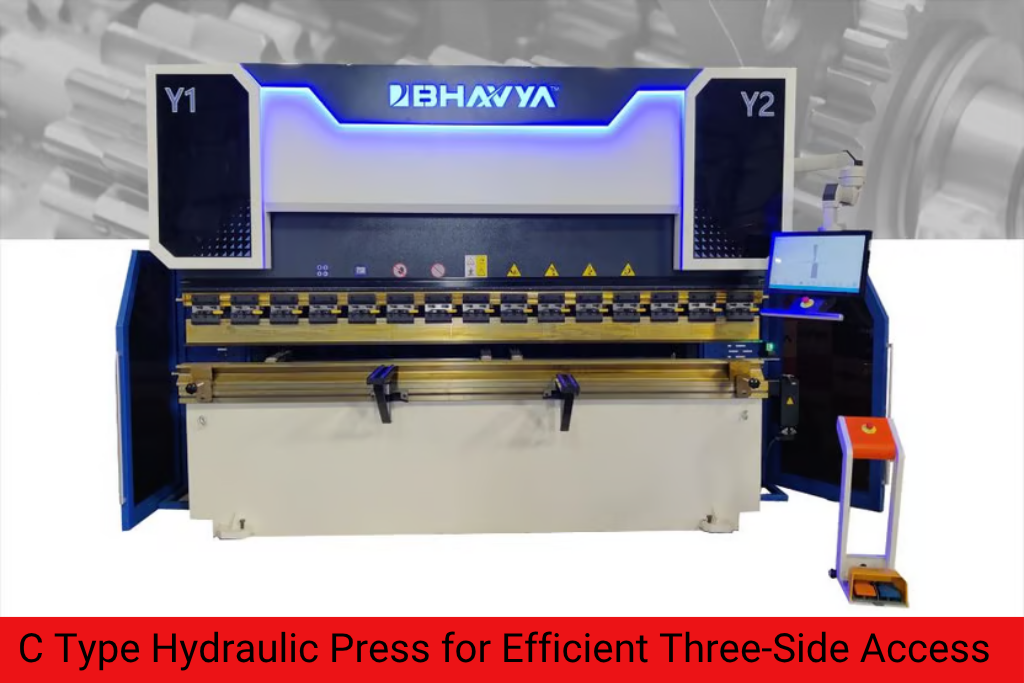
A C type hydraulic press features an open front frame design, resembling the letter C, which provides excellent accessibility to the working area from three sides for loading and unloading components. This design is particularly useful for operations that require frequent part handling or where fixtures need to be positioned from the side rather than only from the front. C type hydraulic presses are commonly used for assembly work, bearing pressing and small forming operations where quick access to the die area improves overall cycle efficiency. The open frame structure does mean slightly less rigidity compared to fully enclosed frame types, making C type presses better suited to lighter tonnage applications rather than heavy forming work.
Four Column Hydraulic Press for Heavy Forming Operations
A four column hydraulic press uses four vertical guide columns to support the moving platen, providing excellent rigidity and even force distribution across large die areas during heavy forming operations. This press type is commonly used in industries producing large sheet metal parts, deep drawn components and heavy die forming applications where uneven pressure distribution could cause part defects or premature tooling wear. The four column design also allows for larger table sizes compared to H type or C type presses, accommodating bigger dies and more complex tooling setups. Manufacturers producing automotive panels, appliance bodies and large structural components often rely on four column hydraulic presses for their combination of stability and higher tonnage capacity.
Read Our Article
In What ways is Power Press Useful as a Workshop Machine?Deep Drawing Hydraulic Press for Sheet Metal Forming
A deep drawing hydraulic press is specifically designed to stretch flat sheet metal into three dimensional shapes such as cups, shells and enclosures through a controlled drawing process that avoids tearing or wrinkling the material. This press type typically includes a precisely controlled ram speed and pressure profile, since deep drawing operations require gradual, consistent force application rather than a sudden impact. Cushion systems are often built into deep drawing presses to control blank holder pressure, which prevents metal from wrinkling as it flows into the die cavity. Kitchen equipment, automotive body panel and general sheet metal enclosure manufacturers frequently depend on deep drawing hydraulic presses for producing smooth, defect free formed components.
Forging Hydraulic Press for Shaping Heated Metal Billets
A forging hydraulic press applies gradual, controlled compressive force to heated metal billets, shaping them into desired forms through plastic deformation rather than the rapid impact used in mechanical forging hammers. This press type is valued in forging operations because the controlled force application allows better control over grain flow within the metal, which can improve the mechanical strength of the finished forged component. Forging hydraulic presses are generally built with heavy duty frames capable of withstanding the substantial tonnage required to deform hot metal effectively. Automotive component, tool making and heavy machinery manufacturers use forging hydraulic presses to produce parts that need enhanced strength characteristics compared to simply cast or machined alternatives.
Punching Hydraulic Press for Hole Making and Blanking
A punching hydraulic press is configured to cut clean holes or blank shapes from sheet metal by forcing a punch through the material into a matching die opening with sufficient force to shear the metal cleanly. This press type requires precise alignment between the punch and die to avoid burrs or dimensional inaccuracy on the finished blanked or punched part. Hydraulic punching presses are valued for their smooth, controllable force application compared to purely mechanical punch presses, which reduces noise and vibration during operation. Electrical panel, general sheet metal fabrication and component manufacturing industries commonly use punching hydraulic presses for producing consistent hole patterns and blanked shapes across production runs.
Our Other Product
Threading MachinesBriquetting Hydraulic Press for Compacting Loose Materials
A briquetting hydraulic press compresses loose materials such as metal scrap, biomass or powder into compact, uniform briquettes for easier handling, storage or further processing. This press type applies sustained high pressure over a longer dwell time compared to typical metal forming presses, since compacting loose or granular material requires different force and time characteristics to achieve a stable, cohesive briquette. Recycling facilities, foundries and biomass fuel producers use briquetting hydraulic presses to convert waste material into a more manageable and often more valuable form. The consistent tonnage control offered by hydraulic systems makes this press type well suited to the specialised compaction requirements of briquetting applications.
Workshop Hydraulic Press for General Maintenance Tasks
A general workshop hydraulic press is a versatile, often smaller capacity machine used for a wide variety of maintenance tasks such as pressing bearings, bushings and pins into or out of housings during equipment repair work. These presses are commonly found in vehicle service centers, industrial maintenance departments and general engineering workshops that need occasional pressing capability without dedicated production tooling. Workshop hydraulic presses typically feature adjustable bed heights and simple manual or semi automatic controls, making them accessible for use by maintenance technicians without specialised press operating experience. Their compact footprint and moderate tonnage range make them a practical addition to almost any mechanical workshop environment.
Read Our Article
Factors to Consider Before Buying a Laser Marking MachineStraightening Hydraulic Press for Correcting Bent Components
A straightening hydraulic press applies controlled, localized force to correct bends, warps or distortions in shafts, beams and other structural components that have deviated from their intended straightness. This press type often includes a dial indicator setup that allows the operator to measure deflection accurately while applying incremental pressure until the component returns to the required straightness tolerance. Straightening presses are valuable in maintenance and repair workshops, as well as in production environments where components can become slightly bent during heat treatment or handling. The controlled force application of a hydraulic system makes this press type particularly suitable for straightening operations where excessive force could otherwise cause the material to crack or overcorrect beyond the desired tolerance.
Conclusion
Hydraulic press machines come in a wide variety of configurations, each engineered for specific applications ranging from light workshop tasks to heavy industrial forming, forging and compaction operations. Understanding the differences between hand operated, power operated, four column and specialised press types helps manufacturers select the right equipment for their production needs. Bhavya Machine Tools offers H type hand operated and H type power operated hydraulic press machines designed to deliver reliable, controlled pressing force across a wide range of workshop and industrial applications.
Frequently Asked Questions
Hydraulic Press Machine Types
What is the main difference between a hand operated and power operated hydraulic press?
A hand operated hydraulic press builds pressure manually through a hand pump, while a power
operated hydraulic press uses an electric motor driven pump for faster, continuous pressing cycles.
Which hydraulic press type is best suited for heavy sheet metal forming?
A four column hydraulic press is generally best suited for heavy sheet metal forming because its rigid frame distributes force evenly across large die areas.
Can a deep drawing hydraulic press be used for other forming operations?
While optimised for drawing operations, a deep drawing hydraulic press can often be adapted for
related forming tasks, though dedicated presses typically perform better for specialised deep drawing work.
Are hydraulic press machines used only for metal forming?
No, hydraulic press machines are also used for briquetting loose materials, straightening bent
components and general workshop maintenance tasks beyond typical metal forming applications.
Where can I explore hydraulic press machines offered by Bhavya Machine Tools?
Bhavya Machine Tools offers H type hand operated and H type power operated hydraulic press
machines, which can be explored on their Hydraulic Press Machines category page.