



AI Summary: This article compares NC press brake machines and CNC press brake machines across ten key parameters including control systems, back gauge automation, programming, axis control, cost, precision, operator skill, production suitability, maintenance and industry application, helping manufacturers choose the right hydraulic press brake technology for their sheet metal bending needs.
Press brake machines have evolved significantly over the years, moving from purely mechanical operation to numerically controlled and then fully computer controlled systems. Two terms that often confuse buyers are NC press brake machine and CNC press brake machine, since both use programmable logic to control bending operations but differ substantially in capability, flexibility and cost. An NC front cylinder hydraulic press brake machine typically controls a limited number of functions through a simpler numerical controller, while a CNC hydraulic press brake integrates multi axis computer control that manages back gauge positioning, bend angle, ram speed and sequencing simultaneously. Understanding these differences helps manufacturers select the right press brake machine based on their production volume, part complexity and budget. This article breaks down ten important differences between NC and CNC press brake machines so buyers can make an informed decision when investing in bending equipment for their sheet metal fabrication operations.
Control System Complexity and Programming Method
An NC press brake machine typically uses a basic numerical controller that manages one or two axes, most commonly the back gauge position, requiring the operator to manually set bend angle and ram stroke for each job. A CNC press brake machine, in contrast, uses a computer based controller capable of managing multiple axes simultaneously, including back gauge, ram depth, bend sequence and sometimes even tooling selection through a graphical interface. This difference in control sophistication means CNC bending machines can store complete bend programs with multiple steps, while NC machines often require the operator to input settings for each stage of a job separately. For manufacturers producing complex multi bend parts, the advanced programming capability of a CNC hydraulic press brake significantly reduces setup time compared to the more manual approach required on an NC press brake machine.
 Email Us Today!
Number of Controlled Axes During Bending Operations
NC press brake machines generally control fewer axes, often limited to back gauge movement along a single direction, which restricts the complexity of parts that can be produced without manual intervention. CNC press brake machines can control multiple axes at once, including X and R axes for back gauge, Y axis for ram position, and sometimes additional axes for crowning or tooling positioning. This expanded axis control allows CNC bending machines to handle intricate box shapes, multi flange parts and varying bend angles within a single automated cycle. Manufacturers producing simple angle brackets or straight bends may find an NC press brake machine sufficient, while those making complex enclosures or multi step components typically need the broader axis control that only a CNC hydraulic press brake can provide.
Repeatability and Consistency Across Production Batches
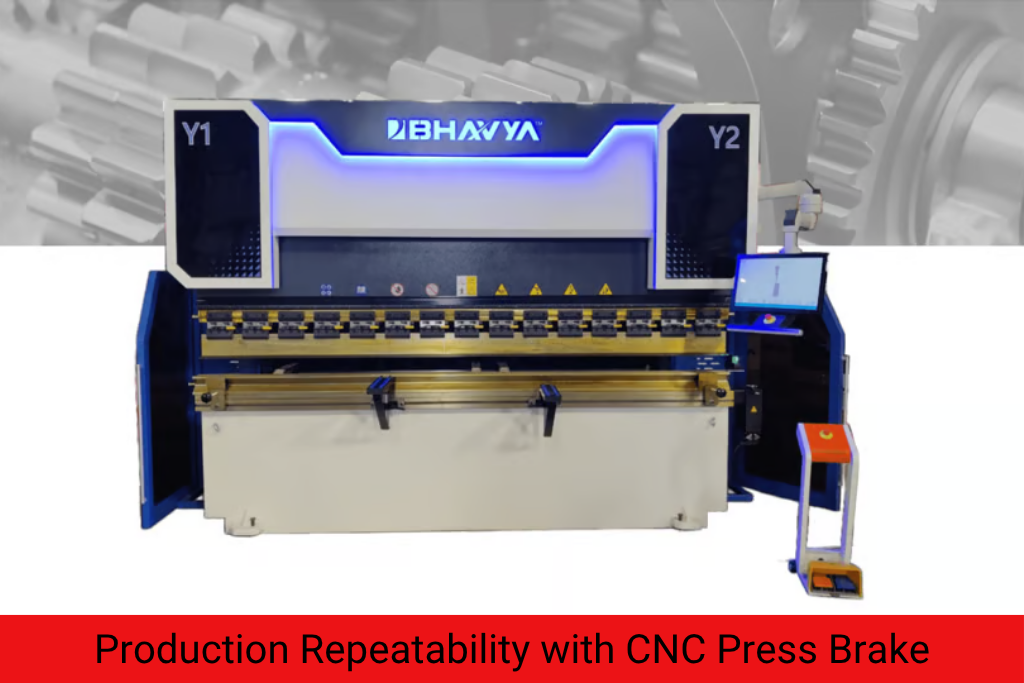
Because a CNC press brake machine can store and recall complete bend programs, it delivers extremely high repeatability across large production batches, with each part matching the previous one within very tight tolerances. NC press brake machines can also repeat settings reasonably well, but since more parameters are manually adjusted between bends, there is a slightly higher chance of variation creeping into a long production run. For industries like automotive or electrical panel manufacturing that need thousands of identical parts, the consistency offered by CNC hydraulic press brake programming is often the deciding factor. NC press brake machines remain suitable for smaller batch sizes or simpler jobs where absolute repeatability across very large quantities is less critical to the overall production requirement.
Initial Investment and Overall Cost Comparison
NC press brake machines are generally more affordable than CNC press brake machines because their control systems are simpler and require fewer sensors, servo motors and software components. This makes NC front cylinder hydraulic press brake machines an attractive option for smaller workshops or manufacturers with limited capital who still want better accuracy than a purely manual press brake. CNC hydraulic press brake machines involve a higher upfront investment due to their advanced controllers, multi axis servo systems and often more sophisticated hydraulic circuits. However, many manufacturers find that the productivity gains and reduced scrap rates from CNC bending machines justify the higher initial cost over the machine’s operating life, particularly for high volume production environments.
Read Our Article
Press Brake – Types of Press Brakes, Applications of Press BrakeOperator Skill Level Required for Efficient Operation
Operating an NC press brake machine generally requires a moderate skill level since the operator still manually handles several setup parameters between different bending stages, relying on experience to fine tune angle and pressure settings. A CNC press brake machine, while more powerful, actually simplifies day to day operation once programs are created, since the computer manages most variables automatically during production. However, programming a CNC hydraulic press brake initially requires a more skilled technician familiar with CAD based bend simulation software. Many manufacturers find that CNC bending machines reduce dependency on highly experienced manual operators for routine production runs, while NC press brake machines continue to rely more heavily on operator judgment throughout each job.
Suitability for Simple Versus Complex Bending Jobs
NC press brake machines are well suited for straightforward bending jobs involving single or double bends on relatively simple sheet metal parts, making them a practical choice for general fabrication workshops. CNC press brake machines excel at complex, multi bend components that require precise sequencing, varying angles and tight tolerances across several fold lines within a single sheet. Industries producing simple brackets or angles can operate efficiently with an NC hydraulic press brake, while those manufacturing intricate enclosures, chassis parts or architectural panels typically need the advanced sequencing capability of a CNC bending machine. Matching machine type to job complexity helps manufacturers avoid overspending on capability they do not need, or underinvesting in equipment that cannot handle their part requirements.
Setup Time and Job Changeover Speed
Switching between different jobs on an NC press brake machine usually takes longer because the operator must manually reconfigure back gauge positions and bend sequences for each new part design. CNC press brake machines dramatically reduce changeover time since stored programs can be recalled instantly, allowing the machine to switch from one part number to another within minutes. This advantage becomes especially valuable for manufacturers who handle frequent small batch orders with varying part designs, since a CNC hydraulic press brake minimises non productive time between jobs. Workshops with a stable, repetitive product line may not notice much difference in changeover speed, but those with diverse, frequently changing orders benefit significantly from CNC automation.
Our Other Product
Lathe MachinesPrecision and Tolerance Achievable on Finished Parts
CNC press brake machines generally achieve tighter tolerances because their computer controlled systems compensate for factors like material springback and bed deflection more accurately than the simpler control loops found in NC press brake machines. This precision advantage becomes particularly important when bending high strength steel or thicker gauge material, where even small angle deviations can cause assembly problems. NC hydraulic press brake machines can still achieve good accuracy for general fabrication work, but may require more operator correction and test bending to fine tune results. For manufacturers producing precision components for electronics, aerospace adjacent or medical equipment industries, the tighter tolerance control of CNC bending machines often makes them the necessary choice over NC alternatives.
What Our Customers Say
“Our production speed has improved ever since we got a Bhavya machine. It’s smooth, durable, and works exactly as promised.”
Arti Mishra On Google
Maintenance Requirements and Long Term Reliability
NC press brake machines tend to have simpler maintenance needs since their control systems involve fewer electronic components and sensors that could require servicing over time. CNC press brake machines, with their multiple servo motors, encoders and computer controllers, generally require more specialised maintenance and occasional software updates to keep the system running smoothly. That said, most reputable press brake machine manufacturers design CNC hydraulic press brake systems with robust components meant for long term industrial use, so reliability remains strong when the machine is serviced according to recommended schedules. Workshops considering a CNC bending machine should factor in access to technical support and spare parts availability alongside the machine’s core capabilities.
Return on Investment for Different Production Scales
For low volume manufacturers or workshops handling occasional custom fabrication work, an NC press brake machine often delivers a faster and more practical return on investment due to its lower purchase price and adequate capability for simpler jobs. For medium to high volume manufacturers producing complex, multi bend parts across large batches, a CNC press brake machine typically provides a stronger long term return through reduced labour dependency, lower scrap rates and faster job changeovers. Evaluating expected production volume, part complexity and available capital helps manufacturers decide whether an NC front cylinder hydraulic press brake or a full CNC hydraulic press brake machine will deliver the better return over the equipment’s working lifespan.
Conclusion
Choosing between an NC press brake machine and a CNC press brake machine ultimately depends on the complexity of parts being produced, expected production volume and available budget. While NC front cylinder hydraulic press brake machines remain a practical and affordable option for straightforward bending jobs, CNC hydraulic press brake machines offer superior automation, precision and repeatability for manufacturers handling complex, high volume sheet metal work. Bhavya Machine Tools manufactures both NC and CNC press brake machine ranges, allowing fabricators to select the technology that best matches their specific bending requirements and production goals.
Frequently Asked Questions
NC Press Brake vs CNC Press Brake: Top 10 Differences
Is a CNC press brake machine always better than an NC press brake machine?
Not necessarily, a CNC press brake machine suits complex, high volume production, while an NC press brake machine can be a more cost effective choice for simpler bending jobs and smaller workshops.
What is the main control difference between NC and CNC press brake machines?
NC press brake machines typically control fewer axes with simpler numerical control, while CNC press brake machines manage multiple axes through computer based programming for greater automation.
Do CNC press brake machines need more skilled operators?
Programming a CNC hydraulic press brake requires a skilled technician initially, but day to day operation is often simpler than an NC press brake machine once bend programs are stored.
Which machine offers better repeatability for large production batches?
CNC press brake machines generally offer better repeatability across large batches because stored programs eliminate manual variation between bending cycles.
How does cost compare between NC and CNC press brake machines?
NC press brake machines usually have a lower upfront cost, while CNC press brake machines involve higher investment but can deliver better long term returns for complex, high volume production.