



AI Summary: This article explains the ten most valuable lathe machine accessories that help workshops boost output, accuracy and tool life. It covers chucks, tailstocks, steady rests, tool posts, DRO systems, collets, faceplates, coolant systems, taper attachments and quick change tool holders, and explains how each accessory supports operators working with all geared lathe machines, CNC lathe machines and heavy duty lathe machines used across manufacturing and tool room applications in India and abroad.
A lathe machine is one of the oldest and most trusted machine tools used for turning, facing, drilling and threading operations across metal cutting industries. Whether a workshop uses an all geared lathe machine, a V belt drive lathe machine or a modern CNC lathe machine, the right combination of accessories determines how fast and how accurately a job gets completed. Lathe machine manufacturers and lathe machine suppliers often highlight that the base machine only provides the platform, while the accessories fitted to it decide the real world productivity, surface finish and repeatability achieved on the shop floor. From small tool rooms to large scale production units, operators rely on accessories to reduce setup time, minimise vibration and extend the working life of both the machine and the cutting tool. This guide walks through ten accessories that consistently deliver measurable gains in output and quality, and explains why each one remains relevant for both conventional and precision lathe machines used in engineering, automobile, defence and general fabrication industries.
Three Jaw and Four Jaw Chucks for Faster Job Holding
A chuck is the single most used accessory on any lathe machine and directly affects how quickly a job can be mounted and centered. Three jaw self centering chucks are ideal for round or hexagonal stock because all jaws move together, saving valuable setup time during batch production. Four jaw independent chucks, on the other hand, allow each jaw to be adjusted separately, making them the preferred choice for irregular or off center components that need precise alignment. Many all geared lathe machine and heavy duty lathe machine users keep both chuck types available so the operator can switch depending on the job at hand. Choosing the correct chuck size and jaw type reduces re machining, improves concentricity and lowers scrap rates, which is why lathe machine manufacturers list chuck compatibility as a key specification when clients compare models.
Tailstock and Its Role in Supporting Long Workpieces
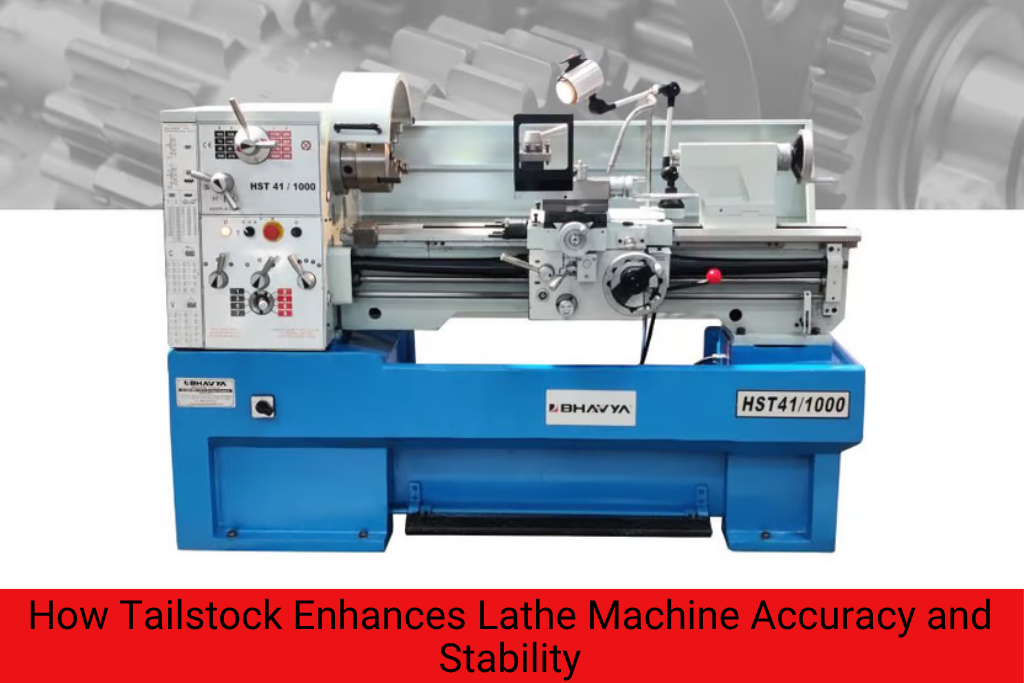
The tailstock supports the free end of a long workpiece and prevents it from bending or vibrating during turning, facing or drilling operations. On a tool room lathe or an engine lathe, a well aligned tailstock is essential for holding centers, drill chucks and dead centers securely in place. Without proper tailstock support, long shafts and rods tend to whip at high speeds, resulting in poor surface finish, dimensional errors and even tool breakage. Many operators fit a rotating live center in the tailstock quill to reduce friction and heat buildup when turning at higher spindle speeds. For workshops handling slender components on a light duty lathe machine or a medium duty lathe machine , the tailstock accessory is what makes it possible to achieve straight, accurate cylindrical parts without constant readjustment.
Steady Rest and Follower Rest for Vibration Control
Long and thin workpieces are prone to deflection and chatter, which is where a steady rest and a follower rest become essential accessories for any precision lathe machine. A steady rest is mounted on the bed and supports the workpiece at a fixed point, commonly used while facing or drilling the end of a long shaft. A follower rest travels along with the carriage and continuously supports the workpiece close to the cutting tool, which keeps vibration under control during turning. Both accessories help operators maintain tight tolerances on slender components that would otherwise flex under cutting pressure. Heavy duty lathe machine operators dealing with long shafts for pumps, motors or agricultural equipment often depend on these rests to avoid taper errors and to protect the surface finish from chatter marks caused by an unsupported workpiece.
Digital Readout Systems for Accurate Positioning
A DRO lathe setup, often called a digital readout system, gives the operator a real time display of the tool position along the X and Z axes, removing the guesswork involved in reading handwheel graduations. This accessory is extremely popular on conventional lathe machines that are being upgraded for semi precision work without investing in a full CNC lathe machine. A DRO lathe machine reduces measurement errors, speeds up repetitive facing and turning operations, and helps new operators achieve consistent results faster than relying on manual dials alone. Many workshops retrofit older all geared lathe machine models with a DRO kit because it dramatically cuts inspection time and rework. For businesses that need better accuracy without the higher cost of automation, a digital readout remains one of the most cost effective productivity upgrades available for a lathe.
Quick Change Tool Post for Reduced Setup Time
A quick change tool post allows an operator to swap between multiple pre set cutting tools in seconds instead of loosening and readjusting a standard tool post for every operation. Each tool holder can be preset to the correct height outside the machine, so once it is clicked into the quick change post, the tool is instantly ready to cut without further alignment. This accessory is especially valuable in tool room lathe environments where a single job may require turning, facing, boring and threading tools in sequence. By cutting down non productive time between operations, a quick change tool post improves overall throughput and allows small and medium lathe machine manufacturer facilities to complete more jobs per shift. It also improves consistency since every tool returns to the same height each time it is mounted.
Our Other Product
Grinding MachinesWhat Our Customers Say
“Largest Display of Machinery across India. Wide range of Machines. Very Co-operative staff. Range of Tapping Machine and Re-sharpening Machines are outstanding. Very Cost effective and useful in Precision Machining Work. Their staff is co – operative for after sales support.”
Tirth Bhojani On Google
Collet Chucks for Precision Work on Small Diameter Stock
Collet chucks are widely used when machining small diameter bar stock that requires excellent concentricity and repeatability, something a standard three jaw chuck cannot always guarantee at very small sizes. A collet closes evenly around the workpiece, distributing clamping force uniformly and reducing the risk of marking delicate surfaces. This accessory is common on precision lathe machine and high speed precision lathe setups used for producing small shafts, pins, bushings and fasteners in large volumes. Collets are quick to change and allow rapid bar feeding, which suits high mix, high volume production environments. For manufacturers producing small turned components for electronics, automotive or instrument industries, collet chucks are often the deciding accessory between acceptable tolerances and rejected batches.
Faceplates and Angle Plates for Irregular Components
Not every component fits neatly into a chuck, and this is where a faceplate becomes an indispensable lathe machine accessory. A faceplate is a flat disc with slots and holes that bolts directly to the spindle, allowing irregularly shaped or asymmetric workpieces to be clamped using clamps, bolts and angle plates. This setup is common when machining brackets, castings or fabricated parts that cannot be held by conventional chucking methods. Angle plates used alongside faceplates help position off center features accurately for facing, boring or drilling operations. Workshops that handle custom or one off jobs on an all geared lathe machine frequently rely on faceplate work, since it extends the versatility of the lathe well beyond simple cylindrical turning and helps avoid outsourcing awkward shaped components.
Coolant and Lubrication Systems for Longer Tool Life
A dedicated coolant system delivers cutting fluid directly to the tool and workpiece interface, reducing heat generation, controlling chip formation and extending the working life of cutting tools significantly. On heavy duty lathe machine and CNC lathe machine setups, continuous coolant flow also washes away chips from the cutting zone, keeping the work area clear and preventing chip related surface defects. Proper lubrication additionally protects the lathe bed, slideways and leadscrew from premature wear, which keeps the machine accurate for a longer period. Many lathe machine suppliers now offer flood coolant, mist coolant and through spindle coolant options depending on the material being machined, since materials like stainless steel and titanium generate more heat than mild steel or aluminium. Investing in the right coolant system pays back quickly through reduced tool cost and fewer rejected parts.
Read Our Article
Types and Applications of All Geared Lathe MachinesTaper Turning Attachments for Complex Geometries
A taper turning attachment allows an operator to produce accurate conical surfaces without repeatedly offsetting the tailstock, which can otherwise disturb the machine’s centering for straight turning work. This accessory uses a guide bar set at the required taper angle to control the cross slide movement automatically as the carriage travels along the bed. Components like tool shanks, spindles, valve seats and certain automotive parts require precise taper angles that would be difficult to hold consistently using manual offset methods. Turret lathe machine and engine lathe operators particularly value taper attachments because they allow quick switching between straight and tapered work without extensive resetting. For workshops producing a mix of standard and tapered components, this accessory saves considerable time while maintaining tight angular tolerances across every piece produced.
Thread Chasing Dial and Threading Attachments
Producing accurate screw threads on a lathe machine requires careful synchronisation between the spindle rotation and the carriage feed, and a thread chasing dial makes this process far more efficient. This accessory tells the operator exactly when to engage the leadscrew so the tool re enters the same thread groove on every pass, which is essential for multi pass threading operations. Without a chasing dial, operators would need to reverse the entire spindle after every cut, which slows down production considerably. Threading attachments paired with a chasing dial are heavily used in tool room lathe and general engineering workshops producing bolts, studs, and threaded shafts. This accessory reduces scrap caused by misaligned thread passes and allows even moderately experienced operators to produce accurate, uniform threads at a consistent pace.
Conclusion
Choosing the right accessories for a lathe machine is just as important as choosing the machine itself, since these attachments directly influence cycle time, tolerance control and tool life. From chucks and tailstocks to coolant systems and threading attachments, each accessory addresses a specific challenge that operators face on the shop floor every day. Workshops that invest in the correct combination of lathe machine accessories, whether working on an all geared lathe machine, a heavy duty lathe machine or a modern CNC lathe machine, consistently report faster turnaround, better repeatability and lower rejection rates. Bhavya Machine Tools, as an established lathe machine manufacturer and supplier, recommends evaluating your typical job mix before finalising an accessory list, since the correct setup can transform an ordinary lathe into a highly productive production asset.
Frequently Asked Questions
Top 10 Lathe Machine Accessories That Improve Productivity
Which lathe machine accessory improves productivity the most for small workshops?
A quick change tool post and a digital readout system together give small workshops the fastest return on investment, since both reduce setup time and measurement errors without needing a full CNC lathe machine upgrade.
Can a DRO lathe kit be fitted on an old all geared lathe machine?
Yes, most digital readout kits can be retrofitted on existing all geared lathe machine and V belt drive lathe machine models with minor modification, giving older machines a modern accuracy boost at low cost.
Why is a steady rest important when turning long shafts?
A steady rest supports the workpiece at a fixed point along the bed, preventing deflection and chatter that would otherwise cause taper errors and poor surface finish on long or slender components.
What is the difference between a chuck and a collet on a lathe machine?
A chuck uses adjustable jaws suited for a wide range of diameters and shapes, while a collet closes evenly around a specific small diameter for higher concentricity and faster bar feeding in precision work.
Do CNC lathe machines still need manual accessories like faceplates?
Yes, faceplates, steady rests and coolant systems remain useful on CNC lathe machine setups whenever a job involves irregular shapes or long slender parts that need extra support beyond standard chucking.