



AI Summary
- CNC shearing machines excel at high-speed, straight-line cutting of sheet metal at a very low cost per cut.
- Fiber laser cutting handles complex shapes, holes, slots, and mixed geometries impossible for a shear.
- Shearing is 5-10× faster and cheaper for simple rectangular blanks; laser wins for complex contour cutting.
- Most well-equipped sheet metal shops need both machines – they are complementary, not competitive.
- Bhavya Machine Tools supplies both CNC hydraulic shearing machines and fiber laser cutting systems.
Introduction: Two Fundamental Approaches to Sheet Metal Cutting
Sheet metal cutting is the first and most critical step in nearly every fabrication workflow. Before bending, welding, or assembly can happen, raw coil or sheet must be cut to size and shape. Two technologies dominate this process in modern fabrication shops: CNC hydraulic/mechanical shearing machines and CNC fiber laser cutting machines.
At first glance, they both ‘cut metal.’ But the comparison ends there. A CNC shearing machine makes straight-line cuts at very high speed using a mechanical shearing action – it cannot cut curves, holes, or complex shapes. A fiber laser cutting machine uses a focused laser beam to cut virtually any shape in 2D, but at higher cost per part and with slower throughput on simple straight cuts.
Understanding when to use each machine – and how they can work together – is essential for optimizing sheet metal shop productivity and profitability.
How Each Technology Works
CNC Hydraulic Shearing Machine (Guillotine Shear)
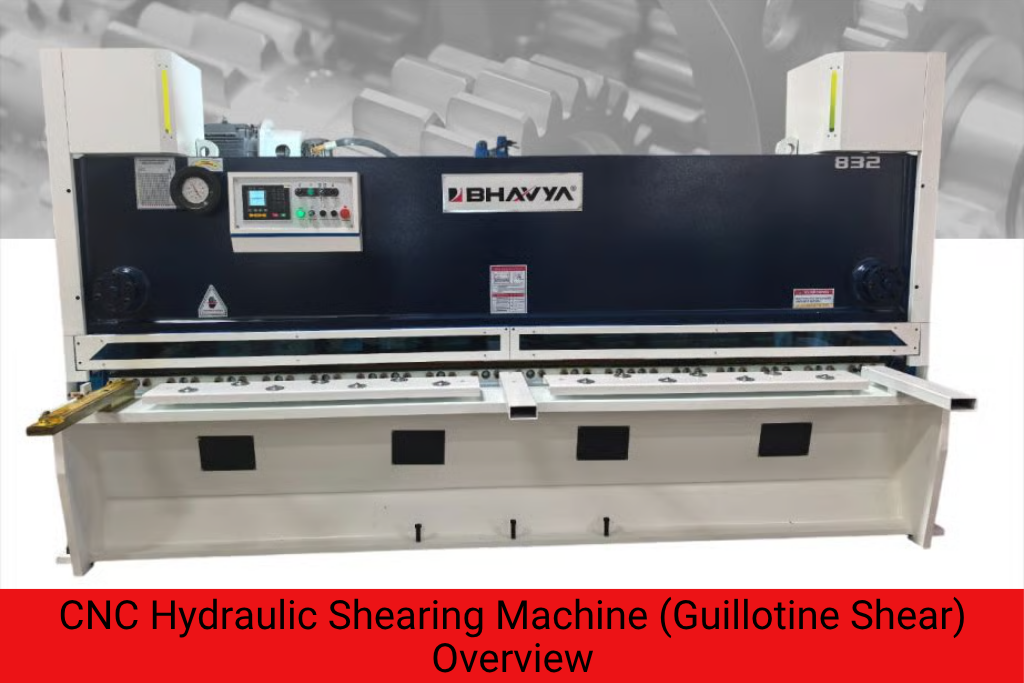
A CNC hydraulic shearing machine uses a hardened steel upper blade that descends against a fixed lower blade at a preset rake angle. The sheet is clamped by hydraulic hold-down cylinders, and the blade traverses the full sheet width in a single stroke, producing a straight cut. The CNC control manages back gauge position (X-axis), blade gap (for material thickness), and cutting sequence. Modern CNC shears make cuts in 2-4 seconds including back gauge repositioning.
CNC Fiber Laser Cutting Machine
A fiber laser machine generates a high-power laser beam from rare-earth-doped optical fibers and focuses it to a spot size of 50-200 µm. This focused beam, combined with a high-pressure assist gas (nitrogen, oxygen, or compressed air), melts and ejects material along a programmed cutting path. The cutting head moves in X-Y across a stationary sheet (or the sheet moves – depending on machine design) to produce any 2D profile: straight lines, curves, holes, slots, notches, and complex contours.
CNC Shearing Machine vs Laser Cutting: Full Comparison
Our Other Product
Bus Bar MachinesWhen to Use a CNC Shearing Machine
High-Volume Rectangular Blank Cutting
If your primary operation is cutting full sheets of mild steel, stainless steel, or aluminum into rectangular blanks for subsequent bending – a CNC shearing machine is unmatched. A modern CNC shear with a 6-axis back gauge can produce hundreds of precisely sized blanks per hour. The cost per cut is a fraction of laser cutting.
Thick Plate Cutting (Straight Lines)
For material above 6-8 mm in mild steel, a shearing machine often remains the most economical solution for straight-line cutting. Cutting thick plate with a laser requires significant power (8,000W+) and higher gas consumption. A hydraulic shear handles up to 16-25 mm mild steel at lower operating cost.
Simple Part Shapes with No Interior Cutouts
Parts that are entirely rectangular or trapezoidal – angle iron blanks, door skins, simple brackets, structural plates – are ideally produced on a shear. If there are no holes, slots, or complex contours in the part geometry, the shear is the right tool.
Speed Is the Priority
Shearing is mechanically the fastest sheet metal cutting method for straight lines. In a high-throughput operation feeding press brakes downstream, a CNC shear can keep pace with multiple press brakes simultaneously. A laser at the same throughput would require multiple cutting heads.
What Our Customers Say
“Largest Display of Machinery across India. Wide range of Machines. Very Co-operative staff. Range of Tapping Machine and Re-sharpening Machines are outstanding. Very Cost effective and useful in Precision Machining Work. Their staff is co – operative for after sales support.”
Tirth Bhojani On Google
When to Use a Fiber Laser Cutting Machine
Complex Part Geometries
If your parts have holes, slots, notches, radii, logos, text, mounting patterns, or any non-straight edge – a laser is the only practical option. No amount of secondary punching or milling can match the efficiency of cutting the complete part profile in a single laser operation. Parts like electrical enclosure blanks with punch-outs, structural brackets with clearance holes, and architectural panels are natural laser applications.
Tight Dimensional Tolerances
When parts must be cut to ±0.1 mm or tighter – for example, components that fit directly into assemblies without secondary machining – laser cutting is required. Shearing tolerances of ±0.2-0.5 mm are often insufficient for precision sheet metal assemblies.
Mixed Material and Thickness Production
A laser cutting machine processes multiple different materials and thicknesses from a single programming environment without tooling changes. Switching from 1 mm stainless to 3 mm aluminum to 6 mm mild steel requires only a parameter change in the CNC controller and a nozzle swap – often automated on high-end machines.
Prototype and Small Batch Production
For prototypes and short runs where tooling investment is not justified, laser cutting’s flexibility makes it ideal. A complex bracket that would require a custom punch die (₹50,000-₹2,00,000) can be laser cut from a DXF file on the same day with no tooling cost.
Can They Work Together? The Optimal Sheet Metal Shop Setup
Best Practice: Use Both Machines in Sequence
Many professional sheet metal shops use a CNC shear to cut full sheets into manageable blanks (reducing laser machine handling time and improving nesting efficiency), then run these blanks through the laser cutting machine for profiling. This hybrid approach maximizes throughput on both machines and minimizes material handling time.
Our Other Product
Bandsaw MachinesCost Comparison: Shearing vs Laser for Common Operations
Frequently Asked Questions on CNC Shearing Machine & Laser Cutting Machine
CNC Shearing Machine vs Laser Cutting: When to Use Each for Sheet Metal
Which is cheaper - CNC shearing machine or laser cutting machine?
CNC shearing machines have a lower purchase price (₹5-40 lakh vs ₹20 lakh-1.5 crore for lasers) and a much lower operating cost per cut for straight-line blanking. However, laser machines offer capabilities (complex shapes, holes, precision contours) that a shear simply cannot provide. The right choice depends entirely on the part geometry you need to produce.
Can a CNC shearing machine cut circles or holes?
No. A CNC shearing machine can only make straight, full-width cuts across the sheet. It cannot cut curves, circles, holes, slots, or any non-straight profile. For parts requiring internal features or non-rectangular shapes, a laser cutting machine, punching machine, or waterjet is required.
What thickness can a CNC hydraulic shearing machine cut?
Standard CNC hydraulic shearing machines in India are rated from 3 mm to 16 mm for mild steel. Heavy-duty models handle up to 25 mm mild steel. For stainless steel, deduct approximately 30-40% - a machine rated 6 mm mild steel will typically handle 3-4 mm stainless. Bhavya Machine Tools offers shearing machines from 2 mm to 12 mm capacity.
How accurate is a CNC shearing machine vs laser cutting?
A CNC shearing machine with a precision back gauge achieves positional accuracy of ±0.1-0.3 mm. A fiber laser cutting machine achieves ±0.05-0.1 mm on the cut profile, with excellent repeatability across large batches. For precision assemblies, laser cutting is the more accurate option.
Which machine is better for stainless steel cutting?
Both machines cut stainless steel, but with different trade-offs. A shearing machine cuts stainless steel blanks quickly and cheaply, though the edge has some rollover and the maximum thickness is lower than mild steel. A laser cutting machine produces a cleaner, more precise edge on stainless, handles complex shapes, and works well on thinner gauges (≤10 mm). For thin polished stainless with complex shapes, laser is clearly better.
What is the production capacity of a CNC shearing machine?
A modern CNC hydraulic shearing machine with a 6-axis back gauge can produce 200-500 back gauge repositions per hour, depending on the cutting sequence and material handling. In practical terms, for a simple blanking operation (e.g., cutting 500×500 mm blanks from a 1500×3000 mm sheet), a shear can produce 400-600 pieces per hour - far beyond what a laser can achieve for the same straight-cut operation.
Do I need both a shearing machine and a laser cutting machine in my shop?
For a general-purpose sheet metal shop handling a variety of part types, having both is ideal. The shear handles high-volume straight-line blanking efficiently and cheaply; the laser handles complex contours, holes, and precision parts. Many shops start with one and add the other as business grows. If forced to choose one: a job shop with varied complex parts should choose laser; a press brake feeding shop should choose shear first.