



AI Summary
Panel bending technology has significantly evolved in modern sheet metal fabrication. Two configurations dominate today’s precision bending landscape – the flexible panel bender and the automatic panel bender. While both serve the same fundamental purpose of shaping metal sheets, they operate on distinctly different principles, tooling logic and production philosophies. Understanding what separates these two systems helps manufacturers, fabricators and procurement teams make smarter capital investment decisions.
Flexible Panel Bender: What Makes This Configuration Truly Adaptable
A flexible panel bender is engineered to handle a wide variety of part geometries, material thicknesses and bend sequences without requiring a complete tooling changeover between jobs. The defining feature is its programmable blade and universal tooling system, which can adapt to different profiles through software-driven adjustments rather than manual retooling.
Unlike fixed-tooling setups, an automatic CNC panel bender can switch from one component profile to another within minutes. This agility is rooted in its modular blade segments, adjustable backgauges and CNC-controlled bending axes. The system reads a new part program, repositions relevant components automatically and executes the bend sequence – all with minimal operator involvement.
This configuration is particularly well-suited for job shops, contract manufacturers and production environments where batch sizes vary, part complexity is high or product changeovers are frequent. The flexibility is not just mechanical – it extends to how the machine interprets bend sequences, handles part repositioning and manages tolerance stacking across multi-bend profiles.
Bhavya Machine Tools, a well-regarded name in precision sheet metal machinery, offers flexible panel bender configurations designed to meet exactly these high-mix, low-to-medium volume demands, where tooling agility directly translates to reduced setup time and faster delivery cycles.
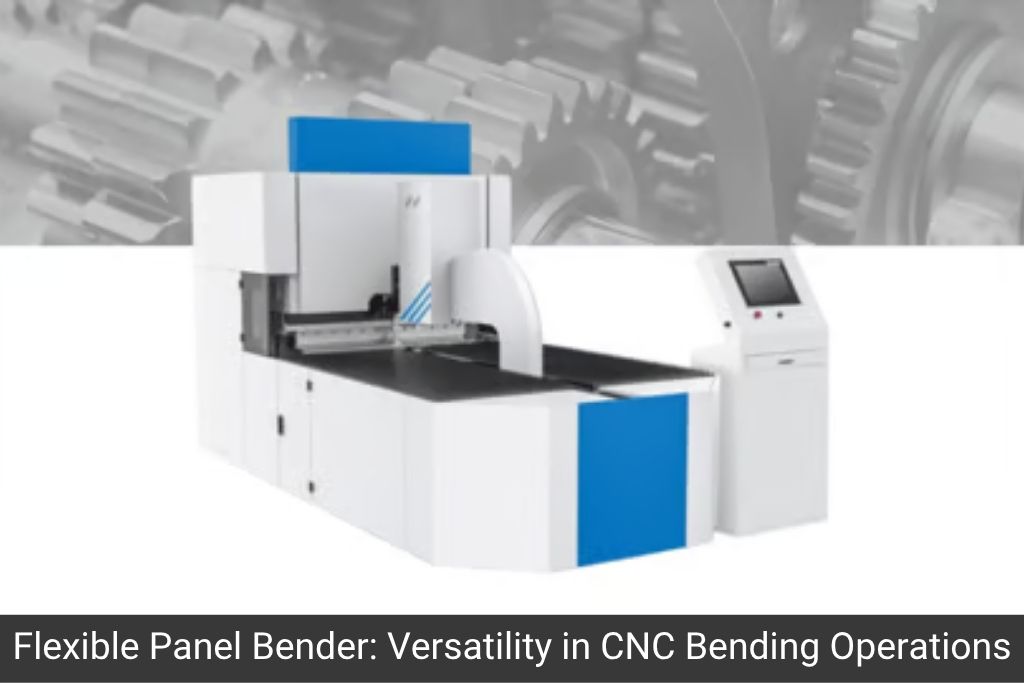
Automatic CNC Metal Sheet Panel Bender: How Fixed and Programmable Tooling Systems Differ
An automatic CNC metal sheet panel bender operates on a higher throughput principle. Here, the machine is typically optimized for a specific range of part families with defined material grades and repeat geometries. The tooling – upper and lower bending blades, clamping beams and backgauge – may be fixed or semi-fixed for a targeted production profile.
Where a flexible panel bender prioritizes changeover speed and geometry versatility, the automatic panel bender prioritizes cycle time, repeatability and uninterrupted production volume. Its programmable CNC control manages the entire bending cycle – part feeding, clamping force, bend angle correction and part extraction – with near-zero manual intervention.
The “automatic” in this context refers specifically to the machine’s ability to handle part manipulation autonomously. Integrated sheet followers, robotic part handlers or suction-cup-based feeding systems keep the panel in controlled contact throughout each bend sequence. This reduces part distortion, maintains angular accuracy and enables lights-out or semi-lights-out manufacturing.
The key structural difference between programmable tooling systems and fixed tooling lies in reconfigurability. Programmable systems store tool positions, blade pressure profiles and bend sequences in digital programs – they are recalled and re-executed at the push of a button. Fixed tooling is ground or machined to a specific profile and must be physically swapped, which takes significantly more time and skilled labor.
Flexible Panel Bender Manufacturer: What to Look for in Tooling System Design
When evaluating a flexible panel bender manufacturer, the critical differentiator is not just machine build quality – it is the intelligence embedded in the tooling architecture. A well-designed flexible bender will feature independently controlled blade segments, real-time angle measurement feedback and offline programming compatibility with standard CAD/CAM platforms.
Look for machines that support automatic tool clamping, programmable crowning systems for deflection compensation and multi-axis backgauge systems capable of handling complex part repositioning. These features directly determine how wide a range of component profiles the machine can produce without manual intervention.
Bhavya Machine Tools designs its flexible panel bender systems with these core engineering considerations embedded – particularly for environments where quick changeover and consistent angular accuracy across varied batch profiles are non-negotiable production requirements.
Our Other Product
Bandsaw MachinesAutomatic Panel Bender: Which Production Environment Benefits Most
The automatic panel bender system is best matched to production environments with high part volume, stable product lines and low geometric variability. Think elevator panels, appliance housings, HVAC enclosures or electrical cabinet doors – parts produced in large quantities with consistent dimensions and material specifications.
In these settings, the machine’s fixed or semi-fixed tooling setup pays off rapidly. Setup time is a one-time investment per product family and subsequent production runs execute at full machine speed with no changeover overhead. The economic logic is simple: when part volume is high and part variety is low, tooling rigidity becomes an asset rather than a constraint.
Conversely, flexible panel benders deliver superior ROI in job shop environments, custom fabrication facilities and industries where part designs evolve frequently – such as architecture, industrial equipment and specialty enclosure manufacturing. The ability to switch between a simple single-bend bracket and a complex multi-flange housing within the same shift makes the flexible configuration economically superior in these contexts.
What Our Customers Say
“Largest Display of Machinery across India. Wide range of Machines. Very Co-operative staff. Range of Tapping Machine and Re-sharpening Machines are outstanding. Very Cost effective and useful in Precision Machining Work. Their staff is co – operative for after sales support.”
Tirth Bhojani On Google
Programmable Tooling vs. Fixed Tooling: A Direct Comparison for Procurement Decisions
The core question for any fabrication manager evaluating these two systems is: what is the production profile over the next five years? If the answer involves increasing part variety, shorter lead times and more frequent design iterations, a flexible panel bender is the more scalable investment. If the answer involves growing volume on an established product range, an automatic CNC metal sheet panel bender with optimized fixed tooling will deliver lower per-part cost at scale.
Programmable tooling systems also offer a future-proofing advantage. As part designs change or new product lines are introduced, the machine adapts through software rather than capital reinvestment in new tooling sets. This is a material advantage in industries with accelerating design cycles.
 Email Us
Conclusion
The distinction between a flexible panel bender and an automatic panel bender ultimately comes down to how tooling is configured, how quickly it adapts and what production volume justifies each approach. Both systems rely on CNC precision and programmable control – the difference lies in the degree of tooling reconfigurability and the production environment each is engineered to serve. Companies like Bhavya Machine Tools offer configurations across both categories, ensuring fabricators can align machine capability with actual production demands rather than compromising either throughput or versatility.
Our Other Product
Bus Bar MachinesFAQs on Flexible Panel Bender & Automatic Panel Bender
Flexible Panel Bender vs. Automatic Panel Bender: Understanding the Difference
What makes a panel bender "flexible" compared to a standard automatic panel bender?
A flexible panel bender uses programmable, modular tooling that adapts to different part geometries without physical changeover, whereas a standard automatic panel bender typically uses optimized fixed tooling suited for high-volume, repeat production runs.
Automatic panel bender systems - can they handle complex multi-bend profiles efficiently?
Yes, automatic CNC metal sheet panel benders handle multi-bend profiles efficiently through stored CNC programs, but their efficiency peaks when part geometry remains consistent across large production batches rather than frequent design changes.
Flexible panel bender manufacturer selection - what technical criteria matter most?
Key criteria include independently programmable blade segments, real-time angle feedback, multi-axis backgauge control, offline CAD/CAM compatibility and the manufacturer's after-sales support capability for tooling adjustments and software updates.
How do programmable tooling systems differ from fixed tooling in terms of changeover time?
Programmable tooling systems switch between part programs in minutes through CNC recall, while fixed tooling requires physical removal, replacement and realignment - a process that can take hours and requires skilled operator involvement.
Which industries benefit most from investing in a flexible panel bender over an automatic panel bender?
Job shops, custom enclosure fabricators, architectural metalwork producers and industrial equipment manufacturers benefit most from flexible panel benders due to high part variety, short batch sizes and frequent design updates that make fixed tooling setups economically inefficient.