



AI Summary: Automatic panel bender investment decisions depend on production volume, component complexity, labour involvement, cycle time and long term manufacturing goals. Buyers evaluate automation by comparing machine investment against gains in productivity, bending accuracy, material utilisation and process consistency. ROI is calculated by measuring labour savings, cycle time reduction and output increase against payback period, helping manufacturers decide when automatic panel bending replaces manual or semi automated bending processes.
Automatic Panel Bender Overview and Investment Relevance
Manufacturers evaluating sheet metal automation often ask whether an automatic panel bender will genuinely reduce cost per component or simply add capital expense without a clear return. The right answer depends on production volume, component complexity, labour involvement and cycle time, not on treating automation as universally better than manual bending. This article explains how industrial buyers can evaluate automatic panel bender ROI using their own production data and what information Bhavya Machine Tools needs to recommend a suitable automatic panel bending solution.
What Is an Automatic Panel Bender and How Does It Work?
An automatic panel bender is a sheet metal automation system that folds flat blanks into finished panels using a programmable bending beam, automated blank loading and CNC controlled tool positioning, with little or no manual repositioning of the sheet during the bending sequence. Unlike a conventional press brake, where an operator manually loads, positions and reorients the sheet for every bend, an automatic panel bending machine follows a pre programmed bending sequence that folds multiple sides of a component in a single continuous cycle.
The core working principle involves three stages:
- Loading, where the flat blank is placed on the machine bed manually or through an automated loading system
- Bending, where a CNC controlled beam applies sequential folds according to the programmed part geometry
- Unloading, where the finished panel is removed for the next production stage
For manufacturers evaluating an automatic panel bending machine for the first time, the decision usually starts with understanding whether their current component mix, batch sizes and accuracy requirements justify a CNC panel bender over a manual or semi automated bending process. Bhavya Machine Tools works with first time automation buyers at this exact stage, helping them map their existing component drawings against the bending sequences an automatic panel bender can realistically perform, so the evaluation is based on actual part geometry rather than general assumptions about automation.
 Drop Us an Email!
Automatic Panel Bender vs CNC Press Brake: Productivity Comparison
A CNC press brake is generally more productive for low volume, highly variable component mixes, while an automatic panel bender becomes more productive as batch size, repeat production and bend count per component increase. The direct answer is that productivity crossover typically occurs once a manufacturer is producing the same or similar components repeatedly, with three or more bends per part, on a regular basis.
The table below summarises the practical differences.
|
Factor |
CNC Press Brake |
Automatic Panel Bender |
|
Operator involvement |
Continuous, every bend |
Minimal after loading |
|
Ideal batch size |
Low to medium |
Medium to high |
|
Bend repeatability |
Depends on operator skill |
Programmed and consistent |
|
Setup between parts |
Required for each new bend |
Programmed offline |
|
Best suited component |
Simple to moderate geometry |
Multi bend enclosures and panels |
Press brakes remain suitable where component geometry changes frequently and batch sizes are small, since reprogramming a panel bender for every unique part can reduce its efficiency advantage. Bhavya Machine Tools reviews a customer’s actual component drawings, bend counts and batch frequency before recommending whether a CNC panel bender or a conventional press brake based process fits their production pattern, rather than positioning automation as the default answer.
How to Calculate Automatic Panel Bender ROI
Automatic panel bender ROI is calculated by comparing the total automation investment against the combined value of labour savings, cycle time reduction and production output increase, then dividing that investment by the annual savings generated to arrive at a payback period.
The basic formula industrial buyers use is:
Payback Period (months) = Machine Investment ÷ Monthly Savings
Monthly savings are typically built from four measurable factors:
- Labour cost reduction from lower operator dependency per shift
- Cycle time reduction translated into additional components produced per shift
- Material utilisation improvement from more consistent blank nesting and reduced rework
- Rejection and rework reduction from improved bending accuracy and repeatability
Manufacturers should collect at least three months of production data, including current cycle time, labour hours per component, rejection rate and monthly volume, before running this calculation, since ROI figures based on assumed rather than actual production data are frequently inaccurate. Bhavya Machine Tools assists customers in structuring this data collection, so that the ROI figure presented internally to plant management is based on the customer’s own production numbers rather than generic industry averages.
Automatic Panel Bender Investment Cost vs Production Benefits
The direct answer is that automatic panel bender investment becomes commercially justified when the value of increased output, labour savings and reduced rejection consistently exceeds the monthly cost of financing or depreciating the machine, typically within a payback window that the manufacturer considers acceptable for capital equipment.
Production benefits that offset the investment include higher throughput per shift, reduced dependency on skilled press brake operators, more consistent component quality and the ability to run unattended or lightly attended production during part of a shift. These benefits compound over the machine’s operating life, which is why total production benefit, not just the initial purchase price, should guide the investment decision.
Manual Press Brake vs Automatic Panel Bender: Cost per Component
This comparison is often the clearest way for a manufacturer to justify or defer automation, since it converts abstract productivity claims into a per component cost figure.
|
Factor |
Manual Press Brake |
Automatic Panel Bender |
|
Labour involvement |
High, every cycle |
Low after loading |
|
Setup time per batch |
Repeated for each bend sequence |
Programmed once, reused |
|
Cycle time per component |
Higher, operator dependent |
Lower, consistent |
|
Production consistency |
Varies with operator |
Uniform across the batch |
|
Material handling |
Manual repositioning |
Reduced repositioning |
|
Component quality variation |
Possible between operators and shifts |
Minimal once programmed |
|
Cost per finished component |
Higher at large volumes |
Lower at large volumes |
At low volumes, the fixed cost of programming and machine ownership can make manual bending cheaper per component. At higher volumes, labour and consistency advantages typically shift the cost per component in favour of automatic panel bending. Bhavya Machine Tools helps customers build this cost per component comparison using their own labour rate, current cycle time and monthly volume, so the crossover point is specific to their operation rather than a general industry claim.
Automatic Panel Bender Production Speed and Cycle Time Savings
Automatic panel benders reduce cycle time primarily by eliminating the manual repositioning, measuring and alignment steps that occur between individual bends on a conventional press brake. Where a manual process may require the operator to reposition the sheet for each fold, an automatic panel bender executes the full bending sequence for a component in one programmed run.
Cycle time savings typically come from:
- Reduced loading and unloading time through consistent part handling
- Elimination of manual repositioning between bends
- Faster tool positioning through CNC controlled movement
- Reduced downtime for measuring and verifying bend angles mid production
The practical effect is not only faster individual components but more predictable shift output, since cycle time no longer depends on individual operator speed or fatigue over a shift. Bhavya Machine Tools works with production planning teams to model expected cycle time improvement against a customer’s actual component range, so the projected output increase reflects realistic bending sequences rather than best case machine specifications alone.
How Automatic Panel Bending Reduces Labour Requirements
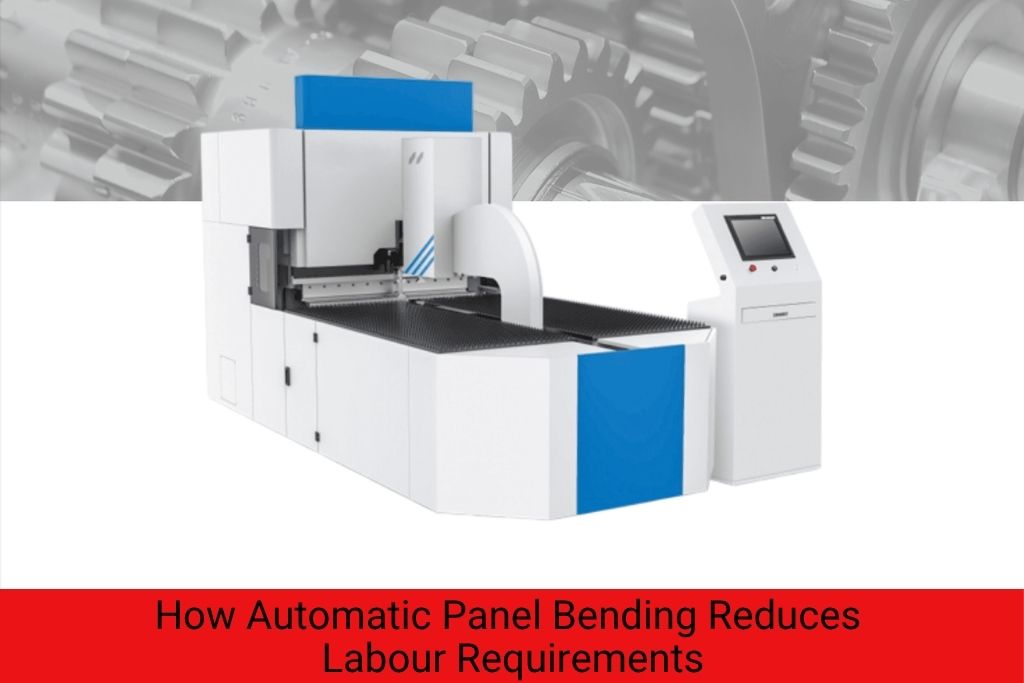
Automatic panel bending reduces labour requirements by removing the need for a skilled operator to manually control every individual bend, allowing one operator to manage loading, unloading and quality checks across a bending cycle instead of manually executing each fold.
This has three practical effects on a plant’s labour structure:
- Fewer skilled press brake operators are required per shift
- Existing operators can be reassigned to loading, inspection or other value adding tasks
- Production is less dependent on the availability of experienced bending operators, which is particularly relevant in regions facing skilled labour shortages
Labour reduction should be evaluated carefully rather than assumed automatically, since very low volume or highly variable production may still require significant operator involvement for programming and setup. Bhavya Machine Tools discusses actual shift structure and current operator allocation with customers before estimating labour savings, so the figure used in an ROI calculation reflects the customer’s real staffing pattern.
Automatic Panel Bender and Material Utilization Benefits
Automatic panel benders improve material utilisation mainly through more consistent blank sizing and reduced scrap from bending errors, since programmed bending sequences reduce the variation that leads to rejected or reworked components.
Material utilisation benefits typically include:
- Reduced scrap from mis bent or damaged components
- More predictable blank requirements for nesting and cutting operations
- Lower rework material consumption, since fewer components require correction
- Better alignment between cutting and bending departments when blank dimensions are consistently accurate
For manufacturers working with expensive sheet materials such as stainless steel or coated steel used in electrical enclosures, material savings from reduced scrap can represent a meaningful part of overall ROI, sometimes comparable to labour savings. Bhavya Machine Tools reviews a customer’s current scrap and rework rate on their existing bending process, since this figure often reveals hidden material cost that automation can directly address.
Automatic Panel Bender for High Volume Sheet Metal Production
High volume sheet metal production is the clearest use case for an automatic panel bender, since the fixed cost of machine ownership and programming is spread across a larger number of components, and consistent output becomes more valuable as volume increases.
Manufacturers running high volume production typically require:
- Predictable cycle time to meet daily or weekly output targets
- Consistent component quality across large batch sizes
- Reduced dependency on operator availability across multiple shifts
- The ability to run extended or unattended production cycles
For high volume manufacturers, an automatic panel bending machine is generally the strongest ROI case among all production profiles, since both labour savings and output increase compound at scale. Bhavya Machine Tools helps high volume manufacturers size the right automatic panel bender for their actual daily output target, rather than recommending the highest capacity machine available, since matching machine capacity to real production volume affects both investment cost and utilisation.
Automatic Panel Bender for Electrical Enclosures and Switchgear
Electrical enclosure and switchgear manufacturers are among the most common adopters of automatic panel bending, since enclosure panels typically require multiple accurate bends, consistent dimensions for door and panel fitment, and repeat production across similar enclosure sizes.
Key requirements in this segment include:
- Tight dimensional tolerance for door alignment and gasket sealing
- Repeatable bending across large production runs of similar enclosure sizes
- Clean, consistent bend lines for painted or powder coated surfaces
- Support for common enclosure materials including mild steel, galvanised steel and stainless steel
Because enclosure and switchgear components are often produced in repeat batches with limited design variation, they align closely with the strengths of automatic panel bending. Bhavya Machine Tools works with enclosure and switchgear manufacturers to evaluate common panel sizes and bend sequences from their existing product range, helping identify which automatic panel bender configuration handles their typical enclosure dimensions and material thickness.
Automatic Panel Bender for HVAC Ducts and Sheet Metal Components
HVAC duct and sheet metal component manufacturers benefit from automatic panel bending primarily through consistent seam and flange bending across long production runs, where dimensional accuracy directly affects duct assembly and airflow performance.
Typical requirements include:
- Accurate flange and seam bending for consistent duct assembly
- Handling of lighter gauge sheet metal common in HVAC applications
- Fast cycle times to support high throughput duct fabrication
- Reduced manual handling of long or large panel sections
HVAC component production often involves repetitive panel shapes with predictable bend sequences, making it a practical application for automatic panel bending once volume justifies the investment. Bhavya Machine Tools reviews typical duct panel dimensions, gauge thickness and daily output requirements with HVAC manufacturers to determine machine bed size and bending capacity suited to their production line.
Automatic Panel Bender for High Mix Manufacturing
High mix manufacturing, where a facility produces many different component types in smaller batches, presents a more mixed case for automatic panel bending than high volume production, since programming time and changeover between different part geometries can offset some of the automation advantage.
Automatic panel bending still benefits high mix manufacturers where:
- Component families share similar bend sequences even if dimensions vary
- Offline programming allows bend programs to be prepared in advance of production
- Repeat orders for the same component occur periodically, even if not continuously
- Quality consistency across variable batch sizes remains important to the customer
For high mix manufacturers, the investment decision depends heavily on how much part geometry overlap exists across the product range. Bhavya Machine Tools analyses a customer’s component library to identify how many part families share compatible bending sequences, which helps determine whether automation delivers sufficient utilisation across a high mix production schedule.
Automatic Panel Bender Tool Change and Automation Benefits
Tool change efficiency directly affects how much of an automatic panel bender’s theoretical cycle time advantage is realised in daily production, since frequent manual tool changes between different component types can reduce overall machine utilisation.
Automation benefits related to tool change include:
- Reduced manual tool changeover time through automated or simplified tooling systems
- Faster transition between component batches, supporting smaller batch sizes without large productivity loss
- Lower dependency on specialised tooling knowledge, since programmed sequences reduce setup variability
- Improved machine utilisation across a working shift when tool change time is minimised
Manufacturers evaluating an automatic panel bender should ask specifically about tool change time for their typical component range, since this factor significantly affects real world cycle time compared to published machine specifications. Bhavya Machine Tools provides customers with realistic tool change and changeover time estimates based on their actual component mix, rather than quoting only best case cycle figures.
Automatic Panel Bender Accuracy, Repeatability and Quality Benefits
Automatic panel benders improve bending accuracy and repeatability primarily because bend angle, bend sequence and sheet positioning are controlled by CNC programming rather than manual operator judgement, which reduces the variation that typically occurs across different operators and shifts.
Quality benefits include:
- Consistent bend angles across every component in a production run
- Reduced dimensional variation between components produced on different shifts
- Fewer rejected or reworked parts due to operator inconsistency
- Better downstream assembly fit, particularly for enclosures, panels and structural components
Repeatability becomes increasingly valuable as component tolerance requirements tighten or as downstream assembly processes depend on consistent panel dimensions. Bhavya Machine Tools discusses specific tolerance requirements and current rejection rates with customers, since components with tighter tolerance expectations often show the clearest accuracy driven ROI from automatic panel bending.
Automatic Panel Bender Total Cost of Ownership
Total cost of ownership for an automatic panel bender includes the initial machine investment, installation, operator training, tooling, ongoing maintenance, spare parts availability and expected machine lifespan, not only the upfront purchase price.
Manufacturers should evaluate total cost of ownership across these factors:
- Machine investment and any financing or leasing cost
- Installation and commissioning requirements
- Operator and programmer training
- Scheduled maintenance and expected service intervals
- Spare parts availability and typical response time
- Expected productive lifespan of the machine under the manufacturer’s production conditions
A lower upfront machine cost does not always translate to lower total cost of ownership if maintenance support or spare parts availability is limited over the machine’s operating life. Bhavya Machine Tools provides customers with maintenance support and technical service planning as part of the purchase evaluation, so the long term cost of keeping the automatic panel bender running is considered alongside the initial investment.
When Should a Manufacturer Invest in an Automatic Panel Bender?
A manufacturer should invest in an automatic panel bender when production volume, repeat component demand and labour cost pressures are high enough that automation savings clearly exceed machine investment within an acceptable payback period, typically supported by consistent batch production rather than one off or highly variable orders.
Practical indicators that automation investment is justified include:
- Consistent repeat production of similar components
- Rising labour cost or difficulty finding skilled bending operators
- Increasing rejection rates from manual bending inconsistency
- Growing production volume that current manual capacity cannot support
- Customer or export quality requirements demanding tighter dimensional consistency
Conversely, manufacturers with highly variable, low volume or prototype heavy production may find that a CNC press brake remains more cost effective until volume and repeatability increase. Bhavya Machine Tools conducts a production profile review with prospective customers, examining volume, component variety and labour structure together, to give an honest recommendation on whether automation timing is right for their current operation.
Automatic Panel Bender ROI Example: Manual vs Automated Production
The following example illustrates how a manufacturer might evaluate automatic panel bender ROI using their own production figures.
Assume a manufacturer currently produces 4,000 panels per month using manual bending, with the following baseline figures:
- Current manual production cost: 250 per panel, including labour and rejection allowance
- Manual cycle time: 6 minutes per panel, requiring two operators per shift
- Automated production cost: 170 per panel, after accounting for reduced labour and lower rejection
- Automated cycle time: 3.5 minutes per panel, requiring one operator per shift
- Labour savings: equivalent to one operator per shift redeployed to other tasks
- Cycle time improvement: approximately 40 percent faster per panel
- Production increase: capacity to produce up to 6,000 panels per month within the same shift structure
- Machine investment: assumed at a representative capital cost for illustration purposes only
Using these figures, monthly savings equal the cost difference per panel multiplied by monthly volume, which in this example is 80 per panel multiplied by 4,000 panels, giving 320,000 in monthly savings before accounting for any production increase.
Payback period is then calculated as machine investment divided by monthly savings. If, for illustration, the investment were represented as a multiple of monthly savings, a manufacturer could estimate payback in a small number of months once actual investment cost is applied to this formula.
Practical interpretation: the manufacturer should apply their own actual manual production cost, labour rate and rejection rate to this same structure, since actual payback period depends entirely on real production data rather than assumed figures. Bhavya Machine Tools assists customers in running this exact calculation using their verified production numbers, rather than providing generic payback claims, since an ROI figure is only useful to plant management when it reflects the customer’s own operating cost.
Automatic Panel Bender Buying Guide for Industrial Manufacturers
Selecting the right automatic panel bender requires matching machine capability to actual production requirements rather than choosing based on maximum available specification. Buyers should evaluate machine bed size, maximum sheet thickness, bending force, automation level and tooling flexibility against their real component range.
Before evaluating an automatic panel bending machine, manufacturers should prepare the following information:
- Typical component dimensions and bend sequences
- Sheet material and thickness range used in production
- Current monthly or annual production quantity
- Current bending process, whether manual, semi automated or CNC press brake based
- Required dimensional accuracy and tolerance expectations
- Automation goals, including whether unattended or lightly attended operation is required
- Expected future production volume or component range changes
Providing this information allows an accurate machine recommendation rather than a generic quotation. Bhavya Machine Tools works directly with buyers to collect these production details before recommending a specific automatic panel bender configuration, ensuring the machine bed size, tooling and automation level match the customer’s actual component range rather than a standard default specification.
Automatic Panel Bender Investment: Final Considerations
Automatic panel bender ROI depends on matching machine capability to actual production volume, component range, labour cost and accuracy requirements, not on assuming automation suits every manufacturer. Buyers who evaluate their current bending process against real cycle time, rejection rate and labour figures are better placed to judge when investment pays for itself. Bhavya Machine Tools works with manufacturers and export oriented production units to review this data and recommend an automatic panel bending solution suited to their requirements.
Automatic Panel Bender FAQs for Global Buyers
What is an automatic panel bender used for?
An automatic panel bender is used to fold flat sheet metal blanks into finished panels through a programmed CNC controlled bending sequence, commonly for enclosures, HVAC components and structural sheet metal parts requiring multiple accurate bends.
How much does an automatic panel bender cost compared to a CNC press brake?
Automatic panel benders generally involve a higher initial investment than a CNC press brake, since they include automated bending and handling systems, but they can lower cost per component at higher production volumes due to reduced labour and cycle time.
How is automatic panel bender ROI calculated?
ROI is calculated by comparing machine investment against combined savings from reduced labour cost, faster cycle time, lower material waste and reduced rejection, then dividing investment by monthly savings to determine payback period.
When does automatic panel bender investment pay for itself?
Payback timing depends on production volume, labour cost and current rejection rate, and generally shortens as batch size and repeat production increase
Which industries commonly use automatic panel bending machines?
Electrical enclosure manufacturers, switchgear manufacturers, HVAC component producers, automotive component suppliers and general sheet metal fabrication companies commonly use automatic panel bending machines.
How many bends per component justify automatic panel bending over manual bending?
Components requiring three or more bends, produced in repeat batches, generally show stronger productivity gains from automatic panel bending compared to manual or CNC press brake processes.
Who should consider a manual press brake instead of an automatic panel bender?
Manufacturers with low production volume, highly variable component designs or frequent prototype work may find a CNC press brake more cost effective until volume and repeatability increase.
How does automatic panel bending improve production consistency?
Because bending sequences are CNC programmed rather than manually executed, automatic panel bending reduces variation between operators and shifts, improving dimensional consistency across production runs.
What information should a manufacturer provide before selecting an automatic panel bender?
Manufacturers should share component dimensions, sheet thickness, material type, current production quantity, existing bending process and required accuracy so a suitable automatic panel bending machine can be recommended.
Where can Indian and export oriented manufacturers source an automatic panel bender?
Manufacturers can evaluate automatic panel bender options from established panel bender manufacturers such as Bhavya Machine Tools, which supports both domestic Indian production requirements and export oriented manufacturing units.
How much labour saving can automatic panel bending typically provide?
Labour savings vary by operation, but manufacturers commonly reduce operator involvement per shift since one operator can manage loading, unloading and quality checks instead of manually executing every bend.
Whose production process benefits most from CNC panel bender automation?
Manufacturers with consistent, repeat batch production of similar components, such as electrical enclosures, HVAC panels and structural sheet metal parts, typically benefit most from CNC panel bender automation.