



AI Summary
- Automatic panel benders excel at high-volume, repetitive bending of large, flat panels with no operator skill dependency.
- CNC press brakes are more versatile – they handle complex profiles, small batches, and a far wider range of tooling geometries.
- Panel benders have a higher upfront cost but lower labour cost per part; press brakes have lower entry cost with higher flexibility.
- For most job shops and fabricators, a CNC press brake is the right starting machine; panel benders suit dedicated production lines.
- Bhavya Machine Tools supplies CNC hydraulic and electric press brakes suitable for Indian SME fabricators.
Introduction
If you run a sheet metal fabrication shop, you’ve almost certainly wrestled with this question: should I invest in an automatic panel bender or a CNC press brake? Both machines bend sheet metal. Both are CNC-controlled. But their design philosophy, ideal use case, cost structure, and return on investment differ substantially.
This article provides a detailed, application-based comparison to help you make the right capital equipment decision for your shop. We’ll cover machine working principles, production metrics, material compatibility, total cost of ownership, and scenarios where each machine wins.
How Each Machine Works
CNC Press Brake
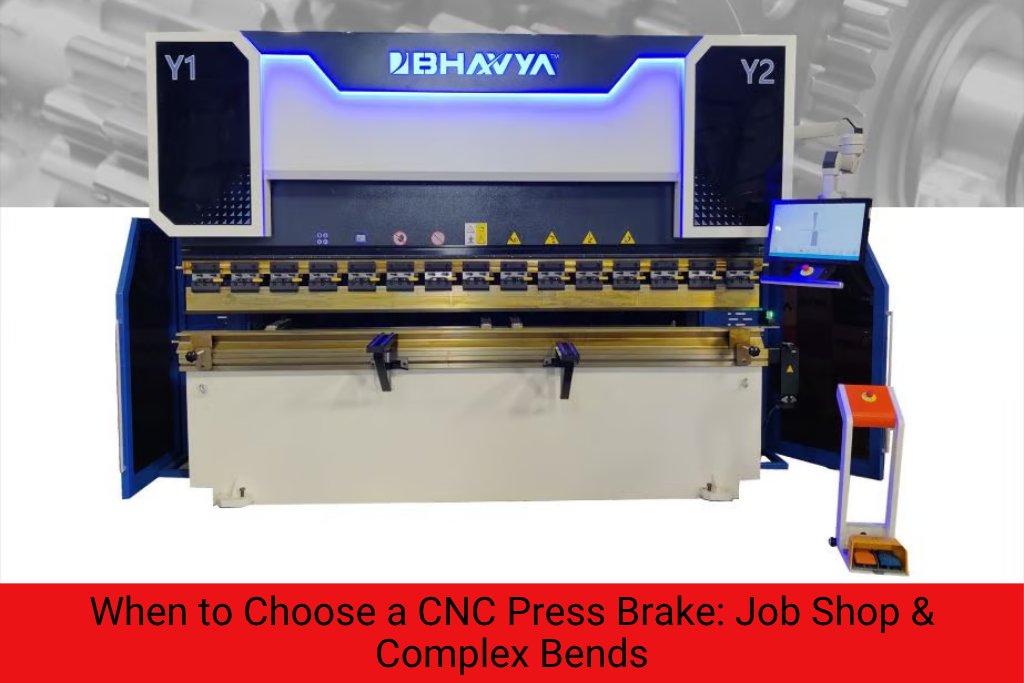
A CNC press brake uses a top tool (punch) that descends into a bottom tool (die) to bend sheet metal along a straight line. The operator or a robot positions the sheet against back gauges (CNC-controlled fingers that set the bend position). The bend angle is controlled by the depth of punch penetration into the die. Modern CNC press brakes use multi-axis back gauge systems, crowning compensation, and angle measurement sensors to achieve consistent results.
Automatic Panel Bender
A panel bender works differently. The sheet is loaded onto a work table and clamped. A bending tool – often a universal blade set – moves around the stationary sheet to execute upper and lower bends sequentially. The sheet does not need to be manually repositioned between bends. This makes panel benders extremely fast for multi-bend flat panels (enclosures, doors, cabinets) because a human operator’s repositioning skill is entirely removed from the process.
Read Our Article
CNC Press Brake Programming: Step-by-Step Guide for OperatorsHead-to-Head Comparison Table
When to Choose a CNC Press Brake
Job Shop and Contract Fabrication
If your shop runs a wide variety of part geometries, materials, and batch sizes – a CNC press brake is the correct choice. With a well-stocked tool library (standard V-dies, hemming tools, radius tooling, box-and-pan sets), a CNC press brake can handle virtually any bend profile. Quick-change tooling systems reduce changeover to under 5 minutes on modern machines.
Complex Profiles and Special Bends
Parts with acute angles (below 30°), very tight inside radii, hemming, or multiple bends on a short flange require specific tooling profiles that a press brake can accommodate. Panel benders use a universal blade approach that, while efficient, cannot execute every geometry a custom punch-and-die set can.
Our Other Product
CNC Panel Bender – Pressure Arm TypeThick Material Bending
Press brakes – particularly hydraulic or servo-hydraulic models – are rated for significant bending force, making them suitable for structural steel plate (up to 15-25 mm mild steel is common). Panel benders are primarily designed for thin-to-medium gauge sheet (typically up to 3-4 mm).
Lower Capital Budget
A quality CNC hydraulic press brake starts at approximately ₹8-15 lakh in India. This makes it accessible for small and mid-sized fabricators. An automatic panel bender represents a significantly higher investment with more specific production requirements to justify the spend.
What Our Customers Say
“Largest Display of Machinery across India. Wide range of Machines. Very Co-operative staff. Range of Tapping Machine and Re-sharpening Machines are outstanding. Very Cost effective and useful in Precision Machining Work. Their staff is co – operative for after sales support.”
Tirth Bhojani On Google
When to Choose an Automatic Panel Bender
High-Volume Panel Production
If your shop manufactures thousands of identical or near-identical enclosures, electrical panels, HVAC components, elevator cab panels, or architectural facades per month, a panel bender pays for itself rapidly. At 3-8 seconds per bend with no operator repositioning, cycle time savings compound dramatically over large volumes.
Labour Cost Reduction
Panel benders reduce dependency on skilled press brake operators – a growing concern in India’s manufacturing sector where experienced press brake benders are increasingly difficult to hire and retain. A single operator can load and unload a panel bender while the machine runs the bend sequence autonomously.
 Email Us Now!
Consistent Repeatability
In products like electrical switchgear enclosures or server rack cabinets, dimensional consistency across thousands of parts is non-negotiable. Automatic panel benders eliminate the operator-induced variability that even skilled press brake operators introduce, producing Cpk values (process capability) consistently above 1.67.
Total Cost of Ownership Analysis
Material Compatibility
- CNC Press Brake: Mild steel, stainless steel, aluminum, copper, brass, high-strength steel – all gauges up to machine tonnage limits.
- Panel Bender: Best suited for mild steel 0.5-3 mm, stainless steel 0.5-2 mm, aluminum 0.5-3 mm. Less effective on harder alloys or thick plate.
Our Other Product
All Electric Bending Machine (Servo Press Brake)Frequently Asked Questions on Automatic Panel Bender & CNC Press Brake
Automatic Panel Bender vs CNC Press Brake: Which Machine Should You Buy?
Can a CNC press brake replace a panel bender?
For most job shop applications, yes - a CNC press brake with the right tooling can produce the same parts as a panel bender. The difference is speed and consistency at high volumes. For dedicated production of thousands of identical enclosures per month, a panel bender is more efficient.
Which machine is better for a small fabrication shop in India?
A CNC press brake is the better choice for small fabrication shops. It offers versatility across different parts and materials, has a lower entry cost, and does not require a dedicated production line to justify the investment.
How much tonnage do I need in a CNC press brake?
Required tonnage depends on material thickness, tensile strength, and bend length. A rule of thumb: for mild steel, multiply the bending length (mm) × sheet thickness² × 6 / die opening. Common capacities for Indian shops are 80T/2500mm, 160T/4000mm, and 250T/6000mm.
Is a servo-electric press brake better than hydraulic?
Servo-electric press brakes offer higher energy efficiency (up to 50% less power), better repeatability, and faster ram speeds. Hydraulic machines offer higher tonnage at lower cost and are more forgiving for heavy-gauge bending. For precision sheet metal (thin gauge), electric is often preferred; for structural bending, hydraulic or servo-hydraulic is standard.
What materials can a CNC press brake not bend?
Standard CNC press brakes cannot bend materials that are too brittle (cast iron, hardened tool steel) or too soft without surface damage (pure copper foil). Very hard high-strength steels (above 1,200 MPa) require specialized high-tonnage machines with wear-resistant tooling.