



AI Summary
- Regular lathe maintenance directly impacts part accuracy, surface finish quality, and machine lifespan.
- Daily tasks include way lubrication, chip removal, coolant level check, and spindle warm-up.
- Weekly tasks include gearbox oil level inspection, chuck jaw cleaning, and tailstock alignment check.
- Monthly tasks include belt tension inspection, headstock oil change intervals, and full geometric accuracy checks.
- Proper lubrication alone can extend lathe machine life by 3-5 years and prevent 60-70% of common breakdowns.
Introduction: Why Lathe Machine Maintenance Cannot Be Optional
A lathe machine is the backbone of any precision machining operation. Whether it’s a conventional engine lathe or a CNC turning centre, neglecting maintenance leads to a predictable chain of consequences: worn bed ways, deteriorated spindle bearings, inaccurate headstock alignment – and eventually costly downtime that far exceeds what scheduled maintenance would have cost.
According to maintenance engineering studies, over 70% of machine tool failures are predictable and preventable through systematic preventive maintenance (PM). For lathe machines specifically, the critical wear points – bed ways, spindle bearings, gearbox, cross-slide – all have clear inspection intervals and lubrication requirements that, when followed, dramatically extend machine life and preserve geometric accuracy.
This guide provides a comprehensive, practitioner-level maintenance checklist for lathe machines – organized by daily, weekly, monthly, and annual intervals – along with lubrication specifications, common fault diagnosis, and tips from experienced machinists.
Understanding Lathe Machine Components and Their Wear Mechanisms
- Bed Ways: The precision-ground guideways along which the carriage travels. Wear from chips, abrasive particles, and inadequate lubrication causes loss of straightness and affects turned diameter accuracy.
- Headstock and Spindle: Houses the main bearings and drive gear train. Spindle bearing wear manifests as vibration, noise, and loss of roundness on turned parts.
- Carriage (Saddle): The cross-slide and compound rest assembly. Gibs (adjustable wear strips) need periodic tightening to eliminate play.
- Tailstock: Must be precisely aligned with the spindle axis. Drift causes taper error on long turned workpieces.
- Chuck and Faceplate: 3-jaw and 4-jaw chucks accumulate chips in the scroll mechanism, causing runout if not cleaned.
- Lead Screw and Feed Rod: Thread engagement wear affects thread cutting accuracy; oil contamination causes slipping.
- Coolant System: Bacterial growth in coolant causes tool life reduction and health hazards; must be managed chemically.
Read Our Article
Lathe Machine Applications in the Oil & Gas IndustryDaily Lathe Machine Maintenance Checklist
Time Required: 10-20 minutes per shift
Perform at the start of each shift before production begins, and a quick check at shift end.
Before Starting the Machine
- Visual inspection – check for any loose covers, damaged guards, or overnight chip accumulation on the bed.
- Lubricate the bed ways – apply way oil (ISO VG 68 slideway oil is standard) using an oil can along the full length of both flat and Vee ways.
- Check coolant level in the reservoir – top up to the marked level with the correct water-miscible coolant mix (typically 8-10% concentration).
- Inspect the chuck – remove any chips lodged between jaws; check for visible jaw cracks or damage.
- Check that all guards and shields are in place and functional.
- Verify the tool post and cutting tools are correctly clamped.
After Starting – Warm-Up Routine
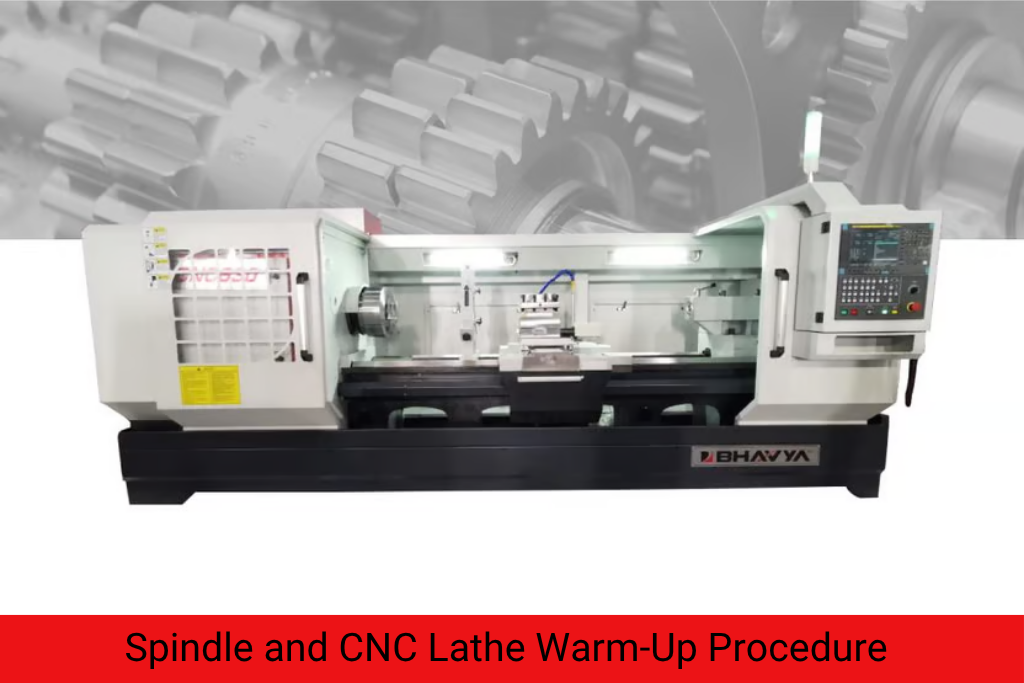
- Run the spindle at low speed (100-200 RPM) for 3-5 minutes to allow spindle bearing and gearbox oil to circulate and reach operating temperature. On CNC lathes, execute the warm-up program.
- Engage the automatic feed in all axes briefly to verify smooth, noise-free movement.
- Check coolant pump operation – confirm flow to the cutting zone.
- Listen for any unusual sounds – grinding, rattling, or rhythmic noise from the spindle or gearbox indicates a problem.
End of Shift
- Remove all chips from the bed, cross-slide, and chip tray. Use a brush – never compressed air (blows chips into bearings).
- Wipe down the bed ways with a clean cloth and apply a thin film of way oil to prevent rust overnight.
- Turn off the coolant pump and allow it to drain back to the reservoir.
- Leave the spindle in neutral; ensure the chuck is not under residual clamping load.
- Log any unusual observations in the machine maintenance logbook.
Our Other Product
V-Belt Drive Lathe MachineWeekly Lathe Machine Maintenance Checklist
Time Required: 30-60 minutes
Best performed at the start of the week or during a planned production break.
- Gearbox oil level – check the headstock gearbox oil sight glass. Top up with the manufacturer-specified gear oil (typically ISO VG 150 or 220 gear oil). Do not mix grades.
- Apron oil level – check and top up the apron (saddle) oil reservoir. This lubricates the feed mechanism, lead screw nut, and rack engagement.
- Chuck jaw cleaning – remove the chuck from the spindle, disassemble the jaws, clean the scroll plate and jaw serrations with solvent, dry, and regrease with molybdenum disulfide grease or white lithium grease.
- Tailstock alignment check – mount a precision test bar between centres and check with a dial indicator along the length. Adjust the tailstock offset screw if taper is detected. Acceptable: <0.02 mm over 200 mm.
- Cross-slide and compound gib adjustment – check for play in the cross-slide by pushing/pulling the slide while holding the handwheel stationary. Tighten the gib screws (located on the side of the slide) until play is just eliminated without restricting smooth movement.
- Way lubrication system check (if equipped with auto-lube) – verify that the oil pump actuates correctly and that all way oil outlets show delivery.
- Belt inspection (if belt-drive model) – check V-belt tension and condition. A correctly tensioned belt deflects 10-15 mm under moderate finger pressure at mid-span.
- Coolant concentration check – use a refractometer to verify coolant concentration is within the 8-10% range. Adjust by adding concentrate or water as needed. Check for unusual smell (bacterial contamination).
Monthly Lathe Machine Maintenance Checklist
Time Required: 2-4 hours
Schedule during a planned maintenance window – ideally on a non-production shift.
- Full geometric accuracy check – use a precision level, test bar, and dial indicator to verify: (a) bed levelness (≤0.02 mm/m), (b) headstock spindle alignment to bed (≤0.01 mm over 150 mm), (c) tailstock alignment, (d) cross-slide perpendicularity to spindle axis.
- Spindle runout measurement – mount a precision test mandrel in the spindle and measure radial runout with a 0.001 mm dial indicator. Acceptable: ≤0.005 mm for finish turning; investigate if >0.010 mm.
- Headstock oil change (check interval) – most manufacturers specify oil change every 1,000-2,000 hours or 6-12 months. Drain, flush, and refill with fresh ISO VG 68 or VG 46 spindle oil as specified.
- Electrical inspection – check all limit switch functions, emergency stop response, and verify that all interlocks are operational. Clean the electrical cabinet interior (compressed air with machine off and isolated).
- Lead screw inspection – clean the lead screw along its full length, inspect thread form for wear or damage, re-lubricate with thin machine oil.
- Chuck runout check – mount a precision steel test bar in the 3-jaw chuck and measure runout. A new 3-jaw chuck should show <0.05 mm; if runout exceeds 0.15 mm, the scroll or jaws require replacement.
- Coolant tank cleaning – drain the coolant tank, remove tramp oil (floating oil from the machine), scrub tank interior, and refill with fresh coolant mix.
 Email!
Lathe Machine Lubrication Quick Reference Chart
What Our Customers Say
“Our production speed has improved ever since we got a Bhavya machine. It’s smooth, durable, and works exactly as promised.”
Arti Mishra On Google
Common Lathe Problems and Their Maintenance Causes
Our Other Product
All Geared Lathe MachineFrequently Asked Questions on Lathe Machine
How to Maintain a Lathe Machine: Daily, Weekly & Monthly Checklist
How often should I lubricate a lathe machine?
The bed ways should be lubricated daily (each shift start) with ISO VG 68 slideway oil. The gearbox and apron oil levels should be checked weekly. Full oil changes in the headstock gearbox are typically required every 1,000-2,000 operating hours, or at intervals specified by the manufacturer (commonly every 6-12 months).
What oil is used for lathe machine bed ways?
The standard lubricant for lathe bed ways (flat and Vee guideways) is ISO VG 68 slideway oil. This oil contains anti-stick-slip additives (tackifiers) that prevent the carriage from juddering during slow, precise feed movements - a property not found in standard machine oil.
How do I check lathe spindle runout?
Mount a precision test mandrel (ground to h5 or h6 tolerance) in the spindle taper or chuck. Position a 0.001 mm resolution dial indicator against the mandrel near the spindle nose, and rotate the spindle by hand. The total indicator reading (TIR) is the runout. For general-purpose turning, ≤0.010 mm is acceptable; for precision work, aim for ≤0.005 mm.
How do I adjust the gib strips on a lathe cross-slide?
The gib is a tapered bronze or cast iron strip that runs in the dovetail slide. To adjust: slacken the gib lock screws slightly, then tighten the gib adjusting screw until the slide moves smoothly without detectable play when you try to rock it. Test by moving the cross-slide through its full travel - it should feel consistent throughout. Over-tightening causes premature wear.
What are the signs that lathe spindle bearings need replacement?
Symptoms of worn spindle bearings include: audible rumbling or grinding noise during spindle rotation, excessive heat at the headstock (above 60°C), vibration visible on the workpiece surface, and increased radial runout when measured at the spindle nose. Do not delay bearing replacement - bearing failure causes secondary damage to the headstock housing.
How do I prevent rust on lathe bed ways?
Apply a thin film of way oil or rust-preventive oil (such as Castrol Rustilo or equivalent) to the ways at end of shift. In humid environments, use a way oil with corrosion inhibitors. Never leave bare metal ways exposed overnight in a humid workshop. A PVC way cover greatly reduces contamination and rust risk.
How often should I clean the lathe coolant tank?
Clean the coolant tank completely every 1-3 months, depending on usage intensity. Drain the coolant, remove tramp oil (which floats on the surface and feeds bacteria), scrub the tank with a cleaning solution, rinse, and refill with freshly mixed coolant to the correct concentration (verify with a refractometer). Change coolant more frequently if you notice a foul smell.