



AI Summary: Operating a lathe safely depends on four core areas: personal protective equipment, correct workpiece securing, controlled chip management and reliable emergency stop procedures. This article lists 15 practical rules operators must follow before, during and after machining, covering PPE selection, chuck and tailstock checks, swarf disposal and E-stop readiness. Shop supervisors and buyers sourcing a lathe machine for its facility, will also find guidance on matching machine class to operator safety needs.
Why Does Lathe Machine Safety Depend on More Than Just PPE?
Lathe safety is often reduced to “wear goggles and gloves,” but a lathe involves rotating chucks, exposed workpieces, moving carriages and continuous chip discharge – each carrying a distinct risk. A single missed step, such as an unlocked chuck key or a loose sleeve near the spindle, can cause injury within seconds. The 15 rules below are grouped into four categories so operators and floor supervisors can build a complete safety routine rather than treating precautions as a checklist to skim. Whether the shop runs a single unit or a full production line, the same underlying logic applies: risk grows wherever human attention and rotating mass meet and each rule exists to close one specific gap in that overlap.
Lathe Machinesfor PPE: What Should Operators Wear Before Starting?
- Wear close-fitting work clothing: Loose sleeves, unbuttoned cuffs or dangling drawstrings can catch on a rotating chuck or leadscrew within a fraction of a second. Coveralls should sit snug at the wrists and any apron ties should be tucked in rather than left hanging at the front.
- Use impact-rated safety glasses or a face shield: Turning operations throw off metal chips and coolant spray at speed, often in directions the operator does not expect from a fresh cutting edge. Standard eyewear does not stop high-velocity fragments; ANSI or IS-rated impact glasses are the minimum standard and a face shield adds a further layer during interrupted or roughing cuts.
- Tie back long hair and remove jewellery: Rings, bracelets and loose hair are common causes of entanglement injuries on rotating spindles and even a short strand caught near the chuck can pull an operator toward the machine before there is time to react.
- Wear steel-toe footwear, never gloves near the spindle: Gloves feel protective but are dangerous around rotating chucks, as fabric can wrap around the workpiece and drag the hand in along with it. Footwear should protect against dropped tooling and hot swarf instead, with a sole that resists oil and coolant slip on the shop floor.
- Use hearing protection on medium and heavy duty lathe machine setups: Larger spindle motors and longer bar stock generate sustained noise levels that justify earplugs or earmuffs during extended shifts and hearing checks should be part of periodic operator health reviews on shop floors running these machines continuously.
Vertical Lathe Machine on Workpiece Securing: How Should It Be Done Safely?
- Confirm chuck jaws grip the correct diameter and depth: Under-gripped stock can be flung out during high-speed turning and even a slight mismatch between jaw reach and workpiece diameter reduces clamping force far more than operators expect. Always match jaw reach to the workpiece, inspect jaw wear periodically and replace worn jaw sets rather than compensating with extra torque on the chuck key.
- Remove the chuck key immediately after tightening: A chuck key left in place becomes a projectile the instant the spindle rotates – this is one of the most preventable vertical lathe machine accidents on record and many shops now use self-ejecting or spring-loaded keys specifically to remove this risk from the operator’s memory.
- Support long or slender stock with a steady rest or tailstock centre: Unsupported bar stock beyond a safe length-to-diameter ratio can whip or deflect under cutting force, especially on a light duty lathe machine with a smaller bed and shorter distance between centres.
- Check for balanced clamping on irregular or offset workpieces: Uneven clamping pressure can cause vibration, tool chatter or the workpiece slipping mid-cut and irregular castings or forgings are especially prone to this because their centre of mass rarely aligns with the chuck’s geometric centre. Where possible, use a dial indicator to confirm runout before engaging the feed.
- Test-rotate the chuck by hand before powering on: A quick manual rotation confirms there is no interference with the tool post, tailstock or bed before the motor engages.
Light Duty Lathe Machine with Chip Management: What Are the Best Practices?
- Never clear chips by hand while the spindle is running: Use a chip hook, brush or compressed air (where permitted) after the machine has fully stopped. Hand contact with fresh swarf is a leading cause of cuts on shop floors.
- Keep the chip pan and coolant tray clear during operation: Accumulated swarf near the chuck can catch on rotating parts or contaminate coolant flow, affecting both safety and finish quality; a build-up under the carriage can also interfere with smooth traverse and cause the tool to dig in unexpectedly.
- Direct chip flow away from the operator’s stance: Continuous or stringy chips, common in ductile materials such as mild steel and aluminium, should be broken using proper tool geometry – a chip breaker groove or the correct feed rate – rather than allowed to coil toward the operator, where a single strand can wrap around a wrist in an instant.
Lathe Machines Emergency Stop: What Procedures Should Every Operator Know?
- Know the exact location and function of the E-stop before starting work: Every operator should be able to reach the emergency stop without looking, regardless of the turret lathe machine’s size or duty class and this reflex should be built into training from the very first supervised session.
- Practice a full stop-lockout-tagout sequence periodically: Hitting the E-stop should be followed by isolating power at the mains before any adjustment, jam clearance or tooling change – never rely on the E-stop alone as a maintenance switch.
How Does Heavy Duty Lathe Machine Affect Safety Requirements?
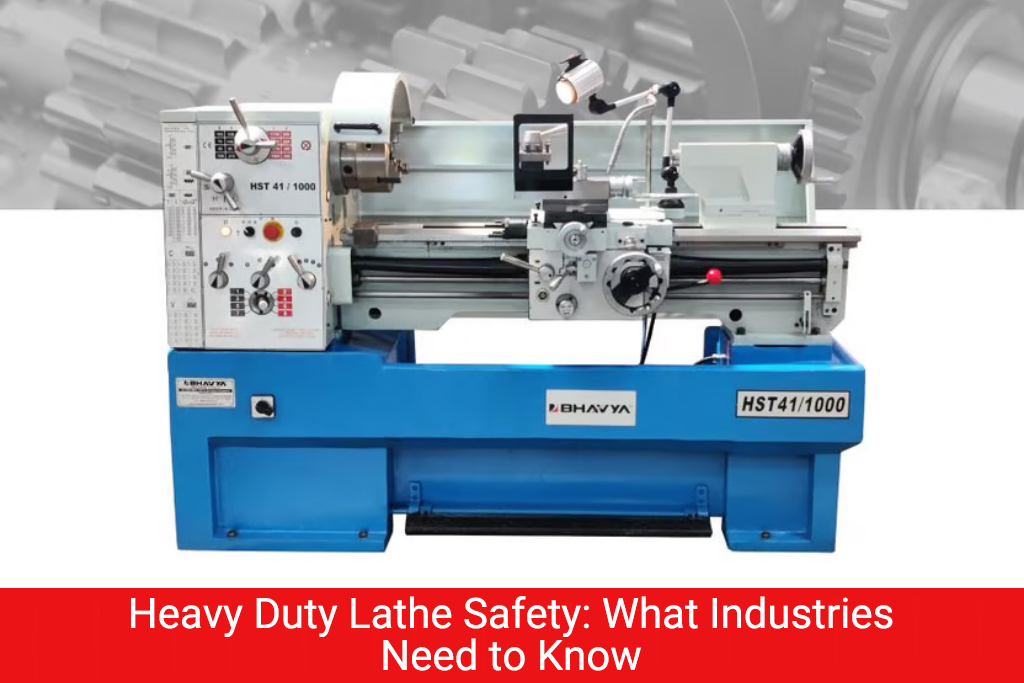
Safety requirements shift depending on machine class. A lighter unit used for small-diameter precision work has lower torque and inertia, but its smaller footprint means operators work closer to the chuck, so hand placement matters more than raw power. A medium duty lathe machine used in general job-shop turning carries higher spindle torque, demanding stricter tailstock support checks before every cut. A heavier unit handling large-diameter shafts or long bar stock generates greater rotational mass, so guard interlocks, chip shields and E-stop response time matter even more than on smaller equipment. Buyers comparing lathe machine price against safety features should treat interlocked chucks, chip guards and two-hand start controls as non-negotiable, not optional add-ons, regardless of which duty class fits their production volume.
Our Other Product
Slotting MachinesLathe Machine Operator Training: How Should New Operators Learn Safety?
New operators should be walked through a supervised sequence: locating the E-stop and isolation switch, identifying chuck and tailstock controls, practising a dry run without power and only then progressing to supervised cutting passes under direct observation. Training records should confirm the operator has demonstrated each of the 15 rules above, not just read or heard them explained once. Facilities working with multiple lathe machine suppliers often standardise this checklist across brands so operators moving between machines of different duty classes follow the same core safety sequence regardless of size, age or manufacturer.
 Email!
Bhavya Machine Tools: A Lathe Machine Manufacturer & Supplier in India
Bhavya Machine Tools is a lathe machine manufacturer based in Ahmedabad, supplying precision engineering machine tools to industrial clients across India and internationally, including an office in Dubai for its overseas operations, reflecting its stand among established lathe machine suppliers in India.
Conclusion
Lathe machine safety is not a single checklist item but a continuous discipline covering PPE, workpiece securing, chip control and emergency response. Operators who internalise these 15 rules reduce the most common causes of shop-floor injury, regardless of the duty class or size of the machine they are running. Facilities sourcing new equipment should weigh safety features as closely as price when evaluating options and should ask any prospective supplier for a clear demonstration of guard interlocks and E-stop response before signing off on a purchase.
FAQs
Lathe Machine Safety Precautions: 15 Rules Every Operator Must Follow
What is the single most important safety rule when operating a lathe?
Removing the chuck key immediately after tightening the workpiece is critical, since a forgotten key becomes a high-speed projectile the instant the spindle starts turning.
Can gloves be worn while operating a lathe?
No. Gloves should be avoided near a rotating chuck or spindle, as fabric can catch and pull the hand into the workpiece. Gloves are appropriate only for handling finished parts or raw stock away from moving components.
How often should the emergency stop button be tested?
The E-stop should be checked at the start of every shift as part of a pre-operation routine and a full stop-and-lockout sequence should be practised periodically as part of ongoing safety training.
Do safety requirements differ between light duty and heavy duty lathe machines?
Yes. Heavier units carry greater rotational mass and torque, requiring stronger guard interlocks and faster emergency response, while lighter units demand closer attention to hand placement due to reduced clearance around the chuck.
What should be checked before powering on a lathe?
Confirm the chuck key is removed, test-rotate the chuck by hand to check for interference, verify the workpiece is securely clamped and ensure the chip pan and coolant tray are clear before starting the spindle.
How does duty class affect what buyers should look for at the sourcing stage?
Buyers evaluating heavier equipment for continuous production should prioritise robust interlocks and rapid E-stop response, while those sourcing a lighter unit for training or low-volume work should still confirm basic guarding is not compromised for a lower price point.