



The modern industrial landscape, characterized by an insatiable demand for miniaturization, high performance, and absolute reliability, relies fundamentally on the creation of perfectly round components. Achieving sub-micron dimensional accuracy and superior surface finish on cylindrical parts is the domain of the Centerless Grinding Machine. Unlike traditional grinding methods that require the workpiece to be held between fixed centers, the centerless process removes the need for fixturing, allowing for continuous, high-speed, and high-volume production with unparalleled concentricity and geometric stability.
The Centerless Grinding Principle: A Foundation for Precision
The efficacy of the centerless grinding method lies in its elegant simplicity, which inherently solves many of the rotational and axial challenges faced by conventional grinding.

The Three Pillars of Centerless Grinding
The core mechanism of a centerless grinder is defined by the interaction of three primary components:
- The Grinding Wheel: This is the large, high-speed abrasive wheel that removes material from the workpiece. Its speed and composition (often utilizing super-abrasives like diamond or cubic boron nitride, or traditional abrasives like aluminum oxide) are critical for determining the material removal rate and the final surface finish.
- The Regulating Wheel: This wheel, typically made of a rubber-bonded abrasive, rotates at a much slower speed than the grinding wheel. Its function is two fold: it controls the rotational speed of the workpiece and dictates the axial feed rate of the part (in through-feed grinding). It is usually mounted at a slight angle to the grinding wheel to facilitate continuous movement.
- The Work Rest Blade: This stationary support blade holds the cylindrical workpiece in the correct position between the two wheels. The height of the work rest blade is a crucial parameter, influencing the part’s final roundness and geometric accuracy.
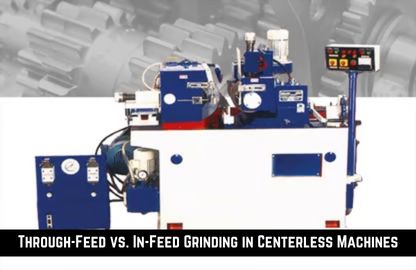
In-Feed vs. Through-Feed Grinding in Centerless Grinding
The machine’s versatility is realized through its operating modes:
- Through-Feed Grinding: Ideal for long, simple cylindrical components (like bar stock or pins). The workpiece passes continuously through the gap between the wheels, making it the most efficient method for high-volume, straight-line production.
- In-Feed (Plunge) Grinding: Used for shorter parts or those with multiple diameters, tapers, or complex profiles (like stepped shafts or piston pins). The workpiece is placed into the gap and ground to size, and then rapidly removed.
Centerless Grinding Specifications
The Scaling of Power and Rigidity
The progression from the SL-75 to the heavy-duty SL-150 reveals key engineering priorities:
- Power Increase in Centerless Grinding : The grinding wheel motor power scales exponentially, from 5 HP to 20 HP This increased power is necessary for heavy stock removal and for grinding larger diameter, high-hardness workpieces, such as large transmission shafts or aerospace bar stock.
- Increased Mass and Rigidity of Centerless Grinding: The weight of the machine more than doubles from the SL-100 to the SL-150 (2000kg to 4500kg). The machine’s foundation, a single block of high Brinell hardness cast iron, is designed with greater material thickness and heavier ribbing. This mass and rigidity are crucial for absorbing vibrations from heavy grinding, a necessity for maintaining sub-micron tolerances and achieving superior surface finish (low Ra values) even under high speed, full extent utilization.
- Wheel Dimensions of Centerless Grinding: The Grinding Wheel on the SL-150 is significantly larger (500mm OD and 200mm width), allowing it to handle broader workpieces and increase the effective grinding contact area, which enhances throughput in high volume applications.
Control and Flexibility in Centerless Grinding
The machines are designed for flexibility across different grinding demands:
- Dressing Capability: The inclusion of a 0.5 HP Hydraulic Power Pack specifically for dressing units (Diamond Dressing Holder included) underscores the necessity of maintaining the precise geometry of both the grinding and regulating wheels.
- Rotational Control: The smaller models (SL-75/100) offer fixed regulating wheel speeds (20-40-60 RPM), while the heavy duty SL-150 provides Infinitely Variable speed control. This advanced control is essential for fine-tuning the workpiece rotation when dealing with diverse materials and complex geometries required in precision sectors.
Indispensable Applications in Precision Sectors
The centerless grinding process is not merely an alternative; it is an essential manufacturing step in sectors where dimensional accuracy is measured in microns (one-millionth of a meter).
The Micron Edge: Aerospace Turbine Components
The aerospace and defense sectors represent the zenith of precision manufacturing, where component failure is catastrophic.
- Challenge: Grinding exotic, high-strength alloys like Titanium, Inconel, and Nickel-Chrome Superalloys. These materials are extremely tough, heat-resistant, and prone to surface damage if not machined correctly.
- Role of Centerless Grinding: The process is vital for finishing turbine shafts, engine control rods, landing gear pins, and specialized fasteners. The centerless method eliminates end-pressure (axial thrust), which is crucial when grinding long, slender shafts from expensive materials, preventing deflection and maintaining perfect roundness and straightness.
- Technology: These applications rely heavily on diamond and super abrasive wheels with high thermal conductivity. These advanced wheels minimize heat build-up a major threat to the material’s structural integrity while achieving tolerances that can be as tight as ensuring safety and optimal engine performance.
From Pins to Pistons: Centreless grinding Dominance in High-Volume Automotive Manufacturing
The global automotive industry, particularly in the mass production of internal combustion and electric drivetrain components, depends on the speed and consistency of centerless grinding.
- Challenge: High volume, high repeatability, and durability. Automotive components often operate under extreme stress and heat, demanding superior surface finishes to minimize friction and wear.
- Role of Centerless Grinding: The machine’s efficiency in the through-feed mode makes it the definitive solution for mass-producing millions of identical parts:
- Piston Pins: Require micro-level surface finish and perfect roundness for smooth piston movement.
- Valve Guides and Stems: Need precision grinding to control engine timing and compression.
- Camshafts and Transmission Shafts: Ground from hardened steel to ensure long-term durability and minimal friction within the gearbox.
- Industry Trend: The capability of modern centerless grinders to achieve accuracy levels of 0.0001 inches while processing thousands of components daily underlines their non-negotiable role in modern, cost efficient automotive production lines.
What Our Customers Say
“Bhavya machine tools is very best work for machine tools Industry and customer support is very best and all machine best work products making very best and micro tolerate work ….. I am very very happy for bhavya machine tools”
Raj Shah On Google
Invisible Precision: Medical and Semiconductor Industries
In the medical and electronics fields, centerless grinding moves into the realm of the minute, often dealing with parts only a fraction of a millimeter in diameter.
- Medical Applications: Centerless grinding is critical for manufacturing minimally invasive medical devices and surgical tools.
- Surgical Instruments & Guide Pins: Requires grinding of high biocompatibility materials like Nitinol, Stainless Steel, and Titanium to achieve complex profiles, multiple tapers, and extremely smooth surfaces (Ra values as low as Ra on the outside diameter of tubing) for patient comfort and functionality.
- Dental Implants: Demands micron-level precision for fit and finish, achieved reliably by the centerless process.
- Semiconductor Industry: In the production of microelectronics, centerless grinding is used for the critical finishing of silicon and quartz components, providing the ultra-flat, fine finishes required for etching microcircuits. The non-contact nature of the centerless support minimizes stress, which is essential when handling these highly brittle and sensitive materials.
Beyond Metal: Grinding Brittle and Exotic Materials
One of the centerless grinder’s most undervalued advantages is its ability to handle materials that are impossible to clamp or chuck in conventional setups.
- Ceramics and Glass: These materials are inherently brittle and prone to fracture under localized clamping pressure or axial thrust. Because the centerless process supports the workpiece continually along its outer diameter, it is the method of choice for grinding ceramic bearings, insulators, and precision glass rods.
- Composites and Hardened Tool Steels: The combination of powerful motors and super-abrasive wheels allows for efficient stock removal and finishing of extremely hard, hardened tool steels (e.g., in the die & mold sector) and challenging composite structures (e.g., carbon fiber components for aerospace).

Conclusion: The Future of Micron Accuracy
The centerless grinding machine remains an unparalleled cornerstone of precision manufacturing. Its inherent design eliminating centering errors and providing rigid, continuous support positions it as the indispensable tool for achieving the tightest tolerances and highest surface finishes on cylindrical components.
The industry’s focus on high-volume efficiency (evident in the continuous through-feed capability), coupled with its necessity in grinding exotic, high-performance, and brittle materials for sectors like aerospace, automotive, and medical devices, ensures its sustained growth. As manufacturing demands continue to push the boundaries of accuracy moving into sub-micron territory the evolution of the centerless grinding machine, leveraging advanced abrasives and CNC control for continuous, automated production, will remain the defining feature of high-precision manufacturing globally.


