



The primary objective of this article is to explore the evolving landscape of the global metal-forming industry, focusing on the shifting demands across key international markets. By analyzing technological advancements and regional industrial growth, this content aims to provide a comprehensive understanding of how modern machinery adapts to the needs of the automotive, aerospace and electronics sectors while highlighting the strategic importance of specialized press configurations.
 Email Us Today!
Power Press Machine Utilization in The Modern Industrial Era
The industrial landscape is undergoing a significant transformation as manufacturing facilities worldwide seek higher levels of precision and efficiency. At the heart of this change is the consistent evolution of the Power Press Machine, a cornerstone of metalworking that has adapted from simple mechanical designs to sophisticated, digitally controlled systems. The global demand for these machines is largely driven by the expansion of the automotive and aerospace industries, where the need for complex, high-strength components is more pressing than ever. As emerging economies invest heavily in infrastructure and domestic manufacturing, the reliance on robust pressing solutions has reached a new peak. This global shift is not merely about raw force but about the intelligent application of pressure, ensuring that material waste is minimized while production speeds are maximized.
Power Press Demand across Emerging and Established Markets
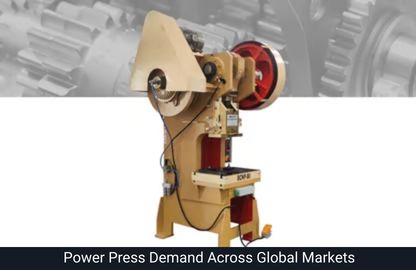
When examining the geographical distribution of market growth, it is clear that both established Western economies and rapidly developing nations in Asia are prioritizing the modernization of their factory floors. In regions like North America and Europe, the focus has shifted toward high-tech, automated solutions that align with green manufacturing standards. Meanwhile, in the Asia-Pacific region, a massive surge in consumer electronics and vehicle production has created a sustained need for various types of industrial presses. The versatility of a standard Power Press allows manufacturers to handle everything from delicate electronic brackets to heavy-duty structural frames. This flexibility is essential in a market where consumer preferences change rapidly, requiring production lines that can be reconfigured with minimal downtime.
H Type Power Press Applications for Heavy-Duty Precision
In the realm of high-precision and high-volume manufacturing, the H Type Power Press stands out due to its superior structural rigidity. Its closed-frame design, which resembles the letter for which it is named, provides the stability necessary to handle significant tonnage without the risk of frame deflection. This characteristic is particularly valued in industries where even a microscopic deviation can lead to part failure, such as in the production of aerospace components or engine parts. By distributing the load evenly across four pillars, this configuration ensures a longer life for the dies and tools used in the process. As manufacturers move toward using tougher materials like high-strength steel and advanced alloys, the demand for the stability offered by this specific frame type continues to grow globally.
Pneumatic Power Press Efficiency in High-Speed Assembly
For operations where speed and repetitive accuracy are more critical than sheer force, the Pneumatic Power Press has become a preferred choice. Utilizing compressed air to drive the ram, these machines offer a clean and fast alternative to traditional mechanical or hydraulic systems. They are widely implemented in the assembly of small components, such as those found in smartphones, home appliances and medical devices. Because they have fewer moving parts and do not require hydraulic oil, they are also easier to maintain and better suited for clean-room environments. The global trend toward miniaturization in electronics has directly boosted the market for these air-operated machines, as they provide the gentle yet precise touch required for thin-gauge materials.
C Type Power Press Versatility for Small-Scale Workshops
The C Type Power Press, often referred to as a gap-frame press, remains a staple in workshops that require easy access to the work area. Its unique open-front design allows operators to load and unload materials from three sides, making it exceptionally user-friendly for manual or semi-automated processes. While it may not offer the same rigidity as closed-frame models under extreme loads, its compact footprint and cost-effectiveness make it an ideal solution for small to medium-sized enterprises. These machines are frequently used for blanking, piercing and bending tasks where the workpieces are not excessively large. In markets where floor space is at a premium, the ability to fit a high-performing machine into a limited area is a significant competitive advantage.
Leading Solutions From Industry Innovators
As the global market becomes more competitive, choosing a reliable partner for machinery is essential. Techno Mechanical Solutions has established itself as a frontrunner in providing a diverse range of metal-forming equipment tailored to modern industrial needs. The company specializes in delivering high-performance machinery, including the Cross Shaft Power Press, which is engineered for synchronized motion and uniform pressure distribution. Their commitment to integrating Industry 4.0 features, such as smart sensors and remote monitoring, ensures that their clients stay ahead of the curve. By offering customized solutions that range from light-duty assembly tools to heavy-duty forming systems, they cater to the specific demands of the automotive and construction sectors, helping businesses optimize their production cycles and reduce operational costs.
Power Operated Hydraulic Press Technology for Deep Drawing
When the manufacturing process requires deep drawing or the forming of very thick plates, the Power Operated Hydraulic Press becomes indispensable. Unlike mechanical systems that rely on a flywheel, hydraulic power allows for full force to be applied at any point in the stroke. This granular control over pressure and speed is vital for shaping complex geometries without cracking the material. Manufacturers of large kitchenware, automotive body panels and heavy industrial tanks rely on the consistent pressure delivery of these systems. The ability to hold pressure for extended periods also makes them suitable for molding and forging applications that require a steady, forceful squeeze rather than a sudden impact.
What Our Customers Say
“Nice company to be deal with,have best experience for sales n after sales services, good staff too.”
Jignesh Thakkar On Google
Hydraulic Press H Type Power Operated Systems for Maximum Stability
Combining the force of fluid power with the structural integrity of a four-pillar frame, the Hydraulic Press H Type Power Operated model represents the pinnacle of heavy-duty metal forming. These machines are designed to survive the most demanding industrial environments while maintaining tight tolerances. By housing a powerful hydraulic cylinder within a rigid H-frame, engineers can achieve a level of precision that is difficult to replicate with other designs. This combination is frequently found in high-capacity factories that produce structural beams, large-scale automotive assemblies and heavy agricultural equipment. The global demand for such robust machinery is fueled by massive infrastructure projects and the move toward larger, more integrated vehicle components.
Cross Shaft Power Press Mechanics and Synchronized Performance
The Cross Shaft Power Press is highly regarded for its ability to minimize vibrations and energy loss during high-speed operations. By utilizing a horizontal shaft to transmit power to the ram, this design ensures that the force is applied smoothly and consistently across the entire surface of the workpiece. This synchronization is crucial for preventing uneven wear on the machine’s components and ensuring that every part produced meets the same quality standards. Industries that require continuous, high-speed stamping – such as the production of hardware and fasteners – benefit greatly from the reliability and durability of the cross-shaft mechanism. Its compact yet powerful nature aligns perfectly with the modern trend of high-efficiency, low-vibration manufacturing.
Strategic Considerations for Future Manufacturing
As we look toward the future, the global demand for metal-forming machinery will be shaped by the twin pillars of automation and sustainability. Manufacturers are no longer just looking for a machine that can hit hard; they are looking for systems that can think and adapt. The integration of servo technology and energy-recovery systems is becoming a standard expectation rather than a luxury. Furthermore, the shift toward electric vehicles is creating a unique market for presses that can handle lightweight materials like aluminum and composites, which behave differently than traditional steel. Companies that invest in versatile and precise equipment today will be the ones that lead the industrial sectors of tomorrow.
Conclusion
The global landscape for metalworking is defined by a diverse range of needs, from the high-speed requirements of electronics assembly to the massive force needed for heavy industrial components. Whether a facility chooses a Power Press for its general-purpose versatility or a specialized H Type Power Press for its unmatched rigidity, the goal remains the same: achieving perfection in every stroke. As technology continues to advance, the synergy between mechanical strength and digital intelligence will drive the next generation of industrial growth, ensuring that the global demand for precision and power is met with ever-more sophisticated solutions.


