



The decision to buy a lathe machine, especially a high-precision CNC Turning Center, is a massive capital investment for any factory. Historically, buyers focused primarily on technical specifications like spindle speed, power, and the initial purchase price. However, in today’s automated global manufacturing environment, this focus has completely shifted. The initial machine sale is now simply the start. The true value-and the key factor driving the purchase is the complete, long-term support system that the lathe machine manufacturers and lathe machine suppliers provide.
This transition, known as “servitization,” means lathe machine manufacturers are transforming from product vendors into strategic, long-term operational partners. Consequently, global service networks, comprehensive after-sales support, local spare parts availability, and robust training programs are now mandatory buying factors. The ability of a lathe machine exporter to guarantee continuous operation (uptime) is now often more important than a slightly lower price tag.

Lathe Machine Service: The Economics of Downtime
In high stakes manufacturing sectors like aerospace, medical devices, and automotive, unexpected machine downtime is extremely expensive. The loss of production from a single hour of CNC machine inactivity can easily cost more than the machine itself in lost revenue and penalties. This financial reality has fundamentally changed how companies evaluate capital equipment purchases.
Total Cost of Ownership (TCO) is King
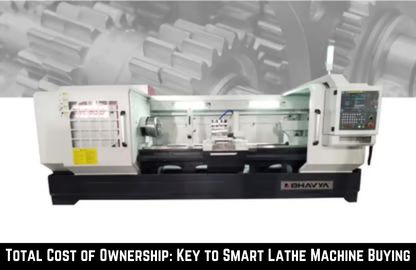
Smart buyers no longer base their decision solely on the starting purchase price. They focus instead on the Total Cost of Ownership (TCO), which accounts for all costs over the machine’s lifetime. A strong, responsive service package dramatically minimizes the most expensive variables in the TCO equation: Downtime Losses and Maintenance Costs. Lathe machine suppliers who can demonstrate higher guaranteed uptime through superior support will secure the contract, even with a higher initial price. Industry data shows that excellent service programs significantly increase a manufacturer’s profit margins through customer loyalty and enhanced lifetime value, proving the profitability of this service-based model.
After-Sales Support: The True Competitive Differentiator
In a crowded global marketplace where all major lathe machine manufacturers offer similar specifications, the quality of the service agreement is the defining competitive edge.
- Building Trust and Reliability: Buyers need confidence that their expensive investment will be protected and optimized throughout its operating life. A dedicated, expert service team the hallmark of a top tier lathe machine exporter builds trust and ensures a long-term relationship, which guarantees repeat business.
- Proactive Maintenance is the Norm: The industry has shifted from reactive repair (fixing things after they break) to proactive maintenance (fixing them before they break). Modern CNC lathe machine manufacturers leverage IoT (Internet of Things) sensors and AI to monitor machine health remotely. They predict when a component will fail and schedule necessary maintenance before a catastrophic breakdown occurs, leading to a much smoother, more predictable manufacturing operation.
Lathe Machine Global Service Network: Essential for Exporters
For a lathe machine exporter selling complex equipment internationally, a robust and decentralized global service network is paramount. A machine tool is highly complex, and when problems arise, they require specialized, often proprietary, technical knowledge.
What Our Customers Say
“Recently we purchase tapping machine from bhavya machine tools and the performance of this machine is truly exceptional.”
Gulamrasul Panara On Google
Local Response with Global Reach
Today’s expectation is not for a technician to fly from the manufacturer’s home country; it’s for a local engineer to arrive from a regional hub within hours.
- Regional Service Hubs are Essential: Leading lathe machine manufacturers establish service centers in key markets (like the Middle East, Southeast Asia, etc.) staffed by locally trained, multi-lingual engineers. This ensures fast service response times, which is critical for minimizing the impact of unexpected machine failures.
- 24/7 Technical Support is Standard: Customers expect priority access to technical hotlines around the clock. Many premium service contracts guarantee rapid telephone support and an on-site service engineer within 24 hours for critical problems, proving the shift in focus from selling a product to guaranteeing a production outcome.
Comprehensive After Sales Support
After-sales support covers a wide range of activities that keep the machine accurate, functional, and up-to-date throughout its life.
- Routine Maintenance and Calibration: This includes scheduled checks and periodic laser calibration of the axes to maintain micron-level accuracy. It prevents major failures, extends the machine’s lifespan, and ensures it runs at peak performance and adheres to the latest manufacturing software requirements.
- Upgrades and Emergency Services: Manufacturers offer access to new technology via upgrades and retrofitting for older models, extending the functional life of the investment. Crucially, guaranteed rapid response times for Emergency Repair Services are the immediate measure of a manufacturer’s commitment.
Lathe Machine CNC Turning Center Spare Parts: The Logistics Barrier
A machine is only operational if its critical, specialized parts are available. For lathe machine suppliers and exporters, spare parts availability and logistics represent a major competitive challenge.
The Inventory Imperative
Modern CNC lathes use many proprietary components spindles, servo motors, control units that cannot be replaced with generic parts.
- Regional Warehousing: Successful lathe machine manufacturers invest heavily in decentralized, regional spare parts warehouses. This stock includes high-wear, long-lead-time components. Buyers prioritize suppliers who can guarantee 90% parts availability within 48 hours via local stock.
- Quality and Authenticity: Customers understand that using non-OEM (Original Equipment Manufacturer) spare parts can severely compromise the machine’s precision and safety, often voiding the warranty. A robust service system guarantees that all replacement parts are original OEM components, maintaining the machine’s accuracy. Furthermore, digital tools are used to track parts from the factory floor to the customer, ensuring authenticity and providing full traceability.
Lathe Machine Service Training: Empowering the Customer
The complexity of modern multi-axis lathe machines demands highly skilled operators and maintenance crews. A superior lathe machine manufacturer views service training not as an extra cost, but as a critical value-add service that boosts customer loyalty and machine uptime.
Comprehensive Training Programs for Machine Tools
Training is a crucial factor because it dictates how quickly a company can start production (ramp-up time) and how efficiently the machine will run long-term.
- Operator and Maintenance Training: Programs cover core CNC programming, efficient setup, and advanced tool path generation for operators. Specialized training for in-house maintenance staff focuses on predictive diagnostics and basic preventative maintenance. This level of empowerment reduces reliance on external service engineers for non-critical repairs.
- Digital Learning Tools: Many manufacturers now offer online portals, video tutorials, and Digital Twin simulations. These tools allow operators to practice complex machining scenarios safely, further increasing their skill without wasting valuable materials or machine time.
By providing extensive training, the lathe machine supplier ensures their machines are used correctly and efficiently. This proactive approach reduces the chances of misuse, cutting down on costly, avoidable warranty claims and significantly strengthening the manufacturer’s reputation for dependable support.

Lathe Machine Tool Servitization: The Future of Manufacturing
The evolution of the lathe machine market is quickly moving toward a complete service-based model servitization driven by modern Industry 4.0 technologies.
- Predictive Service Contracts: The shift is from maintenance based on a calendar schedule to condition based maintenance, where sensors and AI automatically flag issues and trigger service calls based on the machine’s real-time needs.
- Outcome-Based Models: The ultimate service model is where the customer pays based on the machine’s output (e.g., Pay-Per-Part), not on the ownership of the machine itself. The lathe machine manufacturer retains ownership and full responsibility for maintenance, uptime, and consumables. This revolutionary approach fundamentally aligns the manufacturer’s profitability with the customer’s successful, continuous production.
In conclusion, for any business making a large capital investment, the buying decision is no longer about the hardware alone. It is about purchasing a guarantee of production capacity. The success of a lathe machine exporter or manufacturer is now measured by the strength of the vital, powerful network of service, support, and spare parts that ensures their product operates at peak performance, everywhere in the world. This focus on the after-sales ecosystem has become the single most critical factor in the modern lathe machine purchasing decision.


