



Centerless vs Cylindrical Grinding: Differences and Ideal Use Cases
Precision grinding is a cornerstone of modern manufacturing and choosing the right process directly impacts part quality, production speed and cost efficiency. Two widely used methods – centerless grinding and cylindrical grinding – serve distinct purposes and understanding their differences helps manufacturers make smarter decisions. This article breaks down both processes across workpiece holding, applications, accuracy and more so you can confidently determine which suits your production needs.
Centerless Grinding Machines: How the Process Works
Centerless grinding machines remove material from a workpiece without mounting it between centers or in a chuck. Instead, the part rests on a work rest blade, positioned between a grinding wheel and a regulating wheel. The grinding wheel performs the cutting action, while the regulating wheel controls the rotational speed and axial feed of the part.
This setup enables continuous, high-throughput grinding – making it highly efficient for long production runs of cylindrical components. Parts feed through automatically (through-feed grinding) or are held in place for more complex shapes (in-feed grinding). Because no fixturing is required, loading and unloading times are minimal, which significantly reduces cycle time in mass production environments. Bhavya Machine Tools manufactures centerless grinders built for consistent dimensional accuracy across high-volume batches, with rigid machine structures that minimize vibration during operation.
Cylindrical Grinding Machines: Understanding the Core Mechanism
Cylindrical grinding machines hold the workpiece between two centers or in a chuck and rotate it while a grinding wheel engages the surface. The process can be performed as OD (outside diameter) grinding or ID (inside diameter) grinding, depending on the surface being finished.
A hydraulic cylindrical grinding machine uses hydraulic power for table traversal and wheel feed, offering smooth, controlled movement that enhances surface finish quality. The hydraulic cylindrical grinder is particularly effective for components requiring precise taper grinding, shoulder grinding or complex surface profiles that demand tight tolerances.
Cylindrical grinding machines are well-suited for both single-piece and small-batch production, especially when components have varying diameters, steps or contours along their length.
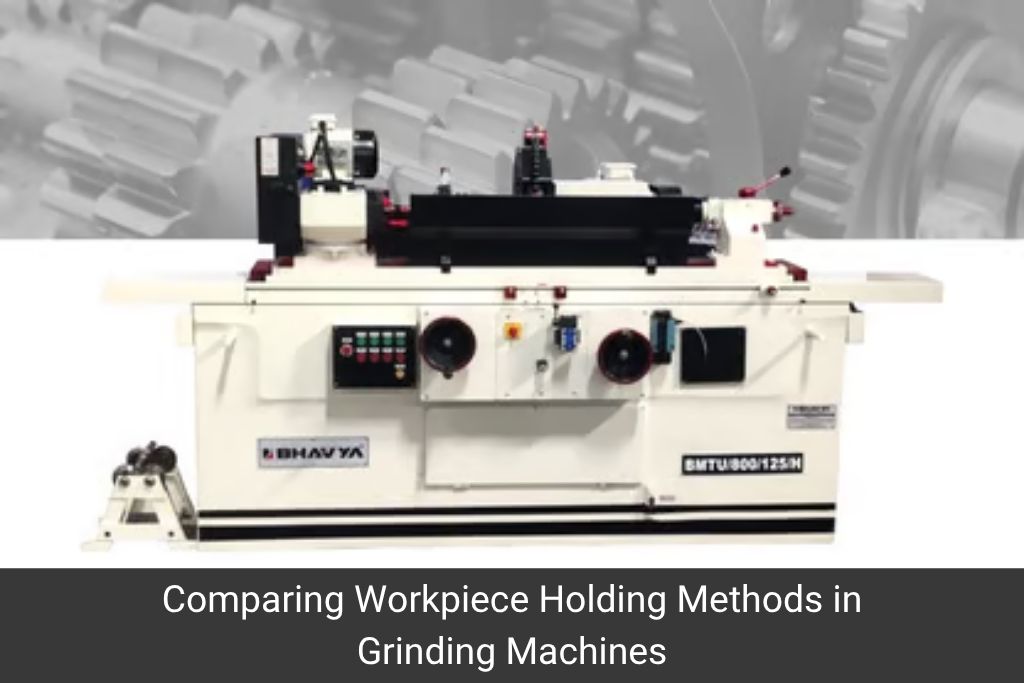
Workpiece Holding Methods for Grinding Machine: The Fundamental Difference
The most defining distinction between these two grinding methods lies in how the workpiece is supported during machining.
In centerless grinders, the part is not clamped or held between centers – it is supported entirely by the work rest blade and the regulating wheel. This eliminates the need for center holes in the workpiece and speeds up setup considerably. However, it also means the machine cannot correct for pre-existing eccentricity or runout in the raw stock.
In cylindrical grinding machines, the part is secured between centers or in a chuck, which establishes a precise axis of rotation. This gives the operator more control over concentricity and is essential when the relationship between multiple diameters on a single part must be held to tight tolerances. The fixturing method in cylindrical grinders makes them ideal for parts that require consistent angular orientation during grinding.
Applications: Where Each Grinding Machine Fits Best
Centerless grinding machines are the preferred choice for grinding pins, shafts, rollers, bushings, tubes and other rotationally symmetric components that are uniform in diameter. Industries such as automotive, bearing manufacturing, medical devices and aerospace rely on centerless grinders for producing these high-volume, tight-tolerance parts efficiently.
Cylindrical grinding machines are better suited for components like spindles, crankshafts, camshafts, hydraulic rods and precision tooling where complex geometry or stepped profiles are involved. A hydraulic cylindrical grinding machine is commonly found in job shops and tool rooms handling custom or low-volume precision work.
Key application differences at a glance:
- Centerless grinding: bars, rods, bearing rings, needle rollers, carbide blanks
- Cylindrical grinding: crankshafts, gear shafts, hydraulic cylinders, tooling components, stepped workpieces
Bhavya Machine Tools offers both centerless and cylindrical grinding machines designed to serve these varied industrial applications with precision and reliability.
Accuracy Levels of Grinding Machines: Tolerance and Surface Finish Comparison
Both processes are capable of achieving tight tolerances and fine surface finishes, but they differ in the type of accuracy they deliver best.
Centerless grinding machines excel at diameter consistency across a batch. Because the workpiece is supported on a blade, the process naturally averages out minor variations and can hold diameter tolerances in the range of ±0.002 mm to ±0.005 mm across long production runs. Surface finish values of Ra 0.2 to 0.4 µm are standard, with fine grinding achieving even lower values.
Cylindrical grinding machines – offer superior control over concentricity, roundness and the relationship between multiple features on a single part. They can achieve tolerances of ±0.001 mm or tighter in controlled conditions, making them the go-to for components where geometric accuracy (not just dimensional accuracy) is critical.
For grinding machines used in high-precision sectors like aerospace or medical manufacturing, cylindrical grinding often wins when part geometry complexity demands controlled axis alignment throughout the cut.
Centerless Grinders & Cylindrical Grinding Process Comparison: Speed, Setup and Flexibility
When comparing the two grinding processes from a production standpoint, several operational differences become clear.
Centerless grinders have a faster throughput rate. Once set up correctly, parts pass through the machine in a continuous stream with minimal operator intervention. Setup time is longer initially, but the per-part cycle time is extremely low, making it ideal for batches of hundreds or thousands of identical parts.
Cylindrical grinding machines offer greater flexibility per setup. Changing from one diameter to another, adjusting for a taper or switching between OD and ID grinding is relatively straightforward. This makes cylindrical grinding machines more versatile for varied work schedules. The hydraulic cylindrical grinding machine adds further precision to this flexibility through consistent feed rates and smooth table movement.
From a cost-per-part perspective, centerless grinding wins in high-volume scenarios, while cylindrical grinding is more economical for complex, low-volume precision parts.
What Our Customers Say
“Our production speed has improved ever since we got a Bhavya machine. It’s smooth, durable, and works exactly as promised.”
Arti Mishra On Google
Choosing Between Centerless and Cylindrical Grinding Machines
The decision between a centerless grinder and a cylindrical grinder comes down to part geometry, batch size and the type of accuracy required.
Choose a centerless grinding machine when:
- Parts are uniform cylinders without steps, tapers or shoulders
- High-volume production is the priority
- Center holes are not available or desirable
- Consistent diameter across the batch is the key quality parameter
Choose a cylindrical grinding machine when:
- Parts have stepped diameters, tapers or complex profiles
- Concentricity between surfaces is critical
- Batch sizes are small to medium
- A hydraulic cylindrical grinder’s smooth, precise feed is needed for fine surface finishing
Bhavya Machine Tools provides both grinding machine categories, allowing manufacturers to select the right solution based on their specific production and quality requirements.
 Email Us
Conclusion
Centerless and cylindrical grinding machines each serve a clear purpose in precision manufacturing. Centerless grinders deliver speed and consistency for high-volume cylindrical parts, while cylindrical grinding machines – especially hydraulic models – offer superior geometric control for complex, precision-critical components. Understanding the process differences, workpiece holding methods and accuracy capabilities covered here helps manufacturers invest in the right grinding machine for the right application.


