



The landmark Free Trade Agreement (FTA) signed in January 2026 between the European Union (EU) and India marks a historic shift in the global manufacturing hierarchy. For the machine tools industry, this agreement is not merely a reduction in tariffs; it is a catalyst for a technological merger between Europe’s high-precision engineering and India’s rapidly scaling industrial infrastructure.
As trade barriers fall, the impact is being felt across the entire spectrum of machinery—from the fundamental lathe machine to specialized shaping machines and high-capacity power presses.
Strengthening the “Make in India” Backbone
For Indian manufacturers, the FTA provides unprecedented access to the European market, which has traditionally maintained high entry barriers regarding safety standards and environmental certifications.
- Lathe Machines & CNC Centers: Indian-manufactured lathe machines and CNC turning centers are seeing a surge in demand from Eastern and Central Europe. The removal of import duties makes Indian machines a highly competitive alternative to East Asian counterparts, offering European SMEs a balance of affordability and robust performance.
- Precision and Quality: To meet EU “CE” marking requirements, Indian manufacturers are rapidly upgrading their quality control protocols. This “upward pressure” is improving the baseline quality of all machine tools produced within the country.
European Technology Influx: Precision at the Edge
Conversely, European manufacturers—particularly from Germany, Italy, and Spain—now have a smoother pathway to the Indian market.
- Grinding Machines & Surface Finish: High-end European grinding machines are critical for the Indian aerospace and medical device sectors. The FTA has reduced the landing cost of these precision tools by nearly 15%, allowing Indian workshops to upgrade their finishing capabilities.
- Shaping Machines & Heavy Fabrication: While the shaping machine is often considered a traditional tool, European variants with advanced hydraulic controls are now more accessible for Indian heavy engineering sectors, facilitating more complex internal profile cutting in domestic workshops.
Read Our Article
Innovations in Machine Tools that has Changed Global ProductionImpact on Sheet Metal Machinery: Press Brakes & Power Presses
The construction and automotive sectors in both regions are the primary beneficiaries of the new trade terms regarding sheet metal equipment.
Press Brake Technology
The FTA has encouraged joint ventures between European software developers and Indian machine builders. We are now seeing press brake units that combine European-designed CNC controllers with Indian-fabricated frames. This hybrid model provides high-precision bending capabilities at a price point that is attractive to both Indian fabricators and European distributors.
Power Press Machines
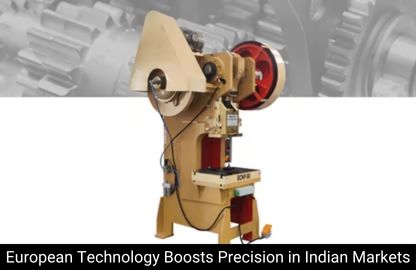
In the realm of mass production, the power press machine is undergoing a transformation. The agreement facilitates the exchange of “Green Manufacturing” technologies. European energy-efficient servo-motors are now being integrated into Indian power press lines, reducing energy consumption by up to 25% for Indian automotive component manufacturers.
Our Other Machines
All Geared Lathe MachineKey Strategic Impacts Across Borders
| Machine Category | Impact in India | Impact in European Union |
| Lathe Machine | Increased export volume to EU SMEs. | Lower procurement costs for entry-level CNCs. |
| Shaping Machine | Access to high-torque European motor tech. | New market for specialized heavy-shapers. |
| Grinding Machine | Faster adoption in Pharma & Aerospace. | Expanded market for high-precision brands. |
| Press Brake | Growth in hybrid “Euro-India” fabrication. | Access to cost-effective industrial frames. |
| Power Press | Integration of European safety & servo tech. | Collaboration on high-volume stamping tech. |
 Drop Us an Email!
Challenges and The Road Ahead: 2026 and Beyond
While the FTA creates opportunities, it also demands adaptation.
- Standardization: Indian manufacturers must align with the EU’s strict ESG (Environmental, Social, and Governance) standards.
- IP Protection: European firms are more willing to share “core” technology for grinding machines and press brakes now that the FTA includes stronger Intellectual Property protections.
- Skills Exchange: We expect a rise in vocational training partnerships, where engineers train technicians at both the ends on the nuances of high-speed power press maintenance.
Conclusion
The Jan 2026 EU-India FTA is more than a trade deal; it is the birth of a new industrial ecosystem. By combining the sturdy construction of Indian machines with the precision performance of European electronics, the global market is set to witness a new generation of machine tools. For the industrialist in 2026, the question is no longer whether to source from India or Europe, but how to leverage the strengths of both.


