



Press Brakes in Renewable Energy Manufacturing
The manufacturing backbone of the renewable energy sector depends on precision metal forming – and nowhere is this more evident than in the production of solar mounting structures and wind tower components. As the global push for clean power accelerates, fabricators supplying these industries face increasing demands for tight tolerances, high-volume output and material versatility. At the center of meeting these challenges sits the press brake – a machine that has evolved from a simple bending tool into a sophisticated forming system capable of handling everything from thin aluminum solar rails to thick-walled steel wind tower flanges.
Understanding how a press brake operation works within this context requires looking beyond standard capabilities. Renewable energy components carry unique structural requirements. Solar mounting systems must withstand wind uplift, thermal cycling and sustained outdoor exposure. Wind towers must endure fatigue loads, dynamic stresses and long-term structural integrity demands. The bending processes that shape these components are therefore not routine – they are precision-critical operations where every degree of angle and every millimeter of flange matters.
Press Brake Machine Capabilities That Define Solar Rail Production
Solar mounting structures – the frameworks that hold photovoltaic panels in position – are predominantly made from aluminum extrusions and formed sheet metal profiles. The rails, purlins, clips and brackets that make up these assemblies require bending with high repeatability across large production volumes. A press brake machine used in this application must maintain angular consistency from the first part to the ten-thousandth, since even minor deviations in rail geometry can affect panel alignment and long-term load distribution.
Modern fabricators producing solar mounting components typically work with aluminum alloys in the 5000 and 6000 series, materials known for springback behavior that differs substantially from mild steel. This springback – the tendency of bent metal to partially return toward its original shape after the forming force is released – must be precisely compensated during the bending process. Machines equipped with real-time angle measurement and automatic compensation are far better suited to this task than older manually adjusted equipment.
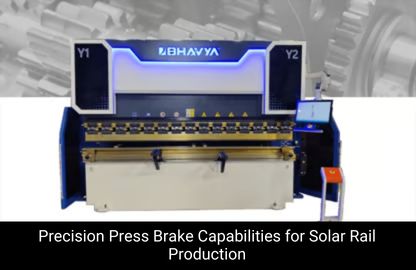
The profile geometries common in solar rail production also demand tooling flexibility. Many brackets and clips require multi-bend sequences with short flange lengths and tight inside radii. Press brake machines with open-height configurations, modular tooling systems and programmable backgauge positioning allow fabricators to execute these complex sequences efficiently without constant retooling between runs.
CNC Press Brake Technology and Its Role in High-Volume Solar Component Forming
The introduction of CNC press brake systems changed how solar component manufacturers approach production planning and quality control. With a CNC press brake, operators can store complete bending programs that include punch and die selection, backgauge positions, ram depth, bending speed profiles and crowning corrections. When a production run resumes after a changeover, the machine reloads all parameters automatically, eliminating setup variation between operators and shifts.
For solar mounting fabricators managing dozens of SKUs – different rail lengths, bracket types and clip configurations for varying installation environments – this programmability directly reduces changeover time and scrap rates. Each program can be validated offline using 3D simulation tools integrated with the CNC controller, allowing engineers to verify bend sequences before any material is loaded onto the machine. This simulation-first approach is especially valuable when forming thin aluminum profiles where tool crashes or incorrect sequences can cause part deformation that is difficult to correct.
CNC press brake bending machines also support multi-axis backgauge systems that allow the workpiece to be repositioned automatically between bends within a single program. This is critical for solar rail profiles that require multiple bends at different positions along the length of a single part. Without automated backgauge positioning, each repositioning step would require operator intervention, significantly slowing throughput on high-volume orders.
Hydraulic Press Brake Machine Strength for Wind Tower Flange and Plate Work
Wind tower manufacturing operates at a completely different scale from solar mounting production. The rolled and welded steel sections that make up a tower segment are formed from thick plate stock, often ranging from 20 mm to 80 mm or more depending on the tower section. Flanges, transition rings, door frames, internal platforms and reinforcing brackets all require bending operations on material that demands substantial tonnage.
A hydraulic press brake machine is the standard solution in this heavy-forming context. Hydraulic systems deliver consistent force across the full length of the ram, which is essential when bending long, heavy plate sections where any deviation in force distribution creates angular variation along the bend line. For wind tower components, where weld joint geometry directly affects structural fatigue performance, dimensional consistency in bent parts is not a preference – it is a structural requirement.
Large-format hydraulic press brake machines used in wind tower fabrication often feature bending lengths exceeding 6 meters and tonnage capacities in the range of several thousand kilonewtons. These machines incorporate synchronized hydraulic cylinders with servo-proportional valve control, ensuring that both ends of the ram descend and apply force in precise unison. This synchronization prevents angular twist in wide parts – a failure mode that would be catastrophic in a structural wind tower component.
Beyond raw power, hydraulic press brake in this segment also incorporate active crowning systems. When bending long, thick plates, the machine bed naturally deflects slightly under load, which would cause the center of the bent part to have a slightly different angle than the ends. Crowning systems counteract this deflection by introducing a controlled upward bow in the bed or lower tool, ensuring uniform angle along the entire bend length. This active compensation is indispensable in wind tower plate work where flanges must meet precise geometric tolerances for bolt-circle alignment.
Mechanical Press Brake Versus Servo-Electric: A Production Context Comparison
When evaluating press brake options for renewable energy component production, the choice between a mechanical press brake and servo-electric alternatives carries real implications for both operational performance and long-term cost of ownership. A mechanical press brake machine operates through a flywheel-driven crankshaft mechanism that delivers the ram stroke at a fixed speed profile determined by the machine’s mechanical geometry. This architecture offers high speed in simple bending operations but provides less flexibility in controlling ram velocity through the forming stroke.
Servo-electric press brakes, by contrast, use direct-drive motor systems to control ram movement with programmable speed profiles at every point in the stroke. This allows the machine to approach the material slowly for precision forming, then retract rapidly for throughput efficiency. For solar mounting components, where springback compensation requires precise control of ram position at the bottom of the stroke, servo-electric technology offers advantages that a traditional mechanical press brake cannot match without additional mechanical compensation systems.
However, the mechanical press brake still holds a place in high-speed, thin-material applications where its cycle speed advantage is meaningful and the application does not demand the fine control of a CNC-driven servo system. Fabricators choosing between these technologies for renewable energy work must map the tonnage range, material thickness and angular tolerance requirements of their specific component mix before making a capital commitment.
CNC Press Brake Bending Machine Integration With Automated Material Handling
The scale of solar and wind energy manufacturing increasingly calls for press brake operations integrated with upstream and downstream automation. A CNC press brake bending machine positioned as part of an automated line can receive blanks from a laser cutting cell, execute programmed bend sequences and pass completed parts to a welding fixture or assembly station – all with minimal human intervention. This integration is not simply about reducing labor. It is about achieving the throughput and consistency that renewable energy supply chains require as installation volumes scale.
Robotic part handling systems paired with CNC press brakes are now a recognized solution in high-volume solar frame and bracket production. The robot loads blanks onto the machine, repositions parts between bends following the programmed sequence and deposits finished parts onto output conveyors. The CNC controller and the robot controller communicate in real time, synchronizing ram movement with part handling to prevent collisions and maintain cycle timing. Achieving this level of integration requires that the press brake’s control architecture supports open communication protocols – a capability now standard on contemporary CNC platforms.
For wind tower fabricators, automation takes a different form. Heavy plate handling systems – including magnetic sheet followers, hydraulic tilt tables and powered roller feeds – assist operators in managing large, thick workpieces that cannot be handled manually without ergonomic risk or dimensional error. These systems work in conjunction with the hydraulic press brake’s programmable backgauge to position plates accurately before each bend, compensating for the manual complexity of working with components that may weigh several hundred kilograms.
What Our Customers Say
“Largest Display of Machinery across India. Wide range of Machines. Very Co-operative staff. Range of Tapping Machine and Re-sharpening Machines are outstanding. Very Cost effective and useful in Precision Machining Work. Their staff is co – operative for after sales support.”
Tirth Bhojani On Google
Best CNC Press Brake Selection Criteria for Renewable Energy Fabricators
Identifying the best CNC press brake for a renewable energy fabrication operation requires a disciplined evaluation process that accounts for the specific demands of solar and wind component manufacturing rather than generic metal forming benchmarks. Several criteria deserve particular attention in this context.
First, the machine’s angle measurement and correction system must be capable of real-time feedback during the bend stroke. Systems that measure angle only after the ram retracts introduce a correction delay that reduces throughput on tight-tolerance parts. In-process angle measurement using laser or tactile sensors integrated directly with the CNC controller provides the fastest correction loop and the most consistent angular output – critical for solar rail profiles and wind tower flanges alike.
Second, the tooling system must support the range of punch and die geometries required by the component mix. Renewable energy components span a wide range of profiles – from narrow solar clips with tight inside radii to wide wind tower flanges with large bend allowances. A CNC press brake equipped with a modular tooling system allows rapid changeover between these profiles without requiring full tool replacement, which preserves productive time across a diverse order book.
Third, the machine’s software environment must support seamless import of CAD bend data. Most solar mounting and wind tower components are designed in 3D CAD environments and the ability to import bend geometry directly into the CNC controller’s programming interface eliminates manual data entry errors and accelerates setup. Machines with integrated offline programming and simulation tools amplify this advantage further.
Finally, the structural rigidity of the machine frame directly affects angular consistency on long bends. Press brake frames that exhibit measurable deflection under load – particularly in the side frames and bed – introduce angular variation along the bend line that no software compensation can fully correct. Fabricators evaluating the best CNC press brake machine options for wind tower or large solar structure work should request deflection specifications as part of the technical evaluation.
CNC Press Brake Machine Price Considerations Versus Long-Term Production Value
The CNC press brake machine price represents a capital investment that must be evaluated in the context of total production value rather than acquisition cost alone. In renewable energy manufacturing, where production volumes are high and component tolerances are strict, a machine positioned at the lower end of the capability spectrum may offer lower upfront cost but introduce ongoing costs through scrap, rework and slower throughput that erode the initial saving over the machine’s operational life.
The value equation for a CNC press brake in solar or wind component manufacturing should include throughput capacity relative to demand forecasts, tooling system compatibility with the planned component mix, expected angular accuracy over the machine’s duty cycle and the cost of integration with automated handling if that capability is on the roadmap. Machines that score well across all these dimensions may carry a higher CNC press brake machine price but deliver a more favorable total cost position when evaluated over a five- to ten-year production horizon.
Service infrastructure also factors into this evaluation. Renewable energy manufacturing operations typically run on tight delivery schedules aligned with installation windows. Machine downtime in this environment carries a cost that goes beyond the direct repair expense – it can affect contract performance and project delivery timelines. Selecting a press brake from a manufacturer with strong regional service presence and parts availability reduces exposure to this risk, regardless of where the machine’s purchase price falls on the market spectrum.
 Email Us
Press Brake Performance in Forming Complex Wind Tower Transition Sections
Wind tower transition sections – the conical segments that connect cylindrical tower sections of different diameters – present one of the more demanding bending challenges in heavy fabrication. These components require plate bending along curved rather than straight bend lines, producing frustum geometries that must mate precisely with adjacent tower sections for welding. Achieving accurate geometry in these parts requires not just machine power but careful process planning that accounts for the interaction between bending sequence, springback and the elastic properties of the high-strength steel typically used.
Fabricators producing transition sections often use press brakes in combination with plate rolling machines, with the press brake used to establish initial geometry and edge flanges before the rolling operation. The press brake’s contribution in this workflow is to pre-bend the plate edges and set initial curvature in regions where the rolling machine cannot reach, ensuring that the final rolled form closes correctly and mates with its flanges without requiring excessive force during assembly.
The CNC capabilities of the press brake are particularly valuable in this multi-step process. Storing and recalling bend programs for each transition section geometry – which varies by tower size, tower section height and structural specification – allows fabricators to reproduce identical forming sequences across production runs without manual recalibration. This repeatability is what makes controlled production of complex wind tower geometries practical at industrial scale.
Conclusion
Press brake technology sits at the intersection of precision engineering and industrial-scale renewable energy production, enabling fabricators to meet the exacting demands of solar mounting structures and wind tower components with consistency and efficiency. Whether deploying a CNC press brake for high-volume solar rail production, a hydraulic press brake machine for heavy wind tower plate work or evaluating the best CNC press brake machine investment for a growing renewable energy order book, the underlying requirement is the same: machines capable of delivering accurate, repeatable bends on demanding materials, integrated with the automation and control infrastructure that modern clean energy manufacturing requires.


