



Maximizing ROI: The Strategic Upgrade from NC to CNC Press Brakes
In the competitive landscape of metal fabrication, Small and Medium-sized Enterprises (SMEs) constantly face the challenge of balancing operational costs with the demand for higher precision and faster turnaround times. For decades, the workshop floor has been dominated by standard metal bending equipment. However, the modern market is shifting. The transition from a manual or NC Press Brake machine to fully automated solutions is no longer just a luxury for large corporations; it has become a necessary evolution for workshops aiming to secure their future.
This article explores the long-term Return on Investment (ROI) of this upgrade, specifically analyzing the qualitative benefits over a five-year horizon. We will examine how advanced bending technology transforms workshop economics, focusing on labor allocation, setup reduction and material efficiency.
Press Brake Machines and the Evolution of Bending
To understand the value of an upgrade, one must first appreciate the baseline. Press Brake Machines are the workhorses of the sheet metal industry. In many SME workshops, the relying technology has traditionally been the mechanical press brake or the hydraulic NC (Numerical Control) variant. These machines are robust and reliable for simple, repetitive bending tasks. They rely heavily on the operator’s skill to adjust the back gauge, set the ram depth and manage the bending angles manually or through basic programming.
However, as customer designs become more intricate and batch sizes become smaller and more frequent, the limitations of these older systems become glaring. The rigidity of an NC Press Brake often leads to bottlenecks. Operators spend significantly more time calculating bend allowances and conducting test bends than they do actually producing parts. This is where the technological leap becomes critical.

CNC Press Brake Technology: Defining the Upgrade
The shift to a CNC Press Brake represents a move from operator-dependent consistency to machine-driven precision. Unlike its predecessors, a CNC system coordinates the movement of the ram and back gauge with micron-level accuracy, driven by sophisticated software that can simulate bends before a single sheet of metal is touched.
This automation does not merely speed up the physical bending process; it revolutionizes the workflow. The machine controls every axis automatically, adjusting for material spring-back and crowning requirements in real-time. For an SME, this means the dependency on a single “master craftsman” is reduced, allowing for a more flexible workforce.
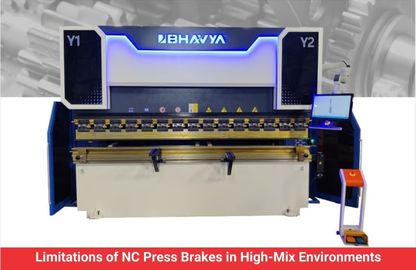
NC Press Brake Limitations in a High-Mix Environment
When analyzing ROI, it is essential to highlight the hidden costs of keeping legacy equipment. An NC Press Brake functions admirably in a low-mix, high-volume environment where the machine is set up once and runs for days. However, modern SMEs rarely enjoy such predictable workflows.
In a high-mix environment – where a shop might switch from bending thick structural brackets to thin aesthetic panels in the same shift – the manual nature of an NC Press Brake becomes a liability. The “dead time” between jobs kills profitability. Operators must manually adjust stops, change tools and perform trial-and-error bends to get the angle right. If the workshop relies on a mechanical press brake, the safety concerns and lack of speed control further hamper productivity. This inefficiency is the primary driver for the migration to CNC technology.
CNC Press Brake Machine Advantages in Setup and Changeover
The most immediate impact of upgrading is the dramatic reduction in setup time. A CNC Press brake machine stores bending programs locally or on a network. When a repeat job comes in, the operator simply calls up the program. The back gauge moves to the correct position instantly and the ram stroke is set automatically.
Consider the cumulative effect of this over a work week. If a shop performs five setups a day and a CNC system saves thirty minutes per setup compared to an NC machine, the workshop gains hours of production capacity every single day. Over a five-year period, this reclaimed time translates into thousands of additional billable hours without hiring extra staff or expanding the facility.
CNC Press Brake Price vs. Long-Term Value: A 5-Year Analysis
One of the main hesitations for SMEs is the initial capital expenditure. The cnc press brake price is undeniably higher than that of an NC or used mechanical unit. However, looking at the sticker price in isolation is a flawed approach to procurement. A comprehensive five-year cost-benefit analysis reveals a different picture.
Year 1: The Transition and Training Phase
In the first year, the costs are highest. The purchase price, installation and operator training consume capital. However, even in this early stage, the reduction in setup times begins to offset the loan payments or lease costs. The “learning curve” is often shorter than expected because modern CNC controllers utilize graphical interfaces that are intuitive for younger operators accustomed to digital touchscreens.
What Our Customers Say
“Largest Display of Machinery across India. Wide range of Machines. Very Co-operative staff. Range of Tapping Machine and Re-sharpening Machines are outstanding. Very Cost effective and useful in Precision Machining Work. Their staff is co – operative for after sales support.”
Tirth Bhojani On Google
Year 2-3: Efficiency and Labor Optimization
By the second and third years, the ROI gains momentum. The workshop is no longer paying for “trial bending.” Labor savings become the dominant factor. Because the CNC Press Brake handles the complex calculations, less experienced operators can produce high-quality parts. This allows the highly skilled (and expensive) fabricators to focus on complex prototyping or welding tasks where their expertise offers higher value. The cost per part drops significantly as labor hours are utilized more effectively.
Year 4-5: Competitiveness and Market Expansion
In the latter half of the five-year cycle, the machine becomes a tool for growth. The capability to handle complex, multi-bend parts with tight tolerances allows the SME to bid on contracts that were previously out of reach. The cnc press brake price has essentially been amortized by the new business generated. Furthermore, the machine retains a higher resale value compared to older NC models, which depreciate rapidly as technology advances.
CNC Press Brake Tooling and Material Savings
Another critical aspect of the ROI equation is scrap reduction. In a manual setup, the first few parts of any run are often sacrificed to setup and adjustment. With the cost of raw materials – stainless steel, aluminum and high-strength alloys – rising steadily, scrap is a direct drain on the bottom line.
Advanced cnc press brake tooling is often precision-ground and segmented, allowing for quick changes. When paired with the CNC’s anti-collision software and automatic crowning systems, the first part produced is usually a good part. Eliminating the “setup scrap” creates a compound saving: the shop saves the cost of the material, the cost of the labor used to cut that material and the cost of waste disposal. Over five years, the reduction in scrap material alone can contribute significantly to the machine’s payoff.
Press Brake Reliability and Maintenance Costs
Maintenance is a factor often overlooked in the excitement of buying new machinery. A vintage mechanical press brake involves flywheels, clutches and brake linings that wear physically and require frequent adjustment. While an NC Press Brake machine is generally hydraulic and more reliable, it still lacks the diagnostic capabilities of modern systems.
A modern CNC system often includes predictive maintenance alerts. It can track pump usage, oil temperatures and valve performance, alerting the maintenance team before a catastrophic failure occurs. This predictive capability reduces unplanned downtime. In an SME workshop, where a single machine going down can halt the entire production line, reliability is a currency of its own. The stability provided by a new Press Brake ensures that delivery schedules are met, protecting the company’s reputation and client relationships.
NC Press Brake vs. CNC: The Human Element
We must also consider the operator experience. Working on a manual or NC Press Brake can be physically and mentally taxing. The operator bears the burden of ensuring every angle is correct, often manually measuring parts throughout the run. This fatigue leads to errors.
Conversely, a CNC Press Brake improves operator morale. The interface is visual, often showing a 3D model of the part and the bending sequence. This visual aid reduces stress and mental fatigue. An operator who feels supported by their equipment is more productive and less prone to costly mistakes. In a labor market where retaining skilled talent is difficult, providing modern, high-tech equipment is a strong retention strategy.
Press Brake Machines as a Pathway to Future Automation
Investing in a CNC machine is also a stepping stone toward further automation. Unlike an NC Press Brake, a CNC system can often be integrated with robotic arms or automatic sheet followers in the future. As the SME grows, the standalone machine can become a cell in a larger automated system. This scalability is impossible with older mechanical press brake technology.
By choosing a CNC platform today, the workshop is “future-proofing” its operations. The software can be updated, new material libraries can be added and the machine can adapt to changing industry standards. This adaptability ensures that the ROI extends well beyond the initial five-year window.

CNC Press Brake Machine Impact on Quality Control
Quality assurance is the final pillar of the cost-benefit analysis. In sectors like aerospace, medical or defense, tolerance traceability is mandatory. An NC Press Brake machine relies on the operator to log data, which is prone to human error.
A CNC Press Brake can log every bend, recording the force applied and the final position of the ram. This data can be exported for quality control reporting. For an SME, the ability to provide clients with digital quality assurance reports can be the differentiator that wins high-value contracts. The cost of poor quality – returns, rework and reputation damage – is minimized, further solidifying the financial case for the upgrade.
Conclusion
The decision to upgrade from an NC Press Brake to a CNC model is significant, involving substantial capital and a shift in operational culture. However, when viewed through the lens of a five-year cost-benefit analysis, the justification becomes clear. The initial cnc press brake price is offset by the cumulative savings in labor, the drastic reduction in setup times and the minimization of material scrap.
For the SME workshop, the Press Brake is more than just a machine; it is the heart of the fabrication process. Sticking with outdated NC Press Brake technology in a world demanding speed and precision is a strategy of diminishing returns. Embracing CNC technology is not merely an expense; it is a strategic investment in efficiency, quality and long-term viability. The ROI is found not just in the money saved, but in the new capabilities gained, allowing the workshop to compete confidently in the modern manufacturing marketplace.


