



When fabricators evaluate metal forming equipment, the comparison between a CNC Panel Bending Machine and a conventional press brake often centers on speed or output volume. However, the more decisive differentiator lies in the geometry of what each machine can actually produce. Certain bend profiles are physically impossible or impractical on a press brake, not because of operator skill, but because of how the tooling engages the sheet metal. A CNC Bending Machine built on panel bender architecture eliminates those geometric barriers entirely through its blade-based bending method, making complex part profiles achievable in a single automated cycle.
Panel Benders use upper and lower blankholder tools to clamp the sheet firmly while a set of counterblades move in coordinated paths to form the flange. This method removes the need for the sheet to be repositioned around a fixed punch-and-die pair, which is the core mechanical constraint that limits press brakes. The result is a class of bend profiles that only Panel Benders can reliably produce at production volumes without secondary operations or custom tooling changes.
CNC Panel Bending Machine Capability: Narrow Positive and Negative Bends in Sequence
One of the defining capabilities of a CNC Panel Bending Machine is its ability to produce alternating positive and negative bends in direct sequence without repositioning the sheet or changing tools. On a press brake, reversing bend direction requires the operator to flip the part manually, creating both handling time and tolerance risk from accumulated positioning errors.
Panel bender architecture applies bends using blades that can engage from above or below the sheet plane, controlled entirely through program-driven axis movement. A sheet can receive a downward hem followed immediately by an upward return flange, all within the same clamping cycle. This is not a convenience feature – it fundamentally changes what closed or near-closed profiles can be formed from flat blanks. Industrial applications in HVAC duct panels, electrical enclosures and refrigeration casing frequently require this alternating geometry and the Automatic Panel Bender executes these sequences without manual intervention between each direction change.
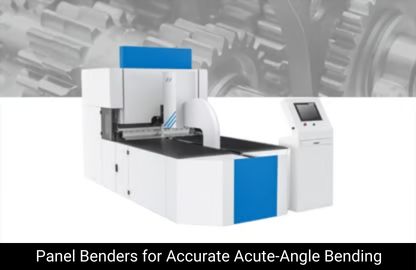
Panel Benders and the Production of Acute-Angle Bends Beyond Press Brake Die Limitations
Press brake tooling operates within a physical clearance envelope. As the punch descends into the die opening, the sheet wraps around the punch nose radius. Achieving acute angles – those below 30 degrees – requires specialized acute-angle tooling and angles below 15 to 20 degrees become mechanically difficult because the die sidewalls impede material movement and springback becomes increasingly unpredictable.
Panel Benders address this through their counterblade geometry. The blade follows a path that curls the flange progressively past the target angle, compensating for springback by overbending before releasing the clamp. There is no die cavity that restricts how far the material can travel. As a result, an Automatic CNC Metal Sheet Panel Bender can produce acute flanges with consistent angular accuracy that would require multiple progressive hits and die changes on a press brake. This capability is particularly relevant in architectural panel fabrication, where tight return flanges are specified for both structural and aesthetic reasons.
CNC Bending Machine Output: Box and Pan Profiles with Four-Sided Closed Flanges
Forming a rectangular box with flanges on all four sides presents a fundamental challenge for press brake operation. After the first two opposite sides are bent, the existing flanges physically interfere with the ram and die tooling when attempting to form the remaining two sides. Operators must use notched corner blanks, finger-brake inserts or perform secondary welding to complete the box geometry. None of these approaches produce the same structural integrity or dimensional consistency as a single-setup forming operation.
A CNC Bending Machine using panel bender technology handles this geometry by clamping the sheet at the blank center and bending each flange outward in a programmed sequence. Because the bending blades work at the sheet perimeter and the clamping zone remains fixed, previously formed flanges do not interfere with subsequent bends. Four-sided box profiles with equal or unequal flange heights are completed in one cycle. This directly impacts cycle time and part quality in industries such as elevator panel manufacturing, server rack fabrication and food processing equipment where multi-flange enclosures are standard components.
Flexible Panel Bender Performance: Variable-Radius Curved Bends Without Die Changes
Curved or radius bends along a straight flange line – not conical or cylindrical rolling, but a progressively changing bend angle across a flat sheet – are outside the mechanical capability of conventional press brake operation without specialized roll-forming attachments or step-bending sequences that require precise incremental positioning along the blank length.
A Flexible Panel Bender achieves variable-radius flanges through programmatic control of the blade engagement path. The blade can be instructed to apply different angular pressure at different points along the flange length within a single pass, producing a graduated curve. This is relevant to automotive trim panels, architectural cladding and transportation equipment where aerodynamic or design contours must be formed from flat sheet stock. The precision of the blade path eliminates the visible faceting that step-bending on a press brake produces, resulting in smooth radius transitions that meet visual quality specifications without additional finishing operations.
Panel Bender Manufacturer Engineering: Multiple Hem Types Including Closed and Teardrop Hems
Hemming – folding the edge of a sheet back onto itself – is achievable on a press brake, but the process requires a minimum of two distinct tool setups and two separate forming strokes. The first stroke flattens the flange to approximately 30 degrees as a pre-hem and the second closes it flat using a dedicated flattening die. Tooling changeover between these steps adds setup time and maintaining consistent hem gap dimensions requires careful die selection and material thickness management.
A Panel Bender Manufacturer designing for production efficiency builds hem capability directly into the blade cycle. The blade path performs the pre-bend and closure in a continuous programmed sequence without tool changes. More significantly, teardrop hems – where the hem is closed partially but with a hollow interior for structural stiffness or edge gripping – are producible through blade path adjustment alone. No additional tooling or manual step is required. Closed hems on thin-gauge stainless steel and aluminum, common in appliance panel and architectural trim production, are formed to gap tolerances that press brakes can only match with considerably more setup effort.
What Our Customers Say
“Our production speed has improved ever since we got a Bhavya machine. It’s smooth, durable, and works exactly as promised.”
Arti Mishra On Google
Automatic Panel Bender Execution: Counter-Bends and Offset Steps in a Single Clamp Cycle
An offset step – where a section of the sheet is displaced parallel to its original plane through two opposing bends – requires the press brake operator to form one bend, reposition the sheet and form the second bend with precise gap control between the two bend lines. Even small positioning errors multiply through the part geometry and achieving a consistent step height across a production run requires highly skilled setup.
The Automatic Panel Bender executes offset steps through coordinated blade positioning that controls both bend locations and the distance between them within the same clamping cycle. The blank does not move between the two forming events, which means the step height and parallelism between the original and offset planes are governed entirely by the machine’s axis positioning accuracy rather than operator skill. This is directly applicable to electrical panel mounting flanges, raised lip profiles for glass or gasket retention and Z-section structural members where offset geometry is defined by tight dimensional tolerances.
CNC Panel Bender Machine Precision: Simultaneous Multi-Bend Profiles on Long Sheet Lengths
Press brakes form one bend at a time along the length of the part. For parts that require multiple parallel bends – such as a hat section, a U-channel with return flanges or a complex stiffener profile – each bend requires a separate positioning and forming stroke. On long sheet lengths, the accumulated handling time and the risk of distortion from repeated clamping events both increase significantly.
A CNC Panel Bender Machine operating on a full-length blank applies all parallel bends in a programmed cycle where the sheet is indexed once across the clamping zone rather than repositioned for each individual bend line. The blankholder clamps the material at the precise location for each successive bend and the blade engages each flange in sequence without releasing the blank to the floor or repositioning it on a back gauge. For profiles with five, six or more parallel bend lines – common in structural framing sections, door reinforcement profiles and transit vehicle body panels – the dimensional accuracy and surface quality achievable on a CNC Panel Bender Machine are fundamentally superior to multi-stroke press brake sequences.
 Email Us
Why Bend Geometry Determines Machine Selection in Advanced Sheet Metal Operations
The seven bend types discussed above are not marginal or exotic capabilities – they represent a substantial portion of the geometry requirements in modern sheet metal product design. As product engineers specify tighter tolerances, more complex edge treatments and multi-flange assemblies, the gap between what press brakes and panel benders can reliably deliver widens.
An Automatic CNC Metal Sheet Panel Bender operating under full programmable blade control resolves the core mechanical limitations that have defined press brake capability for decades. The absence of a die cavity, the coordinated multi-axis blade movement and the fixed-clamp forming cycle each eliminate a category of geometric constraint. The result is that bend profiles once considered difficult or requiring secondary processes become standard, repeatable operations.
For fabricators managing mixed part portfolios with high geometric complexity, the decision to invest in a Flexible Panel Bender is ultimately a decision about which forming constraints to accept. Panel bender architecture accepts fewer. The seven bend categories outlined here represent the practical outcome of that mechanical distinction – profiles that are not theoretical advantages, but documented production realities that panel bender users execute daily at the volumes and tolerances that industrial applications require. As manufacturing demands continue to evolve toward smaller batch sizes with greater geometric variety, the role of the CNC Panel Bending Machine in precision sheet metal fabrication will only expand.
Conclusion
The geometric capabilities of a CNC Panel Bending Machine extend well beyond what press brake technology can deliver within a single production cycle. From alternating positive-negative bends to closed hems and four-sided box profiles, each of these seven bend types addresses a real limitation that press brake tooling imposes on part design. Panel Benders consolidate multi-step forming sequences into programmed single-cycle operations, directly reducing error accumulation and setup dependency. For manufacturers producing enclosures, structural sections or architectural components at volume, the CNC Panel Bender Machine represents a forming capability that press brake operations simply cannot replicate.


