



The modern industrial world, characterized by massive infrastructure projects, high-speed vehicle assembly, and durable heavy machinery, is fundamentally reliant on one ubiquitous component: the threaded fastener, or bolt. Without standardized, high-quality threads, complex structures would lack integrity, vehicles would be unsafe, and machinery would quickly fail. The creation of these precision threads is the domain of the bolt threading machine, a specialized piece of equipment whose role is indispensable across the construction, automotive, and heavy engineering sectors. This article explores why these thread rolling and cutting machines are not just useful tools, but absolutely essential in maintaining the safety, efficiency, and structural reliability of global manufacturing and construction.

Bolt Threading Machines: The Foundation of Structural Integrity
The primary function of a bolt threading machine is to impart helical grooves onto a cylindrical blank (rod or bolt) to create the male thread. This process is critical because the quality of the thread directly dictates the strength of the resulting bolted joint. A poorly formed thread can strip under load, leading to catastrophic failure in structural applications.
Threading Methods and Precision
Threading equipment utilizes two primary methods to achieve the required precision:
- Thread Cutting: This method involves removing material (swarf) from the bolt blank using sharp cutting dies. While effective for small batches and harder materials, it can weaken the material by interrupting its grain structure.
- Thread Rolling (or Forming): This is the superior method for high-volume, high-strength applications. Instead of removing material, hardened dies press against the bolt blank, plastically deforming and displacing the material to form the thread profile. This process actually improves the material’s structural integrity by cold working the surface and compacting the grain structure, leading to significantly higher fatigue resistance and shear strength a critical factor in high stress environments.
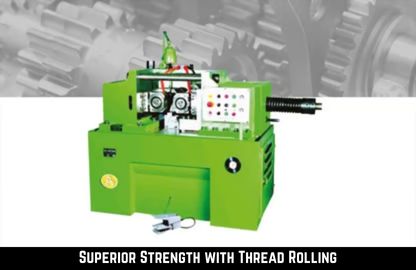
Modern thread rolling machines are capable of holding tolerances measured in microns, ensuring the threads are perfectly uniform in pitch, angle, and diameter. This precision guarantees maximum engagement with the mating nut or tapped hole, optimizing the joint’s clamp load and long-term durability.
Bolt Threading Machines: Indispensable in Construction and Infrastructure
In the construction industry, the scale of projects from skyscrapers and bridges to dams and high-speed rail lines demands fasteners of immense strength and reliability. Bolt threading machines ensure that these critical fasteners meet the rigorous standards required for public safety and longevity.
High Strength Fasteners for Critical Joints
The construction sector relies on large diameter, high-strength bolts (such as those conforming to ASTM standards) for joining structural steel members. These fasteners are crucial in connections that bear extreme compressive, tensile, and shear loads.
- On Site and Workshop Flexibility: While many construction bolts are mass produced, threading equipment provides essential flexibility. For custom lengths, specialized diameters, or unique rebar applications, portable or workshop based bolt thread rolling machines allow fabrication on demand. This ability to produce precise, high-quality threads locally is vital for minimizing delays and addressing specific project needs, such as threading anchor bolts used to secure massive structural bases.
- Rebar Threading: A highly specialized function of threading machines is applying threads to reinforcing steel bars (rebar). This enables couplers to be used to join lengths of rebar together, forming continuous, monolithic concrete structures like bridge decks or high-rise columns. The thread must be strong enough to transfer the full tensile load of the rebar itself, a feat only achievable with precision thread rolling.
- Durability and Weather Resistance: Threads produced by rolling create a hardened surface finish that offers improved resistance to corrosion and wear, which is essential for fasteners exposed to harsh outdoor conditions, saltwater environments, or temperature extremes over decades of service life.
What Our Customers Say
“One of the best machine I have purchased. Busbar bending machine. Working fine after 2 years also. Best price material. Heavy duty and hassle free operation. It really reduce my manpower. Output is next level. Maintenance is Zero. Thanks Bhavya.”
BISHNUSHREE ENTERPRISES On Google
Bolt Threading Machines: The Engine of Automotive Reliability
The automotive industry is characterized by extremely high-volume production, stringent safety regulations, and components that must withstand constant vibration, cyclical loading, and thermal stress. The reliability of every vehicle depends on the consistent quality of hundreds of different fasteners, all produced by bolt threading machines.
Mass Production and Fatigue Resistance
Automotive fasteners are often smaller than those used in construction but are subjected to far more dynamic and cyclical stresses. Applications include engine head bolts, connecting rod bolts, wheel studs, and suspension components, all of which are safety critical.
- High Volume, Zero Defect Production: Thread rolling machines are the dominant technology here due to their speed and superior metallurgical results. They operate at high cycling rates, producing thousands of finished fasteners per hour with near zero defects. This massive output is non-negotiable for automotive assembly lines that depend on just-in-time delivery of components.
- Enhanced Fatigue Life: Engine bolts and suspension bolts are prime examples of components that fail due to metal fatigue (repeated stress cycles), not single-event overload. As mentioned, the cold working process of thread rolling compacts the metal grain, removing surface imperfections and introducing residual compressive stress at the thread root. This dramatically slows the initiation and propagation of fatigue cracks, extending the lifespan of the critical components and ensuring vehicle safety over hundreds of thousands of miles.
- Specialized Threads: Threading equipment is vital for specialized applications like self-tapping or thread forming screws used in plastic and lightweight metal assemblies. These machines must produce unique thread geometries with high precision to ensure proper seating torque and retention in materials with lower inherent strength.
Bolt Threading Machines The Backbone of Heavy Engineering
Heavy engineering encompasses the manufacture of machinery, large scale plant equipment, mining vehicles, power generation turbines, and industrial robots. These machines rely on fasteners that can handle immense forces, extreme temperatures, and powerful vibrations.
Supporting Large Machinery and Maintenance
The fasteners used in heavy engineering often have diameters exceeding standard construction sizes and require threads of specific classes and fits to manage unique loading conditions.
- High Force Applications: In equipment like hydraulic presses, crushers, or forging machines, fasteners must maintain tension under massive fluctuating loads. Threading equipment ensures that the thread profile is accurate enough to distribute the load evenly across all engaged threads, preventing localized stress peaks that could lead to failure.
- Flange and Turbine Fasteners: Power generation (both conventional and renewable) relies on numerous bolted flange connections for pipelines, pressure vessels, and turbine assemblies. These fasteners often operate in corrosive or high-temperature environments. Precision thread cutting and rolling machines are essential for producing and maintaining these bolts, as slight deviations in thread form can compromise the integrity of the sealed joint, leading to dangerous leaks or mechanical failure.
- Maintenance, Repair, and Overhaul (MRO): Beyond initial manufacturing, thread cutting machines are crucial for MRO operations. When large, specialized bolts or studs are damaged in the field perhaps due to corrosion or over torquing it is often necessary to repair or re-thread them. Having reliable, industrial-grade threading equipment allows maintenance facilities to salvage expensive, large-diameter fasteners quickly, minimizing costly downtime for critical industrial plants.

Bolt Threading Machines: Driving Efficiency and Standardization
Ultimately, the essential nature of bolt threading machines comes down to the core manufacturing principles of efficiency, consistency, and adherence to global standards.
Ensuring Global Compliance and Interchangeability
The industrial world operates under strict standards (e.g., ISO, ASME, DIN) that dictate thread sizes, pitches, and tolerances. These standards are necessary for safety and for ensuring that a bolt produced in one country can be reliably used with a nut or tapped hole manufactured anywhere else.
- Standardized Production: Threading machines are designed and calibrated to meet these exact international specifications. Whether producing an M10 metric bolt for a car or a 1 inch UNC bolt for an oil rig, the machine guarantees the thread profile adheres precisely to the standard, ensuring interchangeability and a predictable performance envelope.
- Cost Efficiency: By automating the threading process, these machines drastically reduce the labor component of fastener manufacturing. The high production rate achieved, particularly through thread rolling, lowers the unit cost, making fasteners economically viable for mass consumption across all industrial sectors.
- Future Development: As advanced manufacturing trends toward lighter materials, additive processes, and higher strength fasteners, the role of the bolt threading machine evolves. Manufacturers continue to develop machines capable of threading exotic alloys, composites, and heat-treated steels with ever-increasing speed and precision, ensuring that the critical bolted joint remains the standard for safe and reliable mechanical connection well into the future.
Conclusion
The bolt threading machine is unequivocally an indispensable foundation of modern industrial life. Its impact is not merely confined to fabricating parts; it is centered on ensuring safety, predictability, and durability across the most demanding sectors. By imparting superior fatigue resistance through thread rolling for automotive applications, enabling reliable structural connections for vast infrastructure projects, and supporting the MRO needs of heavy machinery, threading equipment provides the essential metallurgical and dimensional integrity required for modern engineering. Its role in upholding global standards (ISO/ASME) guarantees that components are interchangeable worldwide, streamlining global supply chains and reducing risk. The bolt threading machine is the unseen technological asset that makes every secure structure and reliable machine possible.


