



The Evolution of Sheet Metal Forming
In 2026, the world of metal fabrication is undergoing a seismic shift with automation taking center stage. The CNC panel bender machine has emerged as a game-changing tool, replacing the traditional press brake and pushing the boundaries of speed, precision and efficiency in metalworking. With the rise of lights-out manufacturing – where machines operate autonomously without human intervention – automatic CNC metal sheet panel benders are becoming a requirement, not a luxury, for businesses aiming to stay competitive.
Historically, traditional bending processes were heavily reliant on manual labor and human intervention. Operators would have to physically position and manipulate each sheet of metal, often leading to human errors, slower production speeds and inconsistent results. The introduction of the CNC panel bending machine revolutionized this process by automating the bending sequence, drastically reducing errors and significantly improving production timelines.
As technology continues to evolve, manufacturers are looking for ways to boost their productivity, reduce labor costs and improve product quality. The need for automatic panel benders is becoming more apparent. These machines don’t just bend metal sheets; they also handle complex operations like flipping, rotating and positioning the sheets autonomously, which eliminates the need for constant manual oversight and intervention.
CNC Panel Bending Machine vs. Manual Benders
The most significant difference between CNC panel bending machines and manual benders is automation. CNC (Computer Numerical Control) systems allow the operator to input precise instructions into the machine, which in turn eliminates the human error that often plagues manual processes. This high level of automation ensures that each bend is executed with pinpoint accuracy, reducing scrap and improving product quality.
On the other hand, traditional manual bending machines rely heavily on the operator’s skill, leading to potential inconsistencies in bend angles, shapes and precision. While manual benders are still used in some settings, their inability to scale operations or meet the demand for high-precision work makes them less suited for modern, high-volume industries.
Automatic vs. Semi-Automatic Panel Benders
Another key distinction in the realm of panel benders is between automatic and semi-automatic systems. An automatic panel bender is capable of fully autonomous operation, handling everything from positioning and flipping to rotating the sheet without human intervention. This is a major step forward in terms of efficiency, as it eliminates the need for a person to interact with the material after initial setup.
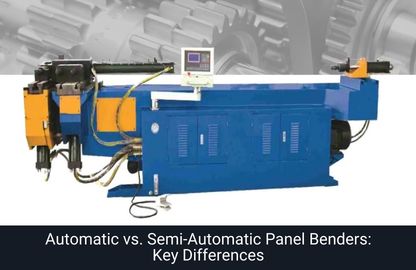
In contrast, semi-automatic panel benders require some level of manual intervention during the bending process, such as the operator moving sheets between stages or adjusting settings manually. While semi-automatic systems can still offer substantial improvements over manual processes, they do not offer the same level of autonomy or speed as fully automatic CNC metal sheet panel benders.
Read Our Article
Bending machine – Application and BenefitsThe Flexible Panel Bender: Versatility and Adaptability
One of the standout features of modern panel bending machines is their flexibility. Unlike older machines that may require tooling changes to accommodate different sheet thicknesses or types of bends, flexible panel benders are equipped with universal tooling that can handle a wide range of materials, thicknesses and shapes without requiring significant changes.
For instance, these machines can effortlessly create complex bends such as hems, offsets and radius bends. This level of versatility makes them ideal for industries that deal with varied metalwork, as they eliminate the need to invest in multiple machines for different tasks.
The Technical Showdown: Electric vs. Hydraulic
When evaluating CNC panel bender machines, it’s important to consider the underlying technology. In particular, two primary systems dominate the market: electric and hydraulic. Both offer distinct advantages, but the electric panel bender is increasingly becoming the preferred option for many manufacturers.
Electric Panel Bender: Precision and Efficiency
The electric panel bender is powered by servo motors, which provide incredible precision – often within a tolerance of just ±0.01mm. This level of accuracy is crucial for industries that require highly detailed metalwork, such as the aerospace, electronics and automotive sectors.
Additionally, electric panel benders consume up to 60% less energy compared to their hydraulic counterparts. The reduced energy consumption, combined with the ability to perform faster, more accurate bends, makes electric panel benders a cost-effective choice in the long run.
Hydraulic Panel Bender: Power for Heavy Duty Bending
While electric panel benders are known for their precision and energy efficiency, hydraulic panel benders still have their place in metalworking. Hydraulic systems are ideal for high-force applications, as they can exert more bending pressure, which is particularly beneficial when working with thicker or stronger materials. However, hydraulic systems tend to be less energy-efficient and may require more maintenance over time.
For many companies, the choice between an electric panel bender and a hydraulic machine boils down to the specific requirements of their projects. Electric panel benders are excellent for industries that prioritize speed, precision and energy savings, while hydraulic machines remain the go-to option for heavy-duty applications that require high force.
Our Other Product
Slotting MachinesPanel Benders: Industrial Applications
Electrical Enclosures & HVAC: Speed and Efficiency
One of the most significant advantages of panel benders is their ability to produce box-shaped parts much faster than traditional methods. In the production of electrical enclosures or HVAC components, where precise, uniform bends are essential, automatic panel benders can increase production speeds by up to three times compared to manual or press brake systems.
What Our Customers Say
“Our production speed has improved ever since we got a Bhavya machine. It’s smooth, durable, and works exactly as promised.”
Arti Mishra On Google
Elevator Panels & Appliances: Zero-Touch Production
Another application where panel bending machines excel is in the production of elevator panels and other appliances. The ability to achieve “zero-touch” production is a game-changer for industries where aesthetic quality and a scratch-free finish are critical. With automatic CNC metal sheet panel benders, operators can rest assured that each part is bent with perfect precision, without the need for manual handling that could damage the surface.
High-Mix, Low-Volume (HMLV): Adapting to Customer Demands
The flexibility of flexible panel benders makes them an ideal solution for high-mix, low-volume (HMLV) production environments. For manufacturers who need to switch from producing one product to another quickly, the ability to easily change tooling and adapt the machine to new specifications is a significant advantage. Whether switching from cabinet doors to drawer fronts, panel bending machines can easily accommodate these changes with minimal downtime.
Read Our Article
Understanding the Different Profile Bending MachinesChoosing the Right Partner: Manufacturers in Focus
When looking to invest in a panel bender machine, choosing the right panel bender manufacturer is crucial. It’s important to focus on factors like machine software, reliability and after-sales support.
Panel Bending Machine Manufacturers in India: The “Make in India” Advantage
India has rapidly emerged as a global hub for panel bending machine manufacturers, offering high-quality, precision-driven machines at competitive prices. The “Make in India” initiative has spurred the growth of local manufacturing, making it easier for companies to access high-performance CNC panel bending machines with faster service, localized training and cost-effective solutions.
 Email Us
ROI Analysis of Fiber Laser Cutting Machine: The Cost of Waiting
When considering the transition to an automatic CNC metal sheet panel bender, many manufacturers hesitate due to the upfront investment. However, the long-term benefits far outweigh the initial cost.
By reducing labor costs by up to 80% and cutting scrap rates by 30%, automatic panel benders provide a rapid return on investment. With improved precision, faster production times and fewer errors, the cost of waiting to adopt this technology is becoming increasingly unsustainable. Companies that continue to rely on traditional methods risk falling behind in an increasingly competitive global market.
Conclusion
The rise of CNC panel bender machines marks a new era in sheet metal fabrication. These advanced machines offer unmatched precision, efficiency and flexibility, making them the ideal solution for industries that require high-quality metalwork at scale. With the advantages of automation, reduced labor costs and superior product quality, automatic CNC metal sheet panel benders are no longer optional but a necessity for companies looking to thrive in the 2026 manufacturing landscape.
FAQs About CNC Panel Benders
What is a CNC panel bender machine?
A CNC panel bender machine is an automated system that bends metal sheets with high precision using computer control, eliminating human error.
How does an automatic panel bender differ from a semi-automatic one?
An automatic panel bender operates fully autonomously, while a semi-automatic requires some manual intervention during the process.
What are the advantages of an electric panel bender?
An electric panel bender offers superior precision, energy efficiency and faster cycle times compared to traditional hydraulic machines.
Can a panel bender handle complex shapes?
Yes, a flexible panel bender can easily handle complex bends, including hems, offsets and radius bends, without requiring tooling changes.
Why are panel benders becoming essential for modern manufacturing?
Automatic CNC metal sheet panel benders increase production speed, reduce labor costs and improve precision, making them essential for competitive, high-volume fabrication.


