



Fiber Laser Cutting: Structural Steel Fabrication that are Reshaping the Industry
The structural steel industry has always been measured by tonnage, turnaround time and tolerance. For decades, plasma and oxy-fuel cutting dominated the shop floor – workhorses built for brute-force output rather than precision. That calculus has fundamentally changed. The arrival of the fiber laser cutting machine in heavy fabrication environments has triggered a shift not just in how steel is cut, but in how entire production workflows are sequenced, how project bids are calculated and how fabricators position themselves competitively in a demanding market.
This article explores the specific speed and throughput gains that fiber laser cutting delivers in structural steel applications – and why those gains are compounding into strategic advantages for early adopters across the fabrication supply chain.
Fiber Laser Cutting and the Structural Steel Challenge
Structural steel fabrication involves cutting thick-gauge plates, wide-flange beams, angles, channels and hollow sections – materials that historically demanded slow, heat-intensive processes prone to distortion and post-process correction. The physics of fiber laser cutting offer a compelling alternative. A fiber laser delivers a high-intensity beam through an active gain medium made of rare-earth-doped optical fiber, concentrating power in a much smaller focal spot compared to CO2 systems. The result is a faster, cleaner cut with a narrower heat-affected zone.
For structural applications, where plates can range from 6mm to 50mm or beyond, the performance difference is tangible. A metal fiber laser cutting machine operating at high wattage can process mid-range structural plate at cutting speeds that would have required multiple passes or secondary grinding with older technology. The kerf is tighter, edge squareness is better maintained and part-to-part repeatability across a production run is dramatically more consistent.
Fiber Laser Metal Cutting Machine Performance in High-Volume Structural Runs
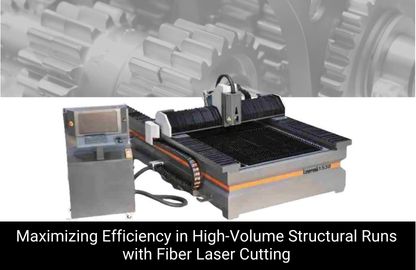
The gains become especially pronounced when evaluating performance across a full production shift rather than a single cut. In structural fabrication, a fiber laser metal cutting machine operating at 10kW or above can maintain aggressive cutting speeds on mild steel plate without the duty-cycle limitations that affect plasma cutting. Plasma systems require electrode and nozzle maintenance that introduces scheduled and unscheduled downtime – a cost that compounds over multi-shift operations. Fiber laser systems, by contrast, are designed for extended run cycles with minimal consumable intervention.
Beyond raw cut speed, the reduction in secondary operations is where fabricators realize the largest time savings. With plasma or flame cutting, structural components often require edge grinding, slag removal and sometimes straightening due to heat distortion. Components cut on a fiber laser system typically arrive at the next fabrication stage – welding, drilling or assembly – with edges that meet specification without rework. In operations running hundreds of structural pieces per day, that elimination of secondary handling represents a measurable compression of total lead time.
Sheet Metal Fiber Laser Cutting Machine Integration in Mixed Structural Shops
Many structural fabrication shops operate across a range of material thicknesses – from thin-gauge connection plates and gussets to heavy structural members. A sheet metal fiber laser cutting machine capable of handling both ends of that spectrum offers an operational advantage that dedicated plasma lines cannot match. Shops that previously needed separate cutting stations for different thickness ranges can consolidate onto a single platform that dynamically adjusts parameters based on the job in queue.
This flexibility has reshaped how structural shops approach job scheduling. Rather than batching jobs by material thickness to avoid machine changeovers, fabricators can sequence mixed-thickness work through the same platform with minimal transition time between cuts. Nesting software integrated with the cutting system can automatically optimize material utilization across a day’s production, reducing scrap and improving throughput without operator reconfiguration between runs.
This adaptability is particularly valuable in structural shops serving multiple project types simultaneously – commercial construction, infrastructure, industrial equipment fabrication – where each project may bring a different mix of plate thicknesses and profile geometries.
Our Other Product
Portable Fiber Laser Marking MachineFiber Laser Cutting Machine Price Considerations in Structural Fabrication Investment Decisions
When structural fabricators evaluate capital equipment, fiber laser cutting machine price is assessed in context – not as a standalone number but as part of a total cost-of-ownership model that accounts for throughput, consumable costs, labor savings and quality-related rework reduction. High-power fiber laser platforms represent a meaningful capital commitment, but the operational economics often distinguish them sharply from lower-cost alternatives when run at structural production volumes.
The consumable profile of a fiber laser system is substantially leaner than plasma. Plasma cutting consumes electrodes, nozzles, shields and swirl rings at a rate that scales directly with production volume. Fiber laser cutting, by contrast, involves primarily assist gas consumption – typically nitrogen or oxygen depending on the material and edge finish required – with the laser source itself designed for tens of thousands of operating hours before service is required.
Labor cost reduction also figures significantly into the investment calculus. Automated nesting, load/unload integration and reduced post-processing requirements mean that a fiber laser line can be operated with fewer labor hours per ton of output compared to older cutting methods. For structural shops operating in tight labor markets, this efficiency multiplier has become a core justification in capital expenditure approvals.
Fiber Laser Cutting Machine Manufacturer Capabilities Shaping Structural-Grade Solutions
Not all cutting platforms are built with structural fabrication in mind. A fiber laser cutting machine manufacturer developing systems for structural applications must engineer around specific demands: heavy bed construction to handle large plate formats and mass, high-power laser sources capable of sustained performance in thick-section cutting, robust material handling to move heavy structural stock without operator intervention and cutting head technology that maintains performance across varying surface conditions common in structural steel.
Leading manufacturers have responded by developing platforms with bed capacities measured in multiple meters, laser sources ranging well beyond the 6kW threshold that historically defined high-power cutting and intelligent height-following systems that compensate for plate camber and surface irregularities. These engineering investments are not incidental – they directly determine whether a platform can sustain the throughput rates that make structural production economics work.
Software integration has also become a differentiating factor. Manufacturers building for structural applications embed nesting intelligence, production scheduling tools and quality monitoring directly into the machine control environment.
Fiber Laser Metal Cutting Machine Accuracy Driving New Structural Design Possibilities
Precision in structural steel is not just about tolerance – it has downstream effects throughout the fabrication and erection process. When connection plates, coped beams and welded assemblies arrive at a fabrication station with dimensional accuracy that matches the design model, fit-up time at the welding bench decreases, assembly jigs require fewer adjustments and field erection proceeds with less remediation. A fiber laser metal cutting machine operating within tight positional tolerances elevates the precision of the structural components it produces in ways that propagate value through every downstream step.
This precision has also opened design conversations between fabricators and engineers that were not previously practical. Complex connection geometries that would have been prohibitively difficult to execute accurately with plasma – slotted holes, compound angles, tightly toleranced copes, complex weld prep profiles – are now routine on fiber laser platforms. Structural engineers working with fabricators who have invested in fiber laser capability can design more efficiently, knowing that the shop can execute what the model specifies.
Fiber Laser Cutting Productivity Metrics Compared to Plasma in Structural Production
Head-to-head productivity comparisons between fiber laser cutting and plasma cutting in structural production environments reveal consistent patterns. In the thin-to-mid range – up to approximately 20mm mild steel – fiber laser cutting speed advantages are most pronounced. As thickness increases beyond that range, the speed differential narrows, but fiber laser systems retain advantages in cut quality, consistency and reduced rework that sustain the overall throughput advantage.
Structural fabricators who have made the transition frequently report reductions in total part cycle time – from raw material on the cutting table to ready-for-assembly component – that have allowed them to compress project lead times meaningfully. In a construction market where schedule compression is a standard client requirement, that compression carries commercial value beyond the fabrication shop itself.
The indirect productivity gains deserve equal attention. Reduced slag management, fewer grinding hours, cleaner material handling between processes and more predictable cut completion times all contribute to a production environment that is easier to schedule, staff and manage. The reduction in process variability is, in many ways, as valuable as the raw speed increase.
What Our Customers Say
“Our production speed has improved ever since we got a Bhavya machine. It’s smooth, durable, and works exactly as promised.”
Arti Mishra On Google
Fiber Laser Cutting Machine Adoption Trends Across Structural Steel Market Segments
The adoption trajectory for fiber laser cutting in structural fabrication follows a recognizable pattern. Early adopters were typically large fabricators with the volume to justify the capital investment and the technical depth to integrate the technology into complex production workflows. Over the past several years, the economics have shifted to bring mid-volume structural shops into the addressable market as equipment costs have evolved, financing options have matured and the case studies from early adopters have built a compelling operational record.
Structural steel specialty fabricators – those focused on connection hardware, stair stringers, industrial platforms and modular assemblies – have found particular alignment with the technology. Their production profiles often combine high mix with meaningful volume, a combination that rewards the flexibility and precision of fiber laser processing more than pure high-volume commodity steel production.
The geographic spread of adoption also reflects the competitive dynamics of structural fabrication. Markets with high construction activity, tight delivery windows and labor cost pressure have seen faster penetration. Where fabricators face margin compression from material costs, competing on speed and quality has become the differentiated position – and fiber laser capability is increasingly the technology that enables it.
Our Other Product
Laser Welding MachineFiber Laser Cutting in Automated Structural Fabrication Lines
The highest expression of fiber laser value in structural fabrication is found not in the cutting cell alone but in the fully integrated production line. When fiber laser cutting is paired with automated material storage and retrieval, robotic part sorting, downstream drilling and punching lines and welding automation, the aggregate throughput gains compound significantly. The precision and consistency of laser-cut components is, in fact, a prerequisite for seamless handoff to downstream automation – robotic welding systems and automated assembly fixtures depend on part consistency that plasma cutting cannot reliably deliver.
Progressive structural fabricators are building production architectures with fiber laser cutting as the anchor process, designing the rest of the workflow around the consistency it provides. This systems-level thinking represents a maturation of fiber laser adoption – from viewing it as a better cutting tool to recognizing it as the enabling technology for a new generation of structural fabrication capability.
 Email Us Today!
Conclusion
Fiber laser cutting has moved well beyond a speed upgrade for structural steel fabrication – it has become a fundamental capability shift that is reordering competitive positions across the industry. The combination of throughput, precision, reduced secondary operations and automation compatibility creates a production profile that older cutting technologies cannot replicate. As more fabricators operationalize this technology and as fiber laser cutting machine manufacturer innovation continues to push performance at higher thicknesses and larger formats, the gap between laser-equipped shops and those still reliant on plasma or flame will continue to widen – reshaping how structural steel fabrication contracts are won, executed and profitably delivered.


