



CNC Automatic Panel Benders: Precision Cladding in the Elevator and Escalator Industry
The elevator and escalator industry operates at the intersection of engineering precision and architectural aesthetics. Every cabin wall panel, escalator side panel, landing door frame and fascia strip must meet exacting dimensional tolerances while reflecting the visual standards demanded by architects, building owners and end users. Achieving this level of accuracy across high-volume production runs is no longer a matter of skilled manual labor alone. Today, leading manufacturers and fabricators rely on the CNC Automatic Panel Bender to deliver the dimensional consistency, material integrity and production throughput that the sector demands.
Cladding in vertical transportation is not decorative afterthought – it is structural skin. Panel geometry must align perfectly with cabin frameworks, door mechanisms and floor-to-ceiling track assemblies. A deviation of even a fraction of a millimeter can compromise the fit of entire assemblies, affect door operation or introduce vibration anomalies that passengers sense immediately. This is precisely where automated bending technology has become indispensable to elevator and escalator OEMs, Tier 1 suppliers and contract fabricators worldwide.
CNC Panel Bending Machine: The Engineering behind Elevator Geometry
Elevator cabin interiors present a fabrication challenge that is distinct from general sheet metal work. Panels must form exact right angles or specified radii with no surface marking, no tool impressions and no residual stress concentrations that could later manifest as deformation. The CNC Panel Bending Machine addresses this challenge through a fundamentally different bending logic than conventional press brakes.
Unlike press brakes, which apply force along the full bend line simultaneously, panel bending machines use a combination of upper and lower bending tools that work progressively along the sheet edge. The sheet remains stationary while the bending tools move, which means the finished surface never contacts tooling that could mark polished stainless steel or pre-lacquered aluminum – materials ubiquitous in elevator interiors. This non-marking capability is not incidental; it is a core production requirement for high-specification cabin cladding that would otherwise require costly post-process polishing or surface restoration.
For escalator skirting panels and step sidewall assemblies, the machine’s ability to hold consistent bend radii across the entire panel length eliminates the cumulative error that arises when operators re-position sheets mid-process. Precision bend sequencing, programmed and executed automatically, ensures that each panel in a production batch is geometrically identical to the last – a prerequisite when escalator panels must interlock with extruded aluminum frames over lengths exceeding several meters.
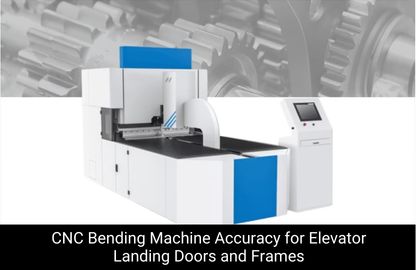
CNC Bending Machine Accuracy and Its Role in Landing Door and Frame Fabrication
Landing doors and their surrounding frame assemblies represent one of the most tolerance-sensitive components in elevator manufacturing. These structures must align with shaft walls, interlock with car-side door panels and operate smoothly across thousands of open-close cycles per month. The CNC Bending Machine used in leading elevator plants programs each bend sequence based on actual material spring-back data, compensating automatically for variations in sheet thickness and temper – factors that cause reject rates to climb when using manually-adjusted conventional equipment.
Frame profiles for landing doors often include complex multi-bend cross-sections: a face flange, a return flange, a sealing lip and a fixing tab – all formed in a single uninterrupted program cycle. This eliminates the need to reposition the panel between bends, which is where positional error accumulates on traditional equipment. Automatic back-gauge positioning, driven by servo motors with micron-level feedback, ensures that each bend lands exactly where the part program dictates regardless of operator variability.
Elevator manufacturers that produce multiple cabin sizes – standard residential, commercial passenger and heavy-duty goods lifts – benefit directly from the machine’s fast program changeover. Rather than resetting tooling for each product variant, operators load a new part program and the machine reconfigures its bending sequence automatically. This responsiveness to product variety without sacrificing throughput is a measurable competitive advantage in a market where elevator specifications vary significantly by building type and regulatory environment.
Panel Benders and the Demand for Scratch-Free Stainless Steel Processing in Elevator
Stainless steel is the dominant surface material in elevator cladding, selected for its longevity, hygiene properties and visual appeal. But stainless steel in mirror, satin or hairline finishes is extraordinarily vulnerable to surface damage during fabrication. Every contact point is a potential scratch and scratches on high-visibility cabin panels are a costly quality failure.
Modern Panel Benders are engineered with this specific concern in mind. Their bending tool geometry keeps contact with the sheet confined to the bend zone and the working surface is equipped with non-marking inserts or coatings at all contact points. The sheet handling system – whether a manual feed table or integrated automation – uses brushed or felt-lined surfaces that support the panel without dragging across its face. Some configurations include roller feed systems that allow the sheet to glide into position with zero abrasion contact.
For decorative panels with etched or embossed textures – increasingly specified in premium elevator interiors – this scratch-free processing is even more critical. The pattern applied to the sheet surface during rolling or chemical etching cannot be restored if damaged. Panel bending technology is, in this context, the only viable high-volume bending process for these high-value materials.
Automatic Panel Bender Integration with CAD/CAM Systems for Escalator Component Production
The escalator industry introduces a fabrication challenge that differs from elevator cabin work in an important respect: component families are larger, more repetitive and produced in tighter tolerances because escalator steps, balustrades and skirting panels must fit within a kinematic system that runs continuously. The Automatic Panel Bender‘s deep integration with CAD/CAM design pipelines allows escalator manufacturers to move directly from a design revision to a production-ready bend program without manual re-interpretation.
Modern escalator balustrade panels are often curved in plan view, requiring compound bends that vary along the panel length. Programming these geometries on a conventional press brake is time-intensive and prone to iteration errors. When the same geometry is imported from a 3D CAD model into a panel bending control system, the machine calculates the required bend sequence, tool positioning and spring-back compensation automatically. This eliminates the trial-and-error phase that traditionally consumed setup time and material when producing prototype or first-off panels.
Traceability is an additional advantage that CAD/CAM-linked bending operations provide. Each part program carries metadata – material specification, batch number, operator ID and machine parameters – that can be logged at the point of production. For elevator and escalator manufacturers subject to safety certification requirements, this documentation capability supports quality management systems and simplifies audit processes.
Panel Bender Manufacturer Selection: What Elevator OEMs Evaluate in Bending Technology Partners
When elevator and escalator manufacturers evaluate capital equipment investment, the choice of Panel Bender Manufacturer carries implications that extend well beyond the initial machine specification. The manufacturer’s ability to support the machine across its operational life – through software updates, tooling supply, technical service and application engineering – is frequently as decisive as the initial machine performance data.
Elevator OEMs typically evaluate bending equipment manufacturers on their application-specific experience. A manufacturer that can demonstrate panel bending programs for stainless steel cabin panels, galvanized steel structural components and aluminum architectural trim – all common in elevator specifications – offers a level of application knowledge that generic equipment suppliers cannot match. Reference installations within the vertical transportation sector are particularly valued during procurement evaluation.
Automatic CNC Metal Sheet Panel Bender: Handling Thin-Gauge Elevator Panel Materials Without Distortion
Weight reduction is a persistent engineering priority in elevator design. Lighter cabin panels reduce the total moving mass, which lowers motor and counterweight requirements and reduces energy draw per cycle. This has driven a shift toward thinner-gauge materials – stainless steel at 0.8mm to 1.2mm and aluminum at 1.0mm to 1.5mm – that achieve the required rigidity through profile geometry rather than material thickness.
The Automatic CNC Metal Sheet Panel Bender handles thin-gauge materials with a level of control that press brakes struggle to replicate at production speeds. The progressive bending action distributes forming forces along the bend length, preventing the local over-stress that causes thin panels to buckle, bow or develop orange-peel surface texture. Closed-loop force control monitors bending resistance in real time, adjusting tool travel to accommodate material variations within the sheet coil – a critical capability when working with thin-gauge materials whose mechanical properties vary more than thicker stock. Multi-bend profiles – the stiffening ribs, return flanges and interlocking lips that give thin-gauge elevator panels their structural rigidity – are formed in a single program cycle without intermediate handling. This eliminates the distortion risk that arises each time a thin panel is repositioned between separate bending operations.
What Our Customers Say
“Our production speed has improved ever since we got a Bhavya machine. It’s smooth, durable, and works exactly as promised.”
Arti Mishra On Google
Flexible Panel Bender Technology Adapting to Modular Elevator Design Trends
The elevator market has shifted meaningfully toward modular cabin design over the past decade. Building owners and architects increasingly specify customized elevator interiors – varied panel configurations, mixed material combinations and unique dimensional formats that differ from building to building even within a single manufacturer’s product range. This mass-customization demand places a direct burden on fabrication operations: they must accommodate product variety without accepting the cost penalties that traditionally accompany short production runs.
The Flexible Panel Bender addresses this directly through its automatic tool selection and positioning system. When a new part program is loaded, the machine’s tooling moves to the required positions under servo control – no manual tool change, no mechanical adjustment, no setup iteration. This means a batch of five cabin side panels in one specification can be followed immediately by a batch of three ceiling panels in a different dimension and material, with the machine reconfiguring itself between batches in seconds rather than the twenty to forty minutes a manual press brake setup requires.
For escalator manufacturers working with evolving safety standard requirements – where skirting panel profiles must be updated to reflect new deflection specifications – this flexibility means that design revisions can be validated and introduced into production with minimal disruption. The tooling does not need physical replacement; only the part program is updated.
CNC Panel Bender Machine Automation and Its Effect on Elevator Plant Throughput
Elevator manufacturing plants producing at scale face a familiar tension: the need to increase panel throughput without proportionally increasing floor space or headcount. The CNC Panel Bender Machine resolves this tension through its integration with automated sheet feeding and stacking systems. Rather than requiring an operator to manually load each panel, position it against back gauges and remove the formed part, automated configurations use robotic or mechanical loading systems that maintain continuous feed rates regardless of operator availability.
In practice, a single operator can supervise multiple machine cells when panel bending is automated end-to-end. The machine signals when the input stack requires replenishment or when the output stack must be cleared – predictable, manageable interventions that do not require the operator’s constant presence at the machine. This labor efficiency is particularly valuable in markets where skilled sheet metal fabricators are in limited supply.
CNC Automatic Panel Bender Capability in Forming Architectural Elevator Cladding Profiles
Architectural elevator cabins in premium commercial, hospitality and mixed-use developments push the boundaries of what standard fabrication processes can achieve. Curved panels, asymmetric cross-sections, folded edge details and multi-plane forms are increasingly common in specifications produced by high-end interior architects. Producing these profiles in metal without surface damage, at the tolerances that precision cabin assembly requires, calls for bending technology that goes beyond what conventional tooling accommodates.
The CNC Automatic Panel Bender brings several specific capabilities to architectural cladding production. Its programmable bend angle control allows radii and angles to be specified at sub-degree precision, producing the gentle curves that architectural detail requires without the angular artifacts that stepped approximations on conventional equipment would leave. Sequential bends can be programmed to build complex profiles in a logical forming order, with the control system verifying each intermediate geometry before proceeding to the next bend step.
The CNC panel bending process accommodates this without the economic penalty of dedicated tooling for each profile – a critical factor in making architectural customization commercially viable for fabricators operating at standard contract margins.
 Email Us
Panel Benders in the Broader Context of Elevator Industry Quality Standards
The elevator and escalator industry operates under a dense regulatory framework that governs the mechanical performance, material specifications and dimensional tolerances of every component in a passenger-carrying system. Inspection regimes in most markets include dimensional verification of cabin and door components as part of installation approval. Panels produced by automated CNC bending processes consistently meet these inspection criteria because the forming parameters are controlled, documented and repeatable across entire production batches.
When panel bending is combined with in-process measurement systems – laser gauging, vision-based angle measurement or tactile probing integrated into the machine cell – dimensional conformance data is captured at the point of production.
The trajectory of the elevator and escalator sector points toward tighter tolerances, more complex geometries and greater product variety – not less. As building designs grow more architecturally ambitious and as passenger expectations for cabin finish quality continue to rise, the manufacturing processes that support this industry must advance correspondingly. Precise CNC panel bending technology, with its combination of geometric accuracy, surface-safe operation, production flexibility and automation readiness, occupies a central position in that advancement – and its role in shaping the cladding that surrounds millions of daily passengers is set to grow with each new generation of vertical transportation engineering.
Conclusion
The elevator and escalator industry’s reliance on the CNC Automatic Panel Bender reflects a manufacturing reality that precision, repeatability and surface integrity cannot be compromised when cladding components enter passenger-facing environments. From scratch-free stainless steel processing and thin-gauge distortion control to rapid program changeover for modular cabin variants, this technology addresses the exact challenges that define vertical transportation fabrication. As elevator and escalator specifications grow more demanding in both geometry and finish quality, manufacturers who invest in advanced panel bending capability position themselves to meet those standards at production scale – consistently, traceably and without the rework costs that manual processes inevitably carry.


