



Machine Tools Industry Resilience and Re-alignment
The year 2025 was a watershed moment for Indian manufacturing. In a series of aggressive trade maneuvers, the United States implemented a “reciprocal tariff” regime that saw duties on Indian goods—including the critical machine tools sector—double from a baseline to a staggering 50% by August 2025.
Initially triggered by geopolitical friction over energy sourcing and trade deficits, these tariffs posed an existential threat to many Indian machine tools exporters. However, by early 2026, the industry has not only survived but emerged with a more diversified and technologically advanced global footprint.
Impact Analysis: The Machines on the Frontline
The 2025 tariff hike targeted the very heart of India’s engineering exports. Below is how specific machine tool categories were impacted:
- Lathe Machines & CNC Centers: As a staple export to US SMEs, the 50% duty initially saw a -11% to -15% drop in export volume to North America. Manufacturers of All-Geared Lathe Machines faced the highest pressure, as their competitive price advantage was temporarily erased by the “receding border” costs.
- Drilling & Grinding Machines: Traditional tools like pillar drilling machines and precision grinding machines saw a sharp rise in landed costs. However, because these tools are essential for the US’s own “Buy American” domestic manufacturing push, some high-end Indian exporters were able to maintain volume by absorbing a portion of the tariff hit to keep their OEM contracts intact.
- Welding & Cutting Machines: While Welding Machines and Laser Cutting systems faced high tariffs, their critical role in US infrastructure projects led to a “sticky” demand. Many Indian firms pivoted to “consignment models” to mitigate immediate cash-flow disruptions.
The Strategic Pivot: Exploring International Frontiers
Rather than retreating, Indian machine tool manufacturers executed a massive “Look East and West” strategy to bypass the US trade wall.
The European & Gulf Expansion
With the US market under pressure, Indian exporters successfully redirected over 18% of their capacity to European and Gulf markets. The Middle East, particularly the UAE and Saudi Arabia, became a major hub for Indian punching machines and air compressors used in massive infrastructure projects.
The Southeast Asian Surge (Look East 2.0)
Countries like Vietnam and Thailand became primary destinations for Indian milling machines and boring machines. Manufacturers leveraged India’s “China+1” position to supply high-precision tools to Southeast Asian factories that were themselves expanding to avoid US-China trade tensions.
Read Our Article
Benefits of Buying Machine Tools from Indian ManufacturersData Insights: Navigating the 2025–2026 Transition
Based on recent performance data (January 2026), we can see the “Resilience Recovery” in action for several key keywords and machine categories:
| Machine Category | 2025 Market Sentiment | Jan 2026 Recovery Status | Strategy Adopted |
| Grinding Machine | High Vulnerability | +15% Growth | Redirected to EU/Vietnam markets. |
| Lathe Machine | Margin Pressure | +7% Stabilization | Adoption of hybrid CNC tech. |
| Pipe Bending | Moderate Risk | +6% Growth | Supply to domestic Railway/Metro sectors. |
| Hydraulic Press | Supply Chain Lag | +8% Growth | Integration into Solar/EV manufacturing. |
| Slotting Machine | Low Demand | +1% Baseline | Focus on domestic maintenance hubs. |
Resilience Factors: Why the Industry Didn’t Collapse
- Domestic Cushioning: The “National Manufacturing Mission” and PLI schemes provided a massive internal market. Demand from the Railways, Aerospace, and EV Battery sectors grew by 17% in FY25, absorbing the excess capacity originally intended for the USA.
- Technological Leap: Facing higher export costs, manufacturers moved from “General Purpose” to “High Precision.” The adoption of Industry 4.0 and AI-driven predictive maintenance helped Indian machines command a premium, making them competitive even with the added tariff burden.
- Third-Country Fulfillment: To manage the 50% US tariff, several Indian firms shifted inventory to “tariff-friendly” hubs like the UAE, allowing them to fulfill global orders without the direct “India-Origin” duty penalty on every trans-shipment.
Our Other Machines/p> Bandsaw Machines
Looking Ahead: The 2026 Outlook
By January 2026, the Indian machine tool industry is no longer dependent on a single market. The diversification into African, European, and South-East Asian markets has created a more stable and “weather-proof” export engine. While the US remains a vital partner, the 2025 tariff hike served as a “wake-up call” that accelerated the indigenization and global expansion of Indian engineering.
The January 2026 EU-India Free Trade Agreement and the structural shifts in global trade following the 2025 USA tariff hikes have created a unique window for Indian machine tools exporters. To maximize this opportunity, manufacturers must adopt a region-specific and product-aligned strategy.
Below is the comprehensive export strategy for all major machine tool categories.
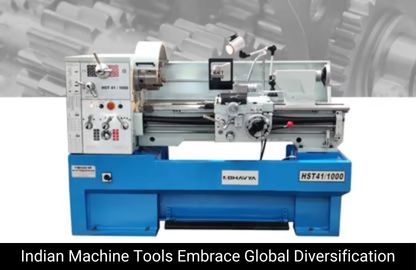
Lathe & CNC Machines: The “Vietnam-First” Strategy
With Vietnam’s GDP projected to grow by 7.5% in 2026, it has become the primary global hub for electronics and automotive relocation.
- Target Markets: Vietnam, Thailand, and Indonesia.
- Strategy: Position the All-Geared Lathe Machine as a cost-effective alternative to Chinese models. Focus on CNC Lathe Machines with “low-maintenance” and “plug-and-play” features for the expanding SME sector in SE Asia.
- Key Action: Establish services in Hanoi and Ho Chi Minh City to provide the 24/7 reliability required by tech-heavy manufacturers.
Our Other Machines
Bending / Press Brake MachinesGrinding & Milling Machines: The “European Precision” Strategy
The EU-India FTA has reduced the cost of high-end Indian grinding machines by nearly 15%, making them highly attractive to German and Spanish manufacturers.
- Target Markets: Germany, Spain, Italy, and Poland.
- Strategy: Focus on high-precision grinding machines and Universal Milling Machines. Ensure all exports are CE certified and meet the EU’s strict 2026 ESG (Environmental, Social, and Governance) standards.
- Key Action: Market the “Hybrid Precision” model—Indian structural rigidity (naturally seasoned casting) combined with European-standard digital readouts (DRO).
Welding & Cutting Machines: The “African Infrastructure” Strategy
Africa is experiencing a construction boom, specifically in Nigeria, South Africa, and Egypt, driving a massive need for portable and rugged welding machines.
- Target Markets: Nigeria, Kenya, Egypt, and South Africa.
- Strategy: Promote MIG, ARC, and Laser Welding Machines that are “weather-resistant” and can operate on unstable power grids common in developing regions. For Fiber Laser Cutting Machines, target the growing metal signage and architectural profile industries in North Africa.
- Key Action: Bundle Welding Machines with consumables (electrodes/wires) to provide a one-stop solution for local contractors.
 Email Us
Press Brake & Power Press: The “Gulf Mega-Project” Strategy
The Gulf region’s focus on non-oil industries and mega-cities like NEOM has skyrocketed the demand for sheet metal fabrication tools.
- Target Markets: Saudi Arabia, UAE, and Qatar.
- Strategy: Export Extra-Heavy Duty Power Press Machines and CNC Press Brakes for structural steel fabrication. Use the “Gulf Hub” to re-export to North Africa and Eastern Europe.
- Key Action: Highlight the Auto Pallet Changer and Automatic Tool Head Feed features to appeal to the region’s desire for automation and “lights-out” manufacturing.
Read Our Article
All You Should Know About Machine ToolsSummary Strategy Table for 2026
| Machine Tool Category | Primary Export Market | Strategy Focus |
| Lathe Machine | SE Asia (Vietnam) | Competitive pricing against China; SME focus. |
| Grinding Machine | Europe (Germany) | CE Compliance; High-precision finishing. |
| Welding Machine | Africa (Nigeria/Egypt) | Ruggedness; Infrastructure-ready bundles. |
| Press Brake | Gulf (Saudi Arabia) | Automation; Structural steel capacity. |
| Milling Machine | SE Asia (Thailand) | Toolroom versatility for automotive hubs. |
| Boring Machine | Middle East | Heavy material removal for energy sectors. |
Strategic Conclusion
The shift from 2025 to 2026 has taught Indian manufacturers that diversification is the only defense against protectionism. By leveraging the EU-India FTA for high-end markets and the Infrastructure Boom in emerging economies, the Indian machine tools industry is set to achieve a record-breaking export value of $55 billion by the end of the 2025-26 fiscal year.


