



The choice of a CNC press brake technology hydraulic, electric (often called servo-electric), or hybrid (electro hydraulic servo-driven) is a critical investment decision that dictates a fabrication shop’s efficiency, precision, operational cost, and capacity. While all modern press brakes utilize Computer Numerical Control (CNC) to automate bending processes and ensure high repeatability, the underlying mechanism responsible for moving the ram and generating tonnage defines the machine’s strengths and weaknesses. Selecting the “best” technology is less about finding a universally superior machine and more about aligning the machine’s core capabilities with a company’s specific production requirements, be it high tonnage for thick plate, micron-level accuracy for small components, or maximal energy savings.

Hydraulic Press Brakes: The Benchmark for Power and Versatility
The hydraulic press brake represents the conventional and most widely adopted technology in the metal fabrication world. It relies on a system of hydraulic pumps, valves, and cylinders to generate the bending force (tonnage).
A hydraulic press brake typically uses two synchronized hydraulic cylinders to move the ram. The primary motor runs continuously to maintain fluid pressure, which is then directed by proportional valves to the cylinders. This design provides several inherent advantages that have kept it at the forefront of heavy duty applications:
- Tonnage Capacity of Hydraulic Press: Hydraulic systems are engineered to handle extremely high tonnages, often extending into the hundreds or even thousands of tons. This makes them the undisputed choice for bending thick, heavy plate steel and materials requiring high forming forces.
- Uniform Force of Hydraulic Press: Hydraulic pressure provides a smooth, consistent force across the entire stroke length, which is crucial when bending long or structurally challenging materials.
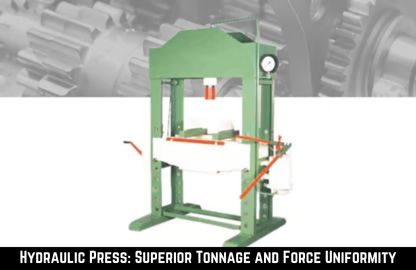
- Accuracy Drawback of Hydraulic Press: Changes in the hydraulic fluid’s temperature and viscosity throughout a long shift can subtly affect the machine’s synchronization and pressure delivery, potentially reducing repeatability and precision compared to highly stable servo systems.
Despite their power, hydraulic press brakes have significant operational and environmental drawbacks compared to newer technologies:
- Energy Consumption: The hydraulic pump motor runs constantly to maintain pressure, even during idle or standby time, leading to significant wasted energy and higher utility bills.
- Speed: The acceleration and deceleration during the actual bending phase are slower than electric models due to the inertia and resistance of the oil system and complex valve shifting.
- Maintenance and Environment: The presence of hydraulic fluid necessitates regular maintenance, including oil and filter changes, and introduces the risk of messy, costly leaks. The continuous operation of the motor also generates more noise compared to electric counterparts, impacting the shop environment.
Electric Press Brakes: The Pioneer of Precision and Efficiency
Often termed servo-electric press brakes, this technology is the true embodiment of modern, high-precision manufacturing. They completely eliminate the hydraulic system, relying instead on high-speed servo motors connected to ball screws or belt/pulley systems to drive the ram movement.
The electric press brake is defined by the direct, precise control afforded by the servo motors:
- Superior Accuracy and Repeatability: The ram movement is controlled directly by the rotation of the servo motors, offering extreme repeatability, often cited at ±0.002mm or even ±0.001 mm (1 micron). This level of precision is unmatched and vital for demanding industries like aerospace and electronics.
- Mechanical Drive System: Power is transmitted via ball screws or belt/pulley systems, offering minimal mechanical friction and high speed engagement. This direct drive eliminates the inherent lag and compliance found in fluid systems.
- Tonnage Limitation: Due to the physical mechanics of ball screw and servo motor systems, electric press brakes generally have a lower upper limit on tonnage.
The operational benefits of this technology translate directly into cost savings and quality improvements:
- Speed and Cycle Time of Electric Press Brakes: Electric press brakes have rapid ram acceleration and deceleration, leading to significantly faster cycle times often 30% or more quicker than hydraulic models. They excel at high volume, repetitive small parts production.
- Energy Efficiency of Electric Press Brakes: The motors only consume power when the ram is actively moving. During idle time, the machine is completely quiet and consumes minimal energy. This results in substantial energy savings, often exceeding 50% compared to traditional hydraulic models, and a rapid return on investment (ROI).
- Clean and Quiet Operation of Electric Press Brakes: The absence of hydraulic oil eliminates maintenance costs associated with fluid changes and the risk of leaks. The machine operates much more quietly, contributing to a better, safer shop environment.
What Our Customers Say
“One stop solution for all kind of machine tools under one roof, Highly-trained & skilled staff to deal with, highly appreciated, prompt response n good staff team, after sales service too, Very prompt response”
AMISH SHETH On Google
Hybrid CNC Press Brakes: The Optimal Middle Ground
The hybrid press brake emerged as a solution to blend the raw power of hydraulics with the efficiency and precision of electric servo technology. They use a hydraulic system for power generation, but instead of a constantly running conventional motor, a servo motor controls a fixed or variable displacement pump.
The hybrid press brake utilizes the servo control to engage the hydraulic pump only when bending force is required, offering a highly efficient compromise:
- Servo Driven Pump in Hybrid CNC: The core innovation is using a servo motor to drive the hydraulic pump. This allows the pump to only run on demand and provides precise control over flow and pressure, giving better accuracy than standard hydraulics.
- High Tonnage with Improved Accuracy in Hybrid CNC: The system achieves high tonnage capacity using the hydraulic structure while the servo control over flow allows for a much finer degree of control over ram movement, resulting in better accuracy and repeatability than standard hydraulics (often around ±0.004 mm).
- Reduced Lag Time: Eliminating large proportional directional valves reduces hydraulic lag time, improving the machine’s responsiveness.
Hybrid models are often the balanced choice for diverse fabrication environments:
- Energy Efficiency: By using a servo-driven pump, the machine automatically turns off the motor during idle time. This dramatically cuts standby energy consumption, achieving energy savings often in the range of 20% to 50% over traditional hydraulic brakes.
- Versatility and Capacity: They retain the ability to handle high tonnage for bending thick plate, making them highly versatile for general fabrication shops with mixed material demands.
- Maintenance Compromise: Maintenance is reduced compared to conventional hydraulics due to lower operating hours for the pump motor, though the machine still requires some hydraulic fluid management.
- Noise Reduction: Since the main motor only runs on demand, the machine operates much more quietly during standby and approach phases, improving the working environment.
CNC Press Brakes: Why is Repeatability Critical for Production?
Repeatability refers to the machine’s ability to consistently return the ram to the exact same position, bend after bend, over the course of a production run. For any CNC press brake, high repeatability is the single most critical factor determining the quality and cost-effectiveness of production.
- Minimizing Scrap and Rework: When a machine consistently hits the required bend angle, fabricators avoid producing scrap parts and minimize the need for manual rework or compensation adjustments. This directly improves profitability, especially in high-volume runs.
- Interchangeability: High repeatability ensures that all parts, regardless of when they were produced, are perfectly identical and interchangeable. This is essential for final assembly, particularly in complex projects like vehicle chassis or equipment casings, where components must fit together precisely.
- Technology Impact: The superior repeatability of electric press brakes (due to direct servo control) over hydraulic press brakes (where fluid temperature can cause drift) is the main reason many precision-focused companies choose the electric option, often prioritizing accuracy over maximum tonnage.

CNC Press Brakes: What is the Total Cost of Ownership (TCO) Difference?
When evaluating press brake technology, the initial purchase price is less important than the Total Cost of Ownership (TCO), which includes purchase, maintenance, energy, and consumable costs over the machine’s lifecycle.
- Energy Savings vs. Initial Cost: While electric press brakes have a higher initial purchase price than comparable hydraulic press brakes, their dramatic reduction in energy consumption and elimination of hydraulic fluid costs often lead to a lower TCO over five to seven years.
- Maintenance Costs: Hydraulic models incur costs for fluid, filters, and labor for managing leaks and fluid changes. Electric models virtually eliminate these costs but may have higher single-event repair costs for complex servo and ball screw assemblies.
- Productivity Value: The higher bending speed and superior accuracy of electric and hybrid press brakes translate to faster production and less scrap, providing a significant hidden value that lowers the TCO through higher output and quality assurance.
Which Technology is Best? Aligning Technology with Production
The choice of the best CNC press brake technology depends entirely on the application profile:
| Feature | Hydraulic | Electric (Servo-Electric) | Hybrid (Servo-Hydraulic) |
| Ideal Application | High Tonnage, Thick Plate, Large Workpieces | High Speed, High Precision, Thin to Medium Gauge Parts | Mid to High Tonnage with Strong Focus on Energy Savings and Accuracy |
| Max Tonnage | Highest (Best for Heavy Engineering) | Limited (Best for Electronics and Small Components) | High (Excellent balance for General Fabrication) |
| Precision/Repeatability | Good (Affected by oil temperature) | Best (Micron-level accuracy) | Excellent (Significantly better than standard hydraulic) |
| Energy Efficiency | Lowest (Highest operating cost) | Highest (Lowest operating cost) | High (Good cost savings) |
| Speed (Cycle Time) | Medium/Slow | Fastest (Best for mass production) | Fast (Good for mixed volume) |
| Maintenance | Highest (Highest fluid and filter cost) | Lowest (Lowest maintenance cost) | Medium (Reduced hydraulic complexity) |
For shops focused on heavy structural steel, the sheer power and robust nature of the hydraulic press brake make it the most viable option. Conversely, for a specialist manufacturer producing small, complex, or high value parts in massive volumes, the speed, precision, and efficiency of the electric press brake deliver the quickest ROI. For the general fabrication shop that needs high tonnage for diverse jobs but also wants to cut energy costs and improve accuracy over traditional machines, the hybrid press brake offers the most balanced and forward looking solution.
Conclusion:
A rigorous, scheduled maintenance program for a bolt threadingmachine transforms it from a tool subject to failure into a reliable, long term asset. The meticulous execution of the daily, weekly, quarterly, and annual checks outlined in this guide is the non negotiable foundation for preserving the machine’s ability to produce high precision, safety critical fasteners. By focusing on lubrication, cleanliness, fluid quality, and alignment, companies not only guarantee the machine’s long life performance but also minimize costly downtime, eliminate expensive scrap, and ensure the consistent quality required by the construction, automotive, and heavy engineering sectors. Preventative maintenance is, therefore, the most vital strategy for maximizing the return on investment in any industrial threading equipment.


