



Tonnage Calculation and Selection for Modern Metal Fabrication
Objective: To provide a comprehensive guide on the variables, mechanical principles and machine considerations required to accurately determine the necessary force for bending operations, ensuring both operator safety and machine longevity.
Selecting the right amount of force for metal bending is perhaps the most critical decision a fabricator makes. When we discuss how to calculate the correct tonnage for your press brake operations, we are not just talking about the ability to bend a piece of metal; we are talking about the preservation of your tooling, the precision of the finished part and the long-term health of your machinery. Whether you are operating a traditional mechanical press brake machine or a modern high-precision system, understanding the resistance of the material against the descending punch is essential.
The concept of tonnage refers to the pressure capacity that a machine can exert. If the tonnage is underestimated, the machine will fail to complete the bend, potentially stalling the motor or damaging the frame. If it is overestimated without proper control, you risk “bottoming out” the tool with too much force, which can lead to tool deformation or even catastrophic failure of the press brake. Therefore, finding the “sweet spot” requires a deep understanding of material science and the mechanical advantages provided by different types of equipment.
Press Brake Machines and the Evolution of Bending Force
The history of metal fabrication has seen a significant shift in how force is applied and controlled. In the early days, the mechanical press brake was the industry standard. These machines rely on a flywheel and a crank mechanism to drive the ram. Because of their design, they deliver the most force at the bottom of the stroke. However, calculating tonnage for these requires extreme precision because a mechanical system does not have an “off” switch for pressure once the cycle reaches a certain point.
As technology progressed, the hydraulic press brake became the preferred choice for those seeking more control. Unlike mechanical versions, hydraulic systems can provide full pressure throughout the entire stroke. This flexibility allows operators to adjust the pressure mid-bend, making the calculation of tonnage slightly more forgiving, though no less important for the accuracy of the final product. Understanding these machine differences is the first step in knowing how to approach your bending calculations.

CNC Press Brake Machine Precision in Modern Workflows
In today’s high-precision environments, the CNC press brake machine has revolutionized how we view tonnage. These machines use sophisticated software to calculate the required force based on the data inputted by the operator. When you use a CNC press brake, the controller looks at the material type, the thickness and the length of the bend to automatically regulate the hydraulic pressure.
However, relying solely on the computer can be a mistake. A professional operator must understand the underlying physics to ensure the inputs are correct. For instance, a small cnc press brake might be perfect for thin-gauge electronics housings, but attempting to bend high-tensile structural steel on such a unit could exceed its physical limits. The integration of “Computer Numerical Control” allows for repeatable accuracy, but the physical laws of material resistance remains constant.
Press Brake Machine Components that Influence Tonnage
To calculate force effectively, one must look beyond the machine itself and examine the tooling. The width of the die opening, often referred to as the V-opening, is the most significant factor in determining required tonnage. A wider V-opening reduces the amount of force needed to complete a bend but increases the internal radius of the part. Conversely, a narrow V-opening requires significantly more pressure from the press brake machine to force the metal into the shape.
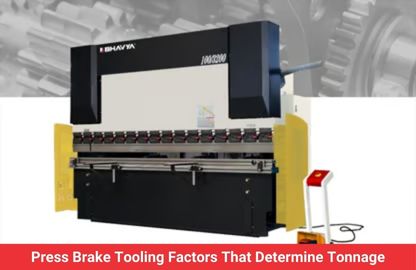
The relationship between the material thickness and the die opening is a delicate balance. If you are working with a CNC press brake bending machine, the software will often suggest a V-opening that is several times the thickness of the material. Choosing the wrong die can lead to “tonnage spikes,” where the resistance increases exponentially, potentially exceeding the rated capacity of your equipment.
Mechanical Press Brake versus Hydraulic Control Systems
When comparing a mechanical press brake to a hydraulic one, the way tonnage is distributed is the primary differentiator. Mechanical systems are often favored for high-speed, high-volume runs where the stroke is consistent. However, because they are driven by a flywheel, the tonnage isn’t as easily regulated as it is on a NC Press Brake machine.
The NC Press Brake machine offers a middle ground, providing a level of programmable control over the backgauge and stroke, which helps in maintaining consistency across multiple bends. While it may not have the full graphical interface of a high-end CNC system, it allows the operator to maintain a steady application of force, which is vital when working with materials that have high springback characteristics.
What Our Customers Say
“One of the best machine I have purchased. Busbar bending machine. Working fine after 2 years also. Best price material. Heavy duty and hassle free operation. It really reduce my manpower. Output is next level. Maintenance is Zero. Thanks Bhavya.”
BISHNUSHREE ENTERPRISES On Google
CNC Press Brake Price and the Value of High-Capacity Units
When businesses look at the CNC press brake price, they are often tempted to purchase a machine that fits their current needs exactly. However, professional advice suggests investing in a machine with a slightly higher tonnage capacity than your thickest current material requires. This “headroom” ensures that the machine is never running at its absolute limit, which extends the life of the hydraulic seals and the frame.
The CNC press brake machine price is often a reflection of the machine’s frame rigidity and the sophistication of its pressure-sensing technology. Higher-end machines can detect the “yield point” of the metal in real-time, adjusting the tonnage on the fly to account for variations in material hardness. This is especially useful when working with recycled metals or batches of steel that may have inconsistent properties.
Small CNC Press Brake Applications and Force Limits
For shops specializing in intricate, small-scale components, a small cnc press brake is an invaluable asset. These machines are designed for speed and precision rather than raw power. When calculating tonnage for these operations, the focus is often on the “concentrated load.” Because the parts are small, the force is applied over a very short distance on the ram.
It is a common misconception that a 50-ton machine can always handle 50 tons of pressure. If that pressure is concentrated in a tiny area in the center of the bed, it can cause “ram upset” or permanent deformation of the machine’s components. Even on a CNC press brake, operators must be careful to distribute the load or calculate the specific pressure limits for short-length bends to avoid damaging the precision-ground surfaces.
CNC Press Brake Bending Machine Maintenance and Tonnage Accuracy
The accuracy of your tonnage calculation is only as good as the condition of your CNC press brake bending machine. Over time, hydraulic fluid can degrade and air can enter the system, leading to “spongy” performance where the actual force exerted does not match what the gauge or the computer screen indicates. Regular calibration is required to ensure that when the machine says it is applying a specific amount of force, it is doing so accurately.
Furthermore, the wear and tear on the punch and die can change the tonnage requirements. A dull punch or a worn-out die increases friction, requiring the press brake to work harder to achieve the same bend angle. By keeping tools sharp and the machine well-lubricated, you ensure that your calculated tonnage remains a reliable metric for your production runs.

Material Variables in Press Brake Operations
Finally, we must consider the material itself. Not all steel is created equal. Stainless steel, for example, often requires significantly more tonnage – sometimes nearly double – compared to cold-rolled steel of the same thickness. This is due to the higher tensile strength and work-hardening properties of the alloy. When you are operating a press brake machine, you must always verify the material grade.
If you switch from mild steel to a high-strength aluminum or stainless alloy without recalculating your force requirements, you risk stalling your hydraulic press brake or cracking the material. The goal of any tonnage calculation is to overcome the material’s yield strength without reaching its ultimate tensile strength, which would cause the metal to fracture.
Conclusion:
Calculating the correct tonnage is a blend of physics, mechanical knowledge and experience. From the heavy-duty capabilities of a mechanical press brake machine to the refined precision of a CNC press brake, the objective remains the same: to shape metal with efficiency and safety. By understanding the relationship between material thickness, V-opening width and machine capacity, fabricators can ensure high-quality results and a long lifespan for their equipment.
Whether you are evaluating the CNC press brake machine price for a new purchase or setting up a complex job on an existing NC Press Brake machine, always remember that force is a tool that must be respected. Accurate calculations prevent costly mistakes, protect your operators and ensure that every bend is as precise as the last.


