



Optimizing Production: Progressive vs. Compound Dies
In the competitive landscape of modern manufacturing, the efficiency of your production line dictates your market standing. For facility managers and fabricators utilizing Sheet Metal Machinery, the quest for maximizing output without sacrificing precision is a constant challenge. The heart of this efficiency often lies in the tooling choices made for the workhorse of the shop floor: the power press. Selecting the correct die configuration – specifically choosing between progressive dies and compound dies – can fundamentally alter the throughput of a facility. This guide aims to demystify these tooling options, exploring how they function, where they excel and how they can be leveraged to achieve superior cycle times and production volume.
Power Press Machine Versatility in Manufacturing
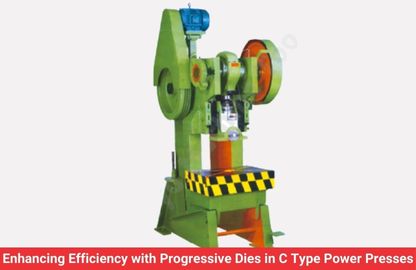
The foundation of high-volume metal stamping lies in the equipment itself. The C Type Power Press is ubiquitous in the industry due to its open-front structure, which allows for easy access to the die area and facilitates the seamless feeding of strip metal. Unlike completely enclosed frames, the C-frame design offers a blend of rigidity and accessibility that is ideal for a wide range of operations, from blanking to forming.
When aiming to maximize output, the interaction between the machine and the die is critical. A standard Power Press generates the force, but the die dictates how that force is utilized. Whether the facility is running a mechanical friction clutch or a more modern Pneumatic power press, the principles of die selection remain the pivot point for productivity. The goal is to reduce the “takt time” – the rhythm of production – by ensuring that every stroke of the ram adds value to the raw material.

Progressive Dies: The Multi-Stage Powerhouse
To truly understand high-speed production, one must look at the mechanics of a progressive die. This tooling setup is designed for continuous, automated production. In this configuration, a metal strip is fed into the press and the die performs a series of operations at different stations within a single tool.
As the Power Press Machine cycles, the material advances from one station to the next. The first station might punch a pilot hole for location accuracy; the next might cut a specific shape; a third might bend a tab; and the final station separates the finished part from the carrier strip. This means that with every single stroke of the press, a finished part falls off the end of the die, even though that specific part has undergone multiple distinct shaping processes.
This methodology drastically reduces cycle time compared to single-stage dies. In a single-stage setup, a part might need to be moved from one machine to another or the operator might need to change dies to perform a second operation. Progressive dies eliminate this handling. For a C Type Power Press setup, this is transformative. It allows a compact machine to act as a complete production line. The reduction in manual handling not only speeds up the process but also reduces the likelihood of operator error, ensuring a consistent output quality that is essential for mass production.
Compound Dies: Precision in Concentric Operations
While progressive dies focus on a sequence of events, compound dies function differently. They are designed to perform multiple operations – typically cutting and forming or blanking and piercing – at a single station during a single stroke. The key differentiator is that these operations happen simultaneously rather than sequentially.
For example, a compound die might punch a hole in the center of a washer while simultaneously blanking the outer diameter of the washer from the metal strip. Because these actions occur in the exact same position without the metal strip moving between operations, the concentricity and accuracy are often superior to other methods.
However, the complexity of compound dies can limit the variety of operations they can perform compared to progressive dies. They are exceptionally effective for flat parts requiring tight tolerances between internal and external features. When running on a Cross Shaft Power Press, which is known for its stability and reduced gear noise, a compound die can produce incredibly precise parts at a steady rhythm. Yet, for maximizing pure volume of complex, multi-bent parts, they often yield to the speed of progressive systems.
CNC Press Brake and Its Role in the Ecosystem
It is important to acknowledge that not all metal forming happens within the confines of a stamping die. In many workshops, a CNC Press Brake serves as the primary tool for bending operations that are too complex or low-volume for hard tooling.
A Press Brake is ideal for versatility. If a manufacturer needs to produce a small batch of brackets with complex angles, setting up a progressive die on a power press would be cost-prohibitive due to the high initial tooling investment. The press brake allows for quick setup and adjustment. However, when the goal shifts to maximizing output for hundreds of thousands of units, the CNC Press brake machine cannot compete with the sheer speed of a progressive die running on a power press.
The progressive die incorporates the bending operations directly into the stamping cycle. Instead of stamping a flat blank and then moving it to a press brake for folding, the progressive die bends the metal while it is still attached to the carrier strip. This consolidation of processes is the defining factor in maximizing output.
What Our Customers Say
“One stop solution for all kind of machine tools under one roof, Highly-trained & skilled staff to deal with, highly appreciated, prompt response n good staff team, after sales service too, Very prompt response”
AMISH SHETH On Google
Press Brake Tools vs. Stamping Dies
The distinction between these production methods is further clarified by examining the tooling. Press brake tools are generally standardized – punches and dies that can be arranged to form various straight-line bends. They are reusable assets applicable to many different jobs. This flexibility is their strength.
In contrast, the tooling for a C Type Power Press – whether progressive or compound – is custom-engineered for a specific part. The investment in designing and manufacturing a progressive die is significant. It requires precise machining and robust materials to withstand millions of cycles. However, this investment is amortized over the high volume of parts produced. Once the die is set, the cost per part drops precipitously compared to the labour-intensive nature of using general-purpose press brake tooling.
Cross Shaft Power Press Stability for High Output
When running high-speed progressive dies, the stability of the press becomes paramount. A Cross Shaft Power Press is often favored in these scenarios. The drive configuration of a cross-shaft design helps in distributing the load more evenly and reducing the vibration associated with high-speed stroking.
Excessive vibration can lead to premature wear on the delicate punches and pilots within a progressive die. By utilizing a machine frame and drive system that prioritizes rigidity and smooth power transmission, manufacturers can run their dies at higher speeds without sacrificing part quality. This stability is equally important for compound dies, where the alignment between the upper and lower die halves must remain perfect to ensure clean shearing of the metal.
Pneumatic Power Press Advantages in Cycle Time
The actuation mechanism of the press also plays a vital role in maximizing output. A Pneumatic power press utilizes air pressure to engage the clutch and brake. This system allows for faster engagement and disengagement compared to older mechanical rolling key clutches.
For progressive die operations, where the feeder must synchronize perfectly with the ram movement, the precise control offered by a pneumatic clutch is invaluable. It allows for “inching” during setup and immediate stopping in case of a sensor fault, protecting the expensive die from damage. Furthermore, pneumatic presses can often achieve higher strokes per minute, directly translating to higher hourly output. When coupled with an automatic coil feeder, a pneumatic C-frame press becomes a fully autonomous production unit.
Sheet Metal Machinery Integration and Workflow
Maximizing output is not solely about the die; it is about the holistic integration of Sheet Metal Machinery. A raw material coil must be uncoiled, straightened and fed with precision. If the feeder is slower than the press capacity, the output is bottlenecked.
In a facility maximizing output, the C-type press with a progressive die sits at the center of a synchronized system. The scrap material must be efficiently removed, often requiring conveyors or choppers. The finished parts need to be collected without damage. This is distinct from a workflow involving a CNC Press Brake, where an operator manually handles each piece. The shift from manual handling to automated, continuous feeding is the leap required for mass production.
Operational Considerations for Die Selection
Choosing between progressive and compound dies for your Power Press Machine eventually comes down to the geometry of the part and the required volume.
If the part requires intricate bending, forming, curling or drawing, a progressive die is the clear winner. It breaks these complex transformations down into manageable bite-sized steps. The strip carries the part through the “progress” of creation. This ability to perform work on the vertical axis (Z-axis) as well as the cutting makes it a 3D manufacturing solution.
Conversely, if the part is flat and requires extreme flatness and concentricity, the compound die is superior. Because the part is often ejected upwards or downwards from the center of the tool, it remains flat, whereas the carrier strip in a progressive die can sometimes introduce slight curvature or “coil set” if not managed correctly. However, for the specific objective of maximizing output speed on complex parts, the compound die often requires a slower stroke rate to ensure the part is cleared from the die area before the next stroke, whereas progressive dies facilitate easy gravity-fed part ejection.
Maximizing Output: The Economic Perspective
The economic argument for investing in complex tooling for a C Type Power Press is strong when volumes are high. While the upfront cost of a progressive die is higher than a compound die or standard press brake tools, the “total cost of ownership” per part is lower for long runs.
Maximizing output means minimizing the time the press sits idle. Progressive dies require longer setup times than simple dies, but once they are running, they can produce parts for days without interruption. The longevity of the die depends on the quality of maintenance. Keeping cutting edges sharp and ensuring proper lubrication of the strip are non-negotiable for sustained high output. A dull die increases the tonnage required, stressing the Power Press frame and potentially causing deflection that ruins the tool.

Future-Proofing with Advanced Machinery
As technology advances, the line between different types of Sheet Metal Machinery blurs, but the fundamental physics of the power press remain relevant. Modern presses are being equipped with smarter controls that monitor tonnage and die protection sensors. These features allow the press to stop instantly if a part fails to eject, preventing the “double hit” that destroys dies.
For facilities looking to upgrade, moving from a mechanical clutch to a Pneumatic power press is a common step toward higher efficiency. Similarly, incorporating servo feeds that integrate electronically with the press controls ensures that the material progression is perfectly timed with the ram cycle, allowing the machine to run at its maximum rated speed safely.
Conclusion
In the pursuit of manufacturing excellence, the C Type Power Press remains a cornerstone of the industry. However, its true potential is only unlocked through the strategic application of tooling. While compound dies offer unmatched precision for flat, concentric parts, they cannot match the multi-faceted, high-speed capabilities of progressive dies for complex geometries.
By utilizing progressive dies, a manufacturer effectively condenses a factory floor’s worth of cutting and bending operations into a single machine footprint. This consolidation significantly reduces cycle times, minimizes material handling and streamlines the workflow. Whether supported by a robust Cross Shaft Power Press for stability or a responsive Pneumatic power press for speed, the transition to progressive tooling is the definitive strategy for maximizing output in mass production. Understanding the distinct roles of these dies – and how they differ from the flexible but slower CNC Press Brake operations – empowers manufacturers to make informed decisions that drive productivity and profitability. The future of efficient stamping lies in the intelligent integration of these powerful machines and the sophisticated tooling that drives them.


