



To provide a comprehensive analysis of the vital role played by specialized welding equipment in the maritime sector, focusing on how different fusion technologies ensure the structural resilience and longevity of vessels during both the initial shipbuilding phase and critical maintenance cycles.
Advanced Fusion Technologies in the Maritime Sector
The maritime industry operates under some of the most demanding physical conditions on the planet. Ships are subjected to constant salt-spray corrosion, immense hydrostatic pressure and the relentless mechanical stress of ocean waves. To build a structure capable of surviving these elements, the engineering must be flawless. Central to this achievement is the application of various thermal joining techniques. Modern shipbuilding is a complex puzzle of thousands of steel plates and structural beams, all of which must be fused into a single, watertight unit that can carry thousands of tons of cargo across the globe.
As the industry evolves toward larger vessels and more sustainable materials, the reliance on high-precision equipment has intensified. Engineers now require a diverse range of tools to handle everything from thick carbon steel hulls to lightweight aluminum superstructures. The ability to create a bond that maintains its integrity for decades is not just a technical requirement; it is a fundamental safety necessity for the global supply chain.
Welding Machine Requirements for Heavy Marine Engineering
A professional-grade Welding Machine is the cornerstone of any modern shipyard operation. These devices provide the controlled electrical energy necessary to melt metal and create high-strength joints. In a maritime environment, these machines must be exceptionally durable to withstand the humidity and dust typical of coastal industrial sites. They are utilized in every stage of construction, from the early fabrication of sub-assemblies in indoor workshops to the final integration of modules in the dry dock.
The versatility of these power sources allows technicians to adapt to the specific metallurgical needs of the vessel. For instance, the welding of high-tensile steel used in ice-breakers requires precise heat input control to prevent the metal from becoming brittle. Reliability is the most sought-after trait in this equipment; a failure during a critical hull weld can lead to expensive delays or, worse, structural vulnerabilities that might only appear once the ship is at sea.
Read Our Article
Laser Welding Machines Role in Aerospace and Defense IndustriesMIG Welding Machine Efficiency in Superstructure Assembly
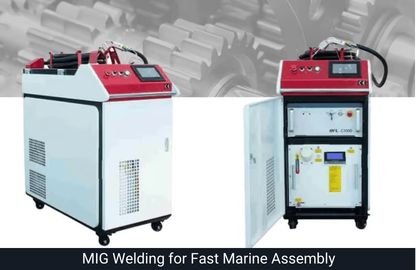
The MIG Welding Machine is widely recognized in the marine industry for its high productivity and ease of use. This process uses a continuous solid wire electrode and an inert shielding gas to protect the weld pool. Because the wire is fed automatically, welders can produce long, clean beads without the frequent interruptions required by manual methods. This efficiency is vital when assembling large internal bulkheads and deck sections.
For vessels that incorporate aluminum components, such as high-speed ferries or naval patrol craft, this technology is the preferred choice. Aluminum’s high thermal conductivity makes it challenging to join without specialized equipment that can provide a stable arc and high wire speeds. The clean, aesthetically pleasing finish produced by these machines also reduces the need for post-weld grinding, which is a significant advantage when building luxury yachts or passenger cruise liners where visual quality is as important as structural strength.
MAG Welding Machine Power for Structural Hull Integrity
When it comes to the heavy-duty structural frames and external hull plates of cargo ships, the MAG Welding Machine is the workhorse of choice. By utilizing active gases like carbon dioxide or argon-CO2 blends, this process achieves deeper penetration into thick steel. This is essential for the “heavy lifting” of shipbuilding, where the metal plates can be several inches thick and must be fused completely to withstand the crushing forces of the deep sea.
This method is particularly effective for high-volume production. Many modern shipyards utilize semi-automated or robotic systems equipped with these machines to perform long fillet welds along the ship’s longitudinal and transverse frames. The ability to maintain a stable arc even at high current levels ensures that the “backbone” of the vessel is rigid and secure. By optimizing the gas mixture, shipbuilders can also control the amount of spatter and the shape of the weld bead, ensuring consistent quality across miles of joints.
Our Other Machine
Bending/Press Brake MachinesCO2 Welding Machine Economy in Commercial Ship Repairs
The CO2 Welding Machine remains a staple in repair yards due to its incredible cost-effectiveness and deep-reaching arc. Using pure carbon dioxide as a shielding gas is significantly cheaper than using argon blends, which is a major factor for commercial maintenance operations that involve massive amounts of weld metal. This process is particularly adept at handling the thicker, lower-grade steels often found in older commercial vessels.
In a repair context, surfaces are often not as pristine as they are in a new-build environment. The intense heat of this process allows it to penetrate through minor surface oxidation or residual coatings better than more sensitive gas-shielded processes. It is frequently used for reinforcing weathered bulkheads, repairing tank interiors and replacing corroded deck plating. While it requires a skilled hand to manage the increased spatter, the resulting joints are exceptionally strong, providing a reliable and economical solution for keeping the world’s aging fleet seaworthy.
ARC Welding Machine Portability for On-Board Maintenance
The classic Welding Machine – often referred to as stick welding – is the most versatile tool for a marine engineer. Its primary advantage is its simplicity and portability. Because it does not require a separate cylinder of shielding gas, it is the ideal choice for performing repairs in the cramped, hard-to-reach areas of an engine room or on the open deck where wind would blow away a shielding gas.
Every ocean-going vessel carries this type of equipment as part of its emergency toolkit. If a structural failure occurs mid-voyage, the ability to perform a manual arc weld can prevent a minor leak from becoming a major crisis. ARC Welding Machines are also used extensively in “underwater welding” for emergency hull patches below the waterline. The flux coating on the electrodes provides its own protection, making the process highly resistant to the elements, which is a critical feature in the unpredictable environment of the high seas.
Read Our Article
Laser Welding Machines – Technical & Industrial AspectsWire Butt Welding Machine Standards in Rigging and Cable Production
In the specialized manufacturing plants that supply shipyards, the Wire Butt Welding Machine is essential for creating high-tension components. This equipment is used to join the ends of metal wires or rods to create continuous lengths without any loss in diameter or significant drop in tensile strength. In the marine world, this is critical for the production of the massive wire ropes used in cranes, stays and mooring lines.
A seamless joint is vital for these applications because any bump or weak spot in the wire could cause it to snag in a pulley or snap under the weight of a heavy shipping container. These machines use resistance heating to fuse the ends of the wires perfectly, ensuring that the rigging used to secure a ship’s cargo is as strong as possible. By automating this joining process, manufacturers can guarantee that every meter of wire rope meets the stringent safety certifications required for international maritime transport.
 Email Us
Future Innovations in Marine Fusion Technology
The maritime industry is currently looking toward a digital future, where “smart” equipment can provide real-time data on weld quality. This transition is essential as shipbuilders experiment with new materials like high-strength composites and specialized alloys designed to reduce the weight of the vessel and lower its carbon footprint. Advanced power sources now come equipped with sensors that can detect a potential weld defect as it happens, allowing for immediate correction.
Furthermore, the rise of offshore renewable energy, such as wind farms, has created a demand for even more robust welding solutions. The foundations for these turbines are essentially specialized marine structures that must endure decades of tidal force without any maintenance. This is pushing the boundaries of automated fusion, leading to the development of laser-hybrid systems that combine the deep penetration of a laser with the gap-filling capabilities of traditional wire-fed processes.
Our Other Machine
Hydraulic Iron Worker MachinesConclusion
The safety and efficiency of global maritime operations depend entirely on the quality of the welds that hold a vessel together. From the massive MAG Welding Machine units that forge the primary hull to the portable ARC Welding Machine used for emergency repairs at sea, each piece of equipment plays a distinct and irreplaceable role. As shipbuilding continues to advance, the integration of these different fusion technologies will remain the foundation of naval architecture. By choosing the right tool for the right application, engineers ensure that the ships of the future are not only larger and faster but also safer for the crews who call them home and the environment they traverse.


