



Lathe Machine Tooling Explained: Select the Right Tools for Engineering Machinery
Selecting the right cutting tools for a lathe machine is not just a matter of preference – it directly affects surface finish quality, dimensional accuracy, cycle time and tooling cost. Whether you operate a light duty lathe machine for small-batch components or a heavy duty lathe machine for industrial shafts and rolls, the cutting tool selection logic remains rooted in the same core parameters: rigidity, versatility, floor space and cost-per-part.
Turning Tools: Rigidity Requirements across Lathe Machine Types
Turning is the most fundamental operation on any lathe – the tool removes material from the rotating workpiece along its length. However, the rigidity demand varies significantly with the machine class.
On a heavy duty lathe machine handling large-diameter forgings or castings, turning inserts with negative rake geometry and robust tool holders are essential. Vibration under interrupted cuts can destroy a carbide insert within seconds if the tool overhang is excessive or the holder lacks proper clamping. Operators sourcing a heavy duty lathe machine from manufacturers like Bhavya Machine Tools specifically look for machines with hardened and ground box guideways, which directly support tool rigidity during deep-pass turning.
On a medium duty lathe machine, the cutting forces are lower and positive rake geometry inserts – typically CCMT or DCMT grades – are the practical choice. These reduce power consumption and work well on aluminium alloys, mild steel and brass without demanding premium toolholders.
For a CNC lathe machine, turning tool selection shifts toward indexable insert holders with quick-change capability. VNMG and WNMG inserts are widely favoured for CNC turning because they offer multiple cutting edges, repeatable insert indexing and compatibility with standard VDI or rectangular shanks across multiple part programs.
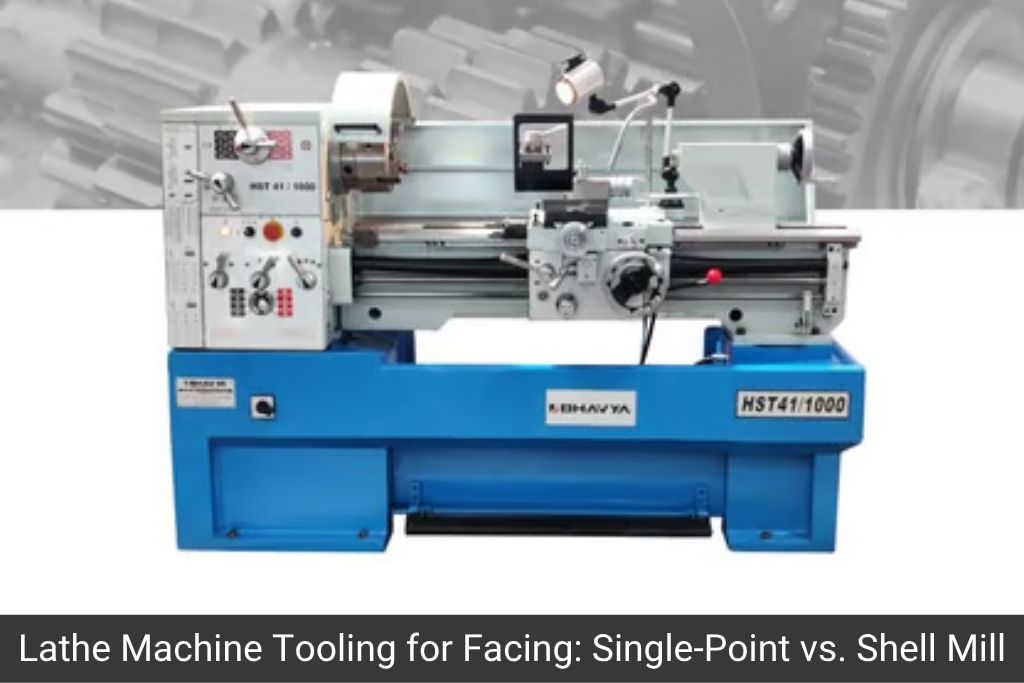
Lathe Machine Tooling for Facing: Choosing Between Single-Point and Shell Mill Configurations
Facing establishes a flat, perpendicular surface on the workpiece end. The choice of facing tool geometry depends heavily on the lathe machine configuration in use.
On a manual or a universal all geared lathe machine, a standard right-hand turning tool with a wide nose radius doubles as a facing tool by traversing radially inward. This versatility is one reason the all geared lathe machine remains a staple across job shops – a single tool handles both turning and facing without a tool change, reducing floor setup time.
On a DRO lathe machine, the digital readout provides precise depth-of-cut feedback, making it easier to hold tight facing tolerances (±0.01mm) even on longer workpieces where manual dial reading becomes error-prone. Bhavya Machine Tools offers DRO lathe machine configurations that support both single-point carbide inserts and multi-tooth facing heads, depending on the diameter range.
For a roll turning lathe machine used in roll refurbishment, facing inserts with wiper geometry are preferred. The wiper flat – an additional minor cutting edge parallel to the machined surface – significantly improves Ra surface finish per revolution, which matters for roll surfaces that demand mirror-quality finishing.
Lathe Machine for Threading Tools: Form Tools vs. Carbide Insert Threading Systems
Threading is one of the most insert-sensitive operations on a lathe. The wrong insert pitch, incorrect nose radius or inadequate rigidity causes torn threads, chatter marks or tool failure before the thread depth is reached.
On a precision metal lathe machine, single-point HSS threading tools ground to 60° (Unified/Metric) or 55° (Whitworth/BSP) are still used for low-volume, custom-pitch jobs where insert availability is limited.
For volume threading on a CNC lathe machine, carbide threading inserts (16ER or 22ER series) with pre-ground flanks are the industry standard. They are faster to index, hold tighter pitch tolerances across production batches and outperform HSS significantly in thread surface finish at higher spindle speeds.
On a hydraulic lathe machine used for large-diameter shaft threading, the thread chasing cycle benefits from hydraulic feed consistency – the feed rate stays constant regardless of depth variation, preventing pitch deviation that occurs with mechanical feed drift on manual machines.
A Practical Comparison of Lathe Machines: Rigidity, Versatility, Floor Space and Cost
When deciding which tooling approach suits your lathe machine, it helps to evaluate four practical dimensions side by side.
Rigidity is non-negotiable on heavy duty lathe machines and roll turning lathe machines. These machines operate at high cutting depths with significant radial forces. Tool deflection ruins dimensional tolerance and accelerates insert wear. Investing in heavy-shank holders with anti-vibration dampening pays back immediately in reduced insert consumption and rework.
Versatility is the core strength of tooling on all geared lathe machine. A small job shop handling mixed components – shafts, sleeves, flanges, custom fasteners – cannot afford a dedicated tool holder for every profile. Quick-change tool post systems allow a single operator to swap between turning, boring, parting and threading tools in under 30 seconds, directly reducing cycle time per job.
Floor space is most relevant when evaluating a light duty lathe machine against a medium duty lathe machine for constrained workshop layouts. Smaller machines accept shorter tool shanks and more compact live tooling, which reduces the overall footprint of the tool rack alongside the machine. For workshops considering whether to buy lathe machine equipment for smaller cells, this spatial economy matters for throughput planning.
What Our Customers Say
“Largest Display of Machinery across India. Wide range of Machines. Very Co-operative staff. Range of Tapping Machine and Re-sharpening Machines are outstanding. Very Cost effective and useful in Precision Machining Work. Their staff is co – operative for after sales support.”
Tirth Bhojani On Google
Cost per cutting edge drives insert selection more than most machinists acknowledge. On an all geared lathe machine used for steel turning, a four-edge CNMG insert at a moderate per-unit cost outperforms a single-use HSS bit across dozens of workpieces. However, that calculation reverses on a precision metal lathe machine running low-volume brass or titanium jobs where each insert requires hand-preparation and insert cost per workpiece is less relevant than setup flexibility.
Threading on All Geared and Hydraulic Lathe Machines
The all geared lathe machine delivers its threading advantage through the gearbox ratio that directly couples spindle speed to leadscrew feed. This mechanical synchronisation ensures that every thread pass follows the exact same helix – critical for multi-pass thread cutting where a deviation of even 0.01mm destroys the already-cut flank surface.
Operators who regularly cut threads on a hydraulic lathe machine notice that hydraulic feed systems provide smoother depth engagement at thread start – reducing the micro-chip tear that mechanical feed engagement sometimes causes at the thread entry.
For lathe machine suppliers evaluating machine capability before quoting thread-cutting jobs, the gearbox range determines the pitch flexibility. A wider gear ratio range means fewer tool changes and fewer specialised thread-cutting attachments, lowering tooling inventory cost for the end user.
 Email Us
Conclusion
Matching cutting tools to the right lathe machine – whether a CNC lathe machine, heavy duty lathe machine, precision metal lathe machine or a versatile all geared lathe machine – is what separates efficient machining from costly rework cycles. Bhavya Machine Tools, as an established lathe machine manufacturer, builds its range across light, medium and heavy duty configurations precisely to support these tooling demands at every production scale. Before you buy lathe machine equipment for a new or expanding workshop, evaluating rigidity requirements, threading needs and tool versatility against your job mix will ensure the machine and tooling work together at peak efficiency.


